10+ Best AI Recruiting Software & Tools to Use in 2026
SUMMARY:
We reviewed 40+ AI recruiting platforms and chose the 19 best AI recruiting software solutions for talent teams in 2026, based on automation depth, ATS integrations, AI capabilities, screening quality, ease of setup, and scalability. This comprehensive list of recruitment AI software helps you find the right fit for your hiring needs.
19 best AI recruiting tools by use case:
Quick Comparison Table of the Best AI Recruiting Software
How We Chose the Best AI Recruiting Software
To create this guide, we evaluated 40+ leading AI recruiting software platforms and various artificial intelligence recruitment software using verified user reviews, product documentation, feature comparisons, and market research.
Our evaluation focused on the criteria that matter most for talent teams: automation depth, ATS and CRM integrations, AI screening and sourcing capabilities, ease of setup, candidate communication quality, pricing transparency, customer support, scalability, and user satisfaction scores from independent review platforms.
We cross-referenced findings with verified user reviews on G2, Capterra, and TrustRadius, and drew additional insights from real recruiter discussions on Reddit and Quora to ensure our picks reflect how these tools perform day-to-day—not just in demos. For companies hiring software developers specifically, platforms like Lemon.io sit alongside these tools — managing the entire pipeline from technical screening and vetting to contracts and payments, so hiring managers don't need in-house technical expertise to evaluate candidates.
Why Trust Our Software Reviews?
For nearly a decade, we've helped over 30,000 professionals choose and implement better communication tools. We've reviewed 200+ products, analyzed 5,500+ verified reviews from G2 and Capterra, and drawn insights from real user discussions on platforms like Reddit or Quora.
In the past year alone, we've published 1,000+ articles, all written and reviewed by humans, for humans, to provide reliable, data-backed insights you can trust.
Learn how we keep our content integrity and our software review methodology.
19 Best AI Recruiting Software & Tools to Use in 2026
Choosing the right AI recruiting software is tough. Every platform claims smarter hiring and faster pipelines. These are the picks that actually help recruiters move quickly while keeping the human touch.
1. CloudTalk: Best AI Recruiting Software for Calls & Candidate Communications
What Is CloudTalk?
CloudTalk is an AI-powered VoIP and contact center platform that recruiting teams use to scale outreach, automate busywork, and keep every call and text tied to the right candidate record through ATS and CRM integrations. It turns high-volume phone work into clean, searchable hiring data—without adding manual steps for your team.
What Are CloudTalk's Main Benefits?
- Phone work turns into clean, searchable data.
- AI voice agents handle first touch screening.
- Calls and SMS log automatically.
- AI summaries replace manual notes so recruiters stay present in conversations and keep momentum in the pipeline.
What Is CloudTalk Missing?
Advanced AI capabilities like conversation intelligence and voice agents are paid add-ons. Smaller teams may want to phase them in. Reliable internet matters to get the best call quality.
What Business Is CloudTalk Best For?
Recruitment firms, staffing agencies, and in-house talent teams that manage high candidate volume or global outreach, especially remote or distributed teams that want one workspace for calls, SMS, and ATS syncing.
What Are CloudTalk's Plans & Pricing?
CloudTalk's pricing plans stand out for being flexible. With each plan offering more value than its competitors:
- Lite: $19/user/month (Americas)
- Starter: $25/user/month
- Essential: $29/user/month
- Expert: $49/user/month
- Custom: Pricing available upon request
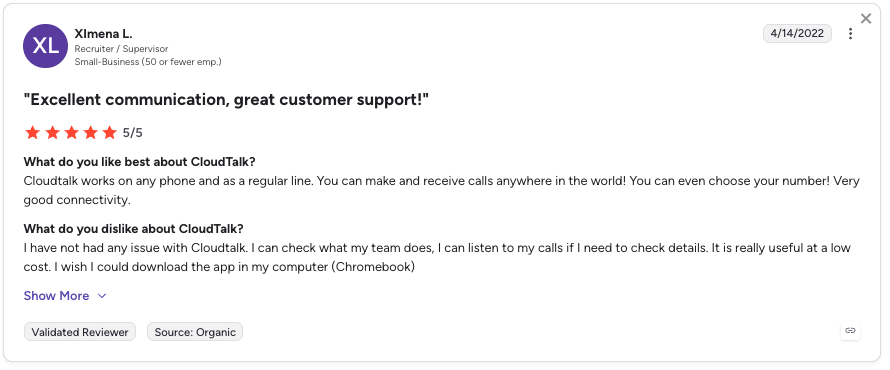
What Customers Say About CloudTalk
2. SeekOut: Best for Sourcing Hard-to-Find Talent and ATS Rediscovery
What Is SeekOut?
SeekOut is a talent intelligence and sourcing platform that taps into 800M+ public profiles, your ATS and CRM history, and alumni networks. As one of the leading AI recruiting solutions, it layers conversational search, granular filters, and outreach so sourcing feels targeted instead of manual.
What Are SeekOut's Main Benefits?
Hard-to-find talent surfaces faster. Rediscovery brings strong past applicants back into play. Campaigns stay consistent, personalization scales, and hiring goals like diversity and niche skill coverage become easier to hit.
What Are SeekOut's Key Features?
- 800M+ profiles with conversational, ChatGPT-style search and 30+ filters
- Prospect campaigns with generative personalization and verified contact info
- ATS rediscovery that refreshes and revives past candidates
- SeekOut Spot for managed, qualified candidate slates
- Integrations with leading ATS platforms
What Is SeekOut Missing?
Pricing is not public and plans are annual with a three-seat minimum. Managed slates from SeekOut Spot are purchased separately. Teams should plan for search syntax and filter logic to get the best results.
What Business Is SeekOut Best For?
In-house talent teams and agencies that source specialized or diverse talent at scale and want both self-serve search and an option for managed candidate delivery.
What Are SeekOut's Plans & Pricing?
SeekOut's pricing is only available upon request.
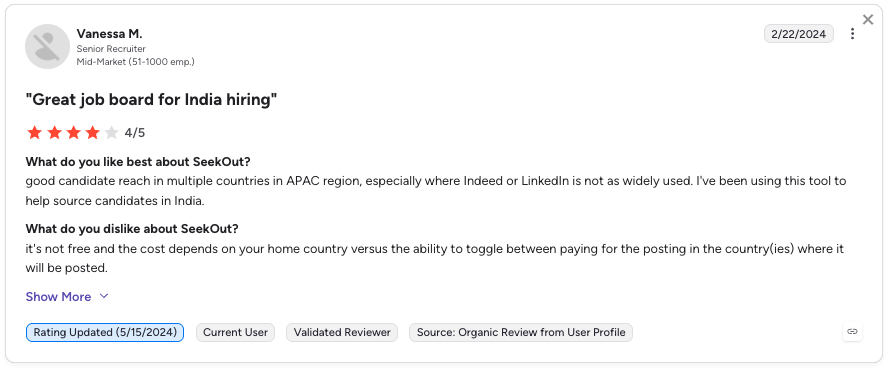
What Customers Say About SeekOut
3. HubSpot: Best for Candidate Nurturing & Recruitment Campaigns
What Is HubSpot?
HubSpot CRM and marketing automation is a platform that helps teams attract, engage, and nurture candidates through automated campaigns. While it's not a traditional ATS, it ranks among the top recruiting AI tools by managing outreach, communication, and engagement at scale.
What Are HubSpot's Main Benefits?
Candidates stay engaged throughout the hiring process with automated email sequences, personalized messaging, and timely follow-ups. Recruiters can build structured workflows for outreach and nurturing, while managers get visibility into campaign performance and candidate engagement, all within one platform.
What Are HubSpot's Plans & Pricing?
- Automated email sequences for candidate nurturing
- Workflow automation based on behavior
- Landing pages and forms for capturing applicant data
- Audience segmentation using CRM data
- Campaign tracking and performance dashboards
- Integration with CRM for contact and activity tracking
What Are HubSpot's Plans & Pricing?
HubSpot's pricing offers a tiered structure that caters to businesses of all sizes, with a free plan available and paid tiers starting from $20/seat/month.
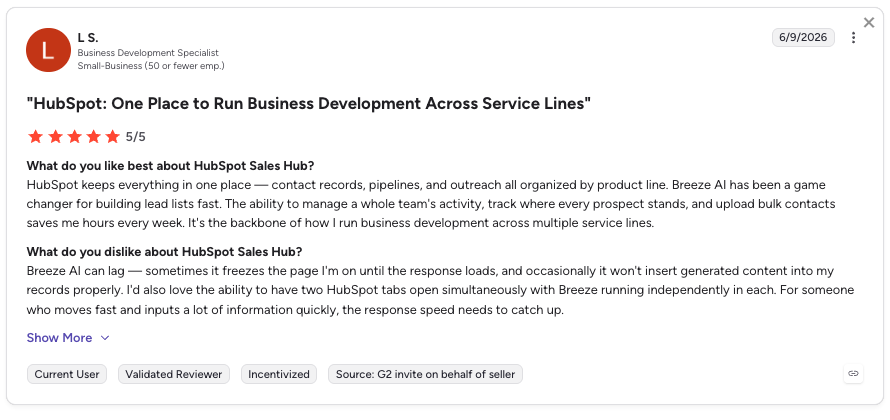
What Customers Say About HubSpot
4. Gem: Best for Multichannel Engagement and Unified Sourcing-to-Schedule Workflows
What Is Gem?
Gem is an AI talent acquisition software platform that unifies ATS connectivity, CRM, sourcing, scheduling, analytics, and a search layer across 650M+ public profiles. The experience feels like one workspace from first touch to offer.
What Are Gem's Main Benefits?
Top-of-funnel work, nurture, and scheduling live in one place, which cuts tool sprawl and handoffs. Unified data sharpens forecasting and full-funnel analytics, while outreach quality stays high with templates and light AI assistance.
What Are Gem's Key Features?
- CRM for talent pools, projects, and long-term nurtures
- Sourcing and outreach automation with one-click adds and AI-assisted messages
- Scheduling and inbound application review
- Full-funnel analytics and forecasting, plus optional career sites and events
- Connectors for Greenhouse, Workday, SuccessFactors, Lever, and more
What Is Gem Missing?
Pricing is custom and varies by size and configuration. Several modules are add-ons, so scoping and data migration planning matter to avoid surprises.
What Business Is Gem Best For?
Startups that want an all-in-one stack, growth-stage teams consolidating tools, and enterprises layering CRM, sourcing, scheduling, and analytics on top of an existing ATS.
What Are Gem's Plans & Pricing?
- Startups: $135/month
- Growth: Custom pricing
- Enterprise: Custom pricing
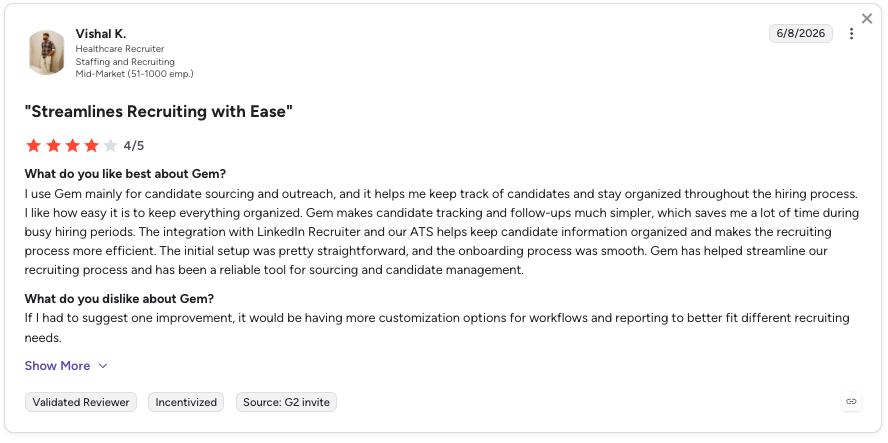
What Customers Say About Gem
5. Workable: Best for Prioritizing Qualified Candidates with Built-In Scheduling
What Is Workable?
Workable is an applicant tracking and recruiting platform that brings AI-assisted ranking, multi-board job posting, scheduling, and evaluation tools into one workspace. It is a powerful example of modern AI recruitment tools in action.
What Are Workable's Main Benefits?
AI ranking pushes the most qualified applicants to the top, so screening starts where it matters. One-click posting and built-in scheduling remove tab hopping and back-and-forth emails, keeping momentum steady. Scorecards and approvals make decisions comparable across teams and reduce guesswork.
What Are Workable's Key Features?
- AI-assisted candidate recommendations and resume screening
- One-click job posting to major boards and social channels
- Interview scheduling with calendar sync and reminders
- Evaluation kits with templates, scorecards, and approvals
- Integrations with CloudTalk, popular HRIS, and collaboration tools
What Is Workable Missing?
Some capabilities are paid add-ons such as texting and video interviews. Pricing scales with headcount and advanced analytics may require higher tiers.
What Business Is Workable Best For?
Teams that want a straightforward ATS with strong job distribution and structured hiring, from lean startups to mid-sized organizations.
What Are Workable's Plans & Pricing?
- Standard: $299/month
- Premier: $599/month
- Enterprise: $719/month
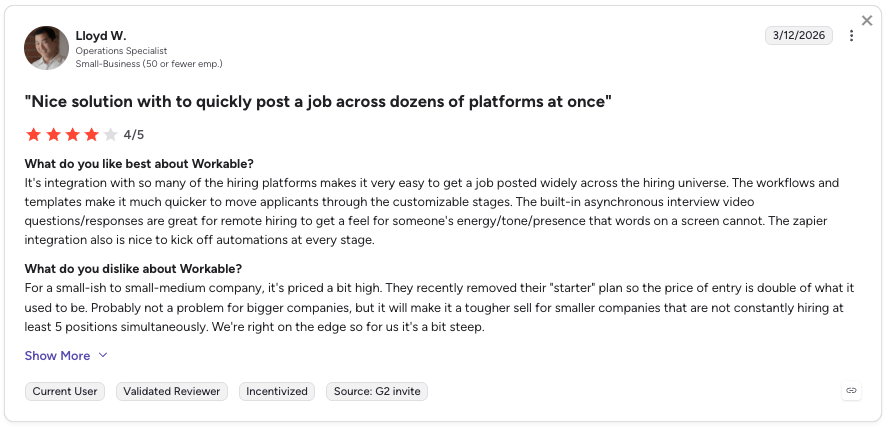
What Customers Say About Workable
6. Recruiterflow: Best AI Recruiting CRM for Staffing and Recruiting Agencies
What Is Recruiterflow?
Recruiterflow is an AI-first recruiting software built specifically for staffing and recruiting agencies. It combines a unified ATS and CRM with automation, multichannel outreach, and advanced reporting to help recruiters spend less time on admin work and more time making placements.
At its core is AIRA, Recruiterflow's built-in AI Recruiting Assistant, designed to handle repetitive tasks and keep data clean and up to date automatically.
What Are Recruiterflow's Main Benefits?
Recruiterflow centralizes candidate, client, and job data in one place, eliminating the need to juggle multiple tools. AI-powered automation reduces manual data entry, follow-ups, and note-taking, while workflows and sequences keep recruiters consistently engaged with candidates and clients. The result is better visibility across pipelines and more time focused on revenue-driving work.
What Are Recruiterflow's Key Features?
- Unified ATS & CRM for candidates, clients, and jobs
- AI Recruiting Assistant (AIRA) for admin tasks, notes, and content generation
- Workflow automation to standardize recruiting processes
- Multichannel sequences across email, LinkedIn, and SMS
- Advanced, customizable reporting and pipeline analytics
What Is Recruiterflow Missing?
Recruiterflow is purpose-built for recruitment agencies, so it may feel less suitable for in-house HR teams. Some features like native timesheet management are not included and may require external tools.
What Business Is Recruiterflow Best For?
Recruiterflow is best suited for staffing agencies, executive search firms, and recruiting teams that want a single platform to manage both ATS and CRM workflows, with strong automation and AI to reduce operational overhead.
What Are Recruiterflow's Plans & Pricing?
- Advanced Plan: $119/user/month (billed annually) or $149/user/month (monthly)
- Custom Plan: Includes all Advanced features plus advanced AI Agents (job change alerts, AI notetaker & transcripts, job-to-candidate matching, compensation & task agents, omnichannel sync, and custom BI dashboards). Pricing available on request.
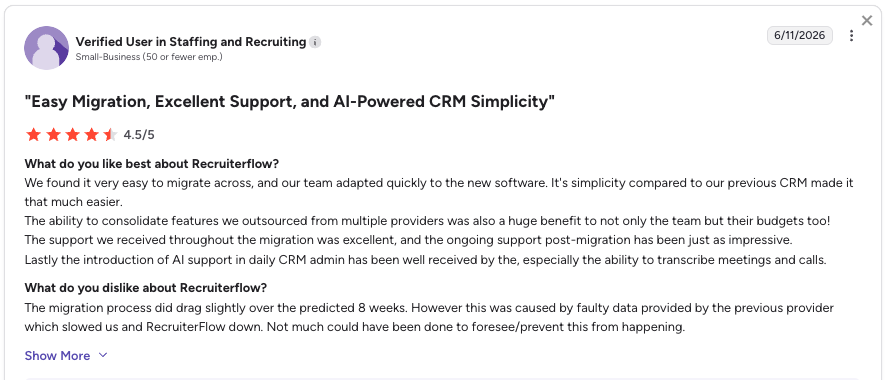
What Customers Say About Recruiterflow
7. Manatal: Best for Customizable Pipelines and Fast, Practical AI Setup
What Is Manatal?
Manatal is an AI-assisted ATS that helps teams spin up customizable pipelines, enrich candidate profiles, and automate repetitive tasks without heavy setup.
What Are Manatal's Main Benefits?
Setup is quick, and the kanban pipeline makes it clear who needs action next. AI scoring and profile enrichment add context at a glance, so conversations start informed. Automations handle emails, reminders, and updates, helping small teams manage many roles without spreadsheets.
What Are Manatal's Key Features?
- AI candidate scoring and recommendations
- Kanban-style pipelines and customizable stages
- Resume parsing and social media enrichment
- Email and task automation with analytics and reports
- Job board posting and career page builder
What Is Manatal Missing?
Advanced customizations and some integrations are limited on lower tiers. Larger enterprises may outgrow native reporting and lean on external BI.
What Business Is Manatal Best For?
SMBs, agencies, and growing in-house teams that want fast onboarding and an easy-to-use ATS with practical AI.
What Are Manatal's Plans & Pricing?
- Professional: $15/user/month billed annually
- Enterprise: $35/user/month billed annually
- Enterprise Plus: $55/user/month billed annually
- Custom: Pricing available upon request
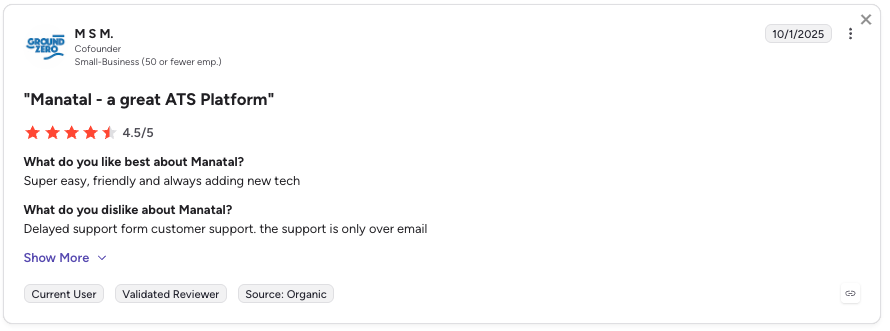
What Customers Say About Manatal
8. Boon: Best for Employee Referrals with Automated Prompts and Rewards
What Is Boon?
Boon is an AI-powered employee referral platform that maps open roles to talent inside employees' networks. It automates referral nudges, captures introductions, and tracks rewards so warm leads become qualified candidates without heavy sourcing.
What Are Boon's Main Benefits?
Automated referral prompts reach employees in their everyday tools, which raises participation rates. Each referral arrives with the referrer's details and rationale, giving recruiters immediate context for faster, more focused screening. Transparent reward tracking sustains engagement and reduces reliance on paid sourcing.
What Are Boon's Key Features?
- AI matching for referral suggestions
- Automated referral campaigns via email and chat
- Reward tracking and leaderboards
- Candidate rediscovery and talent pools
- Analytics and ATS integrations
What Is Boon Missing?
It focuses on referrals rather than full-cycle recruiting. Success depends on employee engagement and a thoughtful incentive plan. Some deeper analytics and workflow options may sit behind higher tiers.
What Business Is Boon Best For?
Companies with engaged teams that can activate their networks, especially startups and SMBs filling trust-sensitive or specialized roles.
What Are Boon's Plans & Pricing?
Boon's pricing includes four plans:
- Professional Plan: $15/user/month
- Enterprise Plan: $35/user/month
- Enterprise Plus Plan: $35/user/month
- Custom Plan
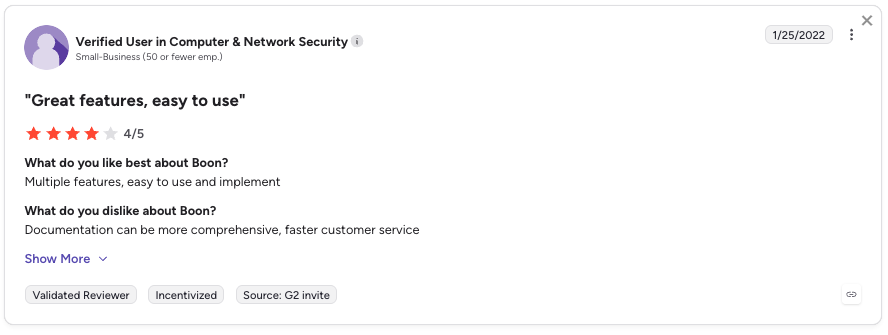
What Customers Say About Boon
9. Willo: Best for High-Volume Video Screening with Collaborative Scoring
What Is Willo?
Willo is an asynchronous video interviewing platform where candidates record short answers on their schedule and hiring teams review, score, and share responses in one workspace.
What Are Willo's Main Benefits?
Early screens move fast without calendar juggling, which keeps momentum high in high-volume hiring. Standardized question sets make comparisons fair and quick, and collaborative scoring tightens alignment with managers. The mobile-friendly flow respects candidate time and reduces drop-off.
What Are Willo's Key Features?
- One-way video interviews with reusable templates
- Shareable links, branded experiences, and mobile recording
- Team scoring and collaboration
- Transcripts and subtitles
- Integrations with popular ATS tools
What Is Willo Missing?
It is less suited for deep technical assessments or roles that benefit from live problem solving. Some candidates prefer real-time conversations, so it works best as an early-stage screen. Analytics focus on activity rather than long-term outcomes.
What Business Is Willo Best For?
High-volume recruiting, campus programs, customer-facing roles, and distributed teams that need structured screening at scale.
What Are Willo's Plans & Pricing?
- Growth: $279/month
- Scale: $409/month
- Enterprise: custom quote
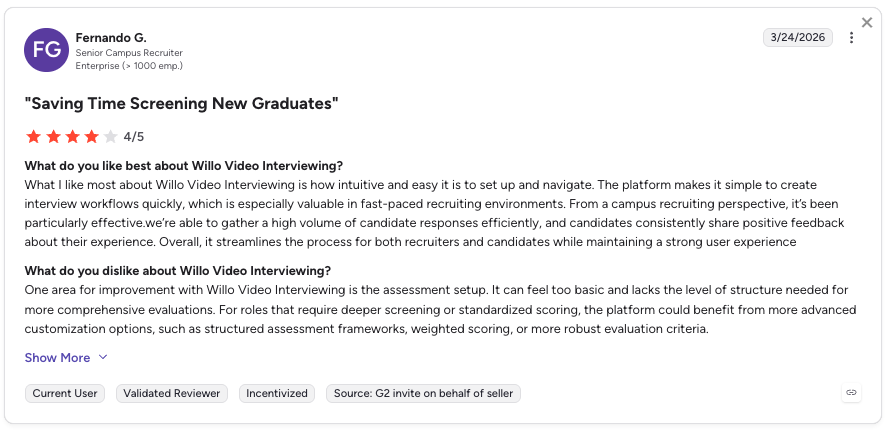
What Customers Say About Willo
10. Recruit CRM: Best for Agencies Managing Candidates and Clients in One System
What Is Recruit CRM?
Recruit CRM is an ATS and CRM for agencies that combines job pipelines, sourcing, resume parsing, email sequencing, and client management in one workspace so candidates and deals stay connected.
What Are Recruit CRM's Main Benefits?
Candidates and clients stay aligned because pipelines, outreach, and account activity live in one system. Recruiters move faster with templates, sequences, and a clear view of next steps for every role. Owners get cleaner revenue and activity reporting without stitching data across tools.
What Are Recruit CRM's Key Features?
- Kanban pipelines with activities and reminders
- Resume parsing and database search
- Email templates and sequencing with inbox sync
- Chrome sourcing extension and job board posting
- Client and deal tracking with reports and dashboards
- API and integrations with common HR and productivity tools
What Are Recruit CRM's Plans & Pricing?
Recruit CRM's pricing includes three plans:
- Pro: $79/user/month
- Business: $109/user/month
- Enterprise: $189/user/month
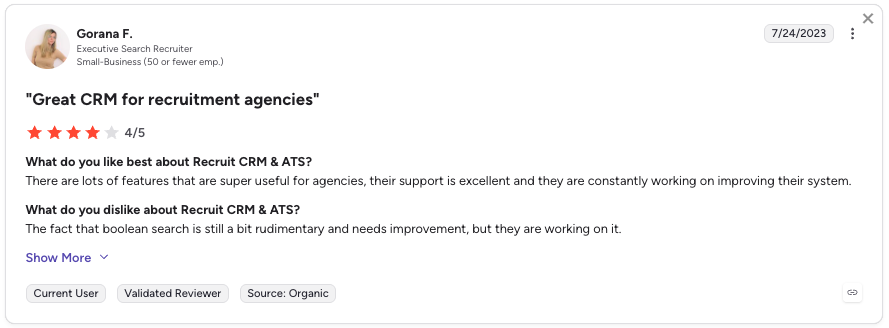
What Customers Say About Recruit CRM
11. Skima AI: Best for AI Resume Screening and Talent Rediscovery
What Is Skima AI?
Skima AI is an all-in-one AI recruitment software. It streamlines resume screening, gives clear match scores, and resurfaces high-fit candidates hidden in existing databases.
Designed for staffing agencies and enterprises, Skima AI relies on its own AI models without external APIs. It includes job postings, detailed reporting and analytics, AI search, skill-evidence detection, and automated outreach campaigns.
Plus, you can integrate Skima AI with over 130 ATS, CRM, and HRIS platforms, as well as LinkedIn.
What Are Skima AI's Main Benefits?
- Faster Shortlists: AI ranking + explainable match reasons surface the strongest candidates quickly.
- Talent Rediscovery: Resurface past applicants and internal talent pools to reduce time-to-hire.
- Scalable Outreach: Automated sequences and generative personalization speed engagement while keeping messages relevant.
- Actionable Analytics: Pipeline and outreach metrics that show real impact on sourcing efficiency.
- Time Savings: Automation for parsing, shortlisting, and outreach can save over 20 hours a week.
- Performance Stats: Users see candidate assessment speed up by 5x. Also, 85% of recruiters report multiplied ROI within months.
- Strong Integrations: Close ATS/CRM/HRIS integrations require little change management for busy TA teams.
What Are Skima AI's Key Features?
- AI Resume Analysis: Parses resumes from ATS, job boards, email, and cloud storage into structured fields.
- Explainable Matching: Generates match scores with clear reasons and highlights of relevant skills.
- Evidence Detection: Verifies claimed skills by checking actual projects and responsibilities in work history.
- Candidate Rediscovery: Finds "hidden gems" in your historical ATS database for new roles.
- Compliance & Security: Designed with SOC 2 and GDPR-ready processes for enterprise use.
- 130+ Integrations: Connects to over 130 ATS, CRM, HRIS, LinkedIn, and storage platforms through APIs and webhooks.
- Time-to-Hire Impact: Customers report up to 67% faster hiring and five times faster screening with integrated AI.
What Is Skima AI Missing?
Best value when you lean into AI workflows; teams that only want a basic ATS may not fully use its matching and campaigns.
What Business Is Skima AI Best For?
Skima AI is best suited for enterprise hiring teams and agencies that want to accelerate shortlisting and rediscovery without ripping out their ATS. It's ideal for:
- In-house talent teams that need better candidate discovery and rediscovery.
- Staffing and recruiting agencies that rely on fast, explainable matches and repeatable outreach.
- Companies that want an AI layer on top of existing ATS workflows for faster time-to-hire.
What Are Skima AI's Plans & Pricing?
Skima AI offers custom pricing.
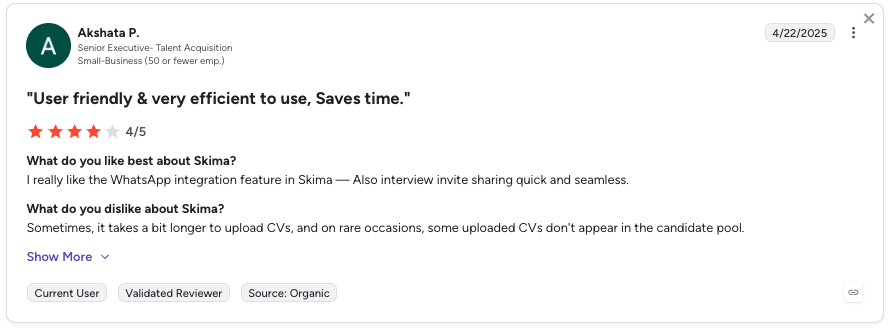
What Customers Say About Skima AI
12. Marlee: Best for Collaboration-Focused Hiring and Team Culture Fit
What Is Marlee?
Marlee is an AI-powered collaboration and performance platform that helps individuals and teams understand work motivations, improve communication, and boost productivity. Using its proprietary motivation assessment, Marlee delivers actionable insights to support self-awareness, team dynamics, and data-driven hiring decisions beyond skills alone.
What Are Marlee's Main Benefits?
Personalized insights help teams understand individual and group work motivations. Actionable recommendations strengthen collaboration, reduce conflicts, and improve performance. Data-driven guidance supports smarter hiring decisions by assessing team and culture fit, not just resumes.
What Are Marlee's Key Features?
- Proprietary work motivation assessment
- Team communication and collaboration insights
- AI-assisted coaching for personal and professional development and goal tracking
- Recruitment and talent-matching support
What Is Marlee Missing?
Marlee focuses on collaboration, motivation, and team performance rather than full-cycle recruiting automation. Success depends on consistent team engagement and participation in coaching or assessment activities. Some advanced analytics may require higher-tier plans.
What Business Is Marlee Best For?
Organizations, HR teams, and team leaders who want to boost collaboration, align team culture, and make data-driven hiring and development decisions.
What Are Marlee's Plans & Pricing?
Marlee's pricing includes three plans:
- Free Plan
- Growth: $15.99/user/month
- Enterprise: Custom
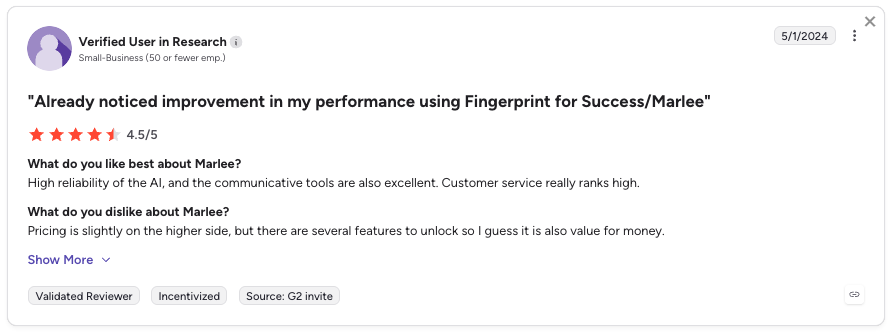
What Customers Say About Marlee
13. AvaHR: Best for Affordable Job Ads, Simple Screening, and SMB Workflows
What Is AvaHR?
AvaHR is a hiring platform for small and growing teams that helps create job ads, manage applicants, screen candidates, and run a straightforward hiring workflow without heavy setup.
What Are AvaHR's Main Benefits?
Jobs go live quickly and applicants stay organized from first touch to offer. Screening and messaging templates remove repetitive work so coordinators and managers stay focused on interviews. Clear status tracking cuts back-and-forth and keeps each role moving.
What Are AvaHR's Key Features?
- Job ad creation and optimization
- Applicant screening and scoring
- Messaging templates and candidate tracking
- Career page and job postings
- Basic reports and team collaboration
- Integrations with popular job boards
What Is AvaHR Missing?
Enterprise controls and deep analytics are limited. Complex interview flows or custom compliance may require additional tools. Larger organizations may outgrow native reporting.
What Business Is AvaHR Best For?
Startups and SMBs that want an affordable system for posting jobs and managing applicants.
What Are AvaHR's Plans & Pricing?
- Lite: $99 per month
- Plus: $165 per month
- Premium: $322 per month
- Max: $457 per month
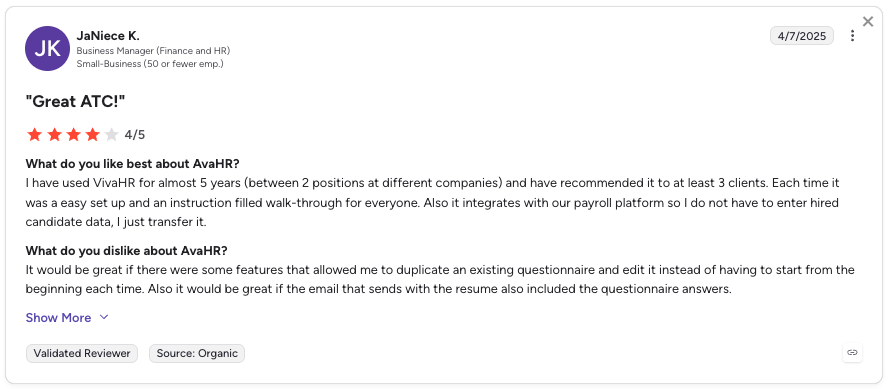
What Customers Say About AvaHR
14. Truffle: Best for Structured AI Screening That Lifts Top Responses Quickly
What Is Truffle?
Truffle is an AI candidate screening and interviewing platform that runs structured screens, scores responses, and moves qualified applicants forward with less manual review.
What Are Truffle's Main Benefits?
Structured screens produce comparable answers across candidates, which tightens shortlists. AI scoring spotlights strong responses so reviewers spend time where it counts. Time shifts from first-pass review to advancing finalists.
What Are Truffle's Key Features?
- Structured screening flows with AI scoring
- Interview quotas and job limits by plan
- Shareable shortlists and reviewer collaboration
- Basic analytics for pass rates and conversion
- Enterprise options for support and custom domains
What Is Truffle Missing?
Advanced scheduling and deep assessment libraries are limited. Teams running complex technical evaluations may pair it with dedicated assessment tools. Reporting is useful but not a full analytics suite.
What Business Is Truffle Best For?
Lean teams and SMBs that need quick, consistent screening for high-volume roles.
What Are Truffle's Plans & Pricing?
- Self Serve: $149 per month
- Custom
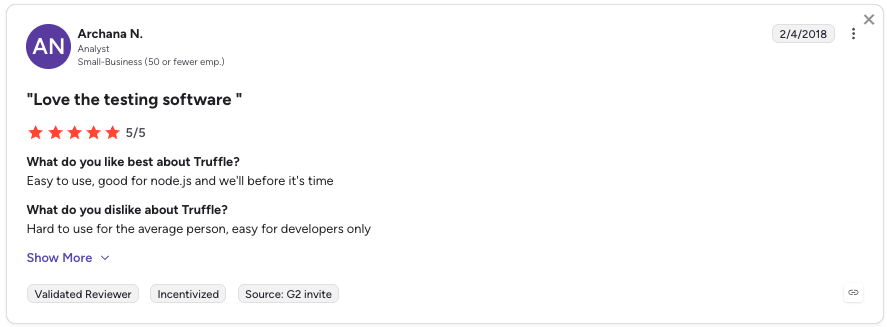
What Customers Say About Truffle
15. Greenhouse: Best for Structured Hiring at Scale with Deep Integrations
What Is Greenhouse?
Greenhouse is an applicant tracking system that standardizes hiring with structured workflows, interview kits, and broad integrations. It also offers AI-assisted content to speed up job descriptions and candidate messaging.
What Are Greenhouse's Main Benefits?
Structured scorecards make interviews consistent across teams. Built-in scheduling, offers, and approvals keep hiring moving without side tools. Dashboards surface bottlenecks and DEI trends so leaders can course correct early.
What Are Greenhouse's Key Features?
- Structured hiring with interview kits and scorecards
- Scheduling, offers, and approvals in one system
- Marketplace integrations for HRIS, assessments, and communications
- Analytics and dashboards for pipeline and quality of hire
- AI-assisted content for job descriptions and outreach
What Is Greenhouse Missing?
Pricing is not public. Setup can be complex for smaller teams and some modules require extra configuration or add-ons. Change management is important when standardizing processes across many stakeholders.
What Business Is Greenhouse Best For?
Mid-sized and enterprise organizations that want mature process control, deep integrations, and detailed reporting.
What Are Greenhouse's Plans & Pricing?
Custom pricing after a demo request.
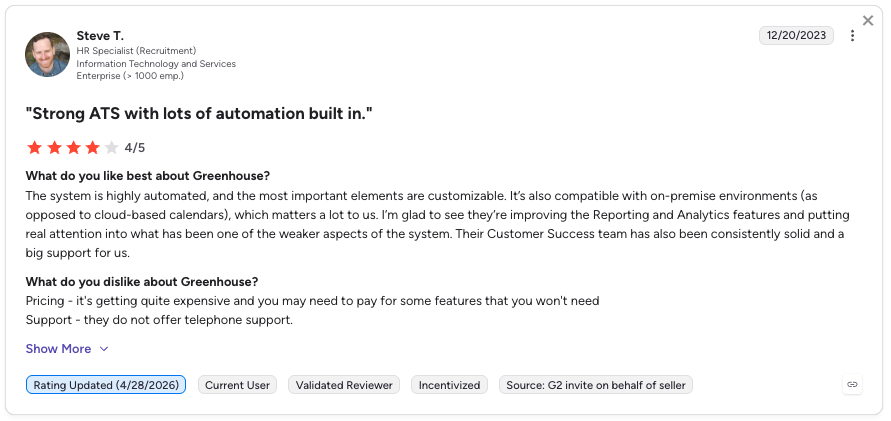
What Customers Say About Greenhouse
16. iCIMS: Best for Enterprise Workflows, Compliance, and Global Rollouts
What Is iCIMS?
iCIMS is an enterprise talent platform that brings applicant tracking, candidate relationship management, career sites, offers, and onboarding into one environment. It functions like a control center for complex hiring where compliance, brand control, and security sit alongside speed.
What Are iCIMS's Main Benefits?
Hiring stays consistent across regions and brands because workflows, permissions, and approvals are standardized. Recruiters publish to many boards, text candidates, and track progress without side spreadsheets. Operations teams get audit trails and retention controls that stand up in regulated industries.
What Are iCIMS's Key Features?
- Applicant tracking with structured workflows and role-based permissions
- Candidate relationship management for pools and multi-step campaigns
- Native texting, video, and multilingual career sites with strong branding
- Offer management and onboarding with e-signatures and tasks
- Analytics for pipeline health, time to fill, and DEI reporting
- Large marketplace of integrations for HRIS, assessments, and communications
What Is iCIMS Missing?
Pricing is not public and configuration can take time, especially with multiple brands or complex approval chains. Some advanced modules are sold separately, so scoping matters before rollout.
What Business Is iCIMS Best For?
Mid-market and enterprise teams with many stakeholders, strict compliance needs, and global hiring that requires deep integrations and standardized processes.
What Are iCIMS's Plans & Pricing?
Custom pricing after a demo request.
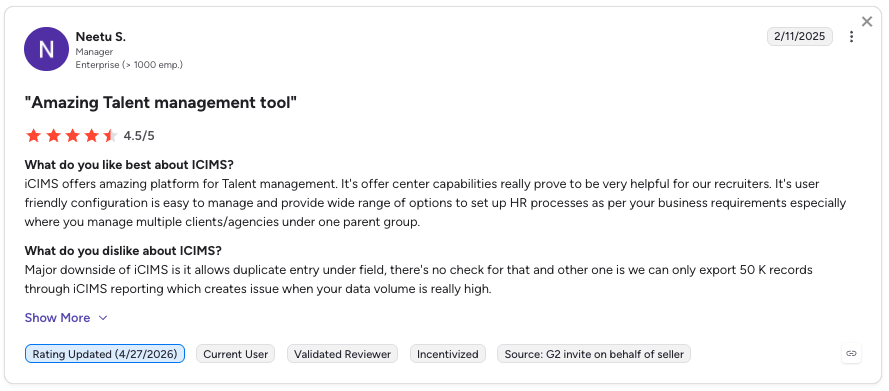
What Customers Say About iCIMS
17. Fetcher: Best for Automated Prospecting and Email Outreach at Scale
What Is Fetcher?
Fetcher is a top-of-the-funnel platform that automates sourcing and outreach. It builds targeted prospect lists, enriches contacts, and runs personalized sequences so recruiters spend time on conversations rather than list building.
What Are Fetcher's Main Benefits?
Pipelines fill faster because search, enrichment, and outreach run as one flow. Reply detection keeps campaigns moving without manual follow-ups, and rediscovery pulls qualified past applicants back into play. Diversity filters help teams widen reach without sacrificing match quality.
What Are Fetcher's Key Features?
- Automated candidate discovery with profile matching and filters
- Contact enrichment and verification to reduce bounce
- Multi-step email sequences with personalization and scheduling links
- Reply detection with open, click, and response tracking
- Rediscovery across your ATS and simple talent pool management
- Connectors for common ATS and collaboration tools
What Is Fetcher Missing?
Focus is on sourcing and outreach rather than assessment or scheduling. Reporting is campaign-level rather than executive dashboard, and teams that want phone-based engagement will pair it with other tools.
What Business Is Fetcher Best For?
Agencies and in-house teams that run outbound recruiting for sales, marketing, and technical roles and need repeatable top-of-funnel volume with minimal manual research.
What Are Fetcher's Plans & Pricing?
Custom pricing available upon request.
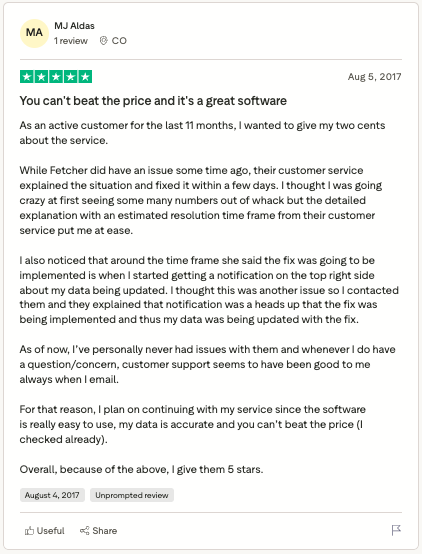
What Customers Say About Fetcher
18. Radancy: Best for Async Video Interviews and Shareable Shortlists
What Is Radancy?
Radancy is an asynchronous video interviewing platform where candidates record short answers on their own schedule and hiring teams review, rate, and share responses in a single workspace.
What Are Radancy's Main Benefits?
Screening volume increases without calendar wrangling. Standardized question sets make reviews fair and comparable, and side-by-side playback shortens decision time. Shareable shortlists keep hiring managers aligned while the mobile-friendly flow reduces candidate drop-off.
What Are Radancy's Key Features?
- One-way video interviews with question templates and time limits
- Branding, intro videos, and candidate guidance screens
- Team scoring, tags, and structured feedback
- Easy sharing with links or role-based access
- Transcripts and subtitles for faster review and accessibility
- Integrations with popular ATS tools
What Is Radancy Missing?
It is not ideal for deep technical or pair-style interviews. Some candidates prefer live conversation, so it works best as an early-stage screen. Reporting focuses on activity rather than long-term outcomes.
What Business Is Radancy Best For?
High-volume roles, campus programs, customer support and sales teams, and distributed hiring where scheduling live screens slows momentum.
What Are Radancy's Plans & Pricing?
Custom pricing after a demo request.
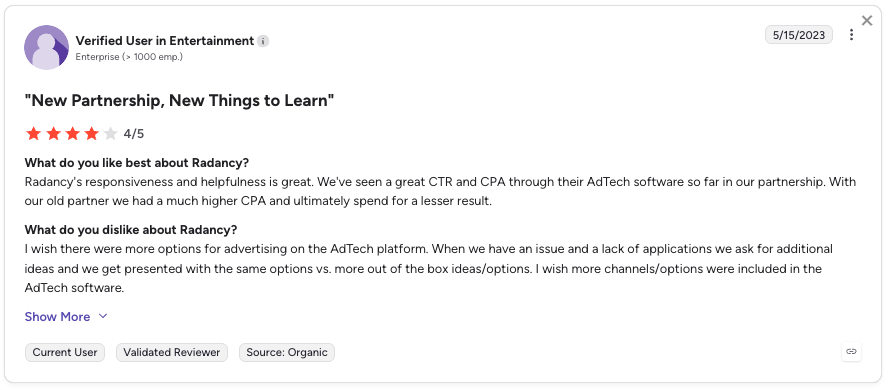
What Customers Say About Radancy
19. Noota Taalent: Best for End-to-End AI Recruiting from Intake to ATS Sync
What Is Noota Taalent?
Noota Taalent is an all-in-one AI recruiting platform that helps teams automate sourcing, outreach, screening, interviews, reporting, and ATS synchronization from one structured workflow.
Recruiters define the role once, and the platform helps structure criteria, find candidates, run pre-qualification, generate candidate reports, and sync hiring data back to the ATS.
What Are Noota Taalent's Main Benefits?
Recruiters spend less time on repetitive sourcing, screening, note-taking, and reporting. Candidate evaluation becomes more consistent because teams can use structured scorecards, measurable criteria, interview insights, and candidate comparison tables.
Noota Taalent also keeps existing ATS workflows in place while adding automation and intelligence on top.
What Are Noota Taalent's Key Features?
- AI intake agent for defining hiring needs and creating role scorecards
- AI candidate sourcing with ranked candidate lists
- Automated outreach sequences
- AI voice agents for structured pre-qualification calls
- Interview recording, transcription, and structured reports
- Candidate scoring and comparison tables
- ATS synchronization and hiring analytics
- Customizable report templates and follow-up email automation
What Business Is Noota Taalent Best For?
Noota Taalent is best for internal talent acquisition teams, recruitment agencies, staffing firms, and companies hiring across several roles at once.
It fits teams that want to reduce manual sourcing and screening, standardize candidate evaluation, and keep candidate insights connected to their ATS without rebuilding their entire recruiting stack.
What Are Noota Taalent's Plans & Pricing?
Noota's pricing starts at $299/user/month.
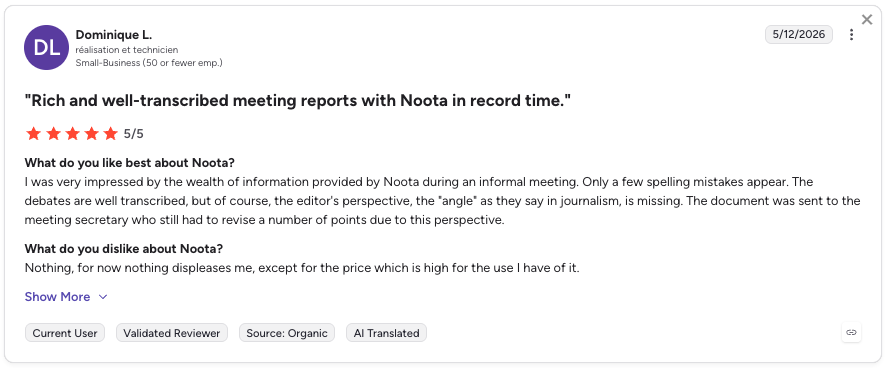
What Customers Say About Noota Taalent
Which Tool Does What Best?
Strong hiring starts with fast, clear communication. From there, every step should add signal without adding friction. Use these tools by job-to-be-done, starting with communication.
Communication And Candidate Engagement
- CloudTalk: AI voice agents for first touch and pre-screens, SMS, AI call summaries, Trending Topics, sentiment, and searchable transcripts that all sync to your ATS.
- Gem: Multichannel nurture and automated sequences with performance analytics.
- Recruit CRM: Agency-style email sequencing with client and candidate tracking in one place.
- AvaHR: Message templates and status updates that keep applicants informed.
- Fetcher: Enriched email campaigns with reply detection to maintain top-of-funnel momentum.
Screening And Interviews
- CloudTalk: Phone pre-screens at scale with AI summaries and sentiment so notes are ready for handoff.
- Willo: Async video screens with templates, transcripts, and team scoring.
- Radancy: One-way responses, side-by-side review, and shareable shortlists.
- Truffle: Structured screening flows with AI scoring that lift the best answers.
Candidate Sourcing And Rediscovery
- CloudTalk: Power and Parallel Dialers with local presence to reach sourced lists quickly.
- SeekOut: Deep filters, conversational search, and ATS rediscovery for past applicants.
- Fetcher: Automated prospecting that builds qualified lists and runs outreach.
- Gem: Sourcing plus long-term nurture over public profiles and ATS records.
- Manatal: AI scoring and enrichment to surface strong matches already in your database.
- Recruit CRM: Chrome sourcing extension and quick add to pipelines.
Scheduling And Coordination
- CloudTalk: Skill-based routing and IVR for instant callbacks and fast handoffs to the right recruiter.
- Gem: Interview scheduling alongside sourcing and CRM.
- Workable: Calendar sync and reminders built into the ATS flow.
Applicant Tracking And Structured Hiring
- CloudTalk: Automatic call and SMS logging to ATS records to keep histories complete.
- Workable: AI-assisted ranking, job distribution, and scorecards in one ATS.
- Manatal: Drag-and-drop pipelines and practical automations for quick setup.
- Greenhouse: Interview kits, scorecards, and deep integrations for scale.
- iCIMS: Enterprise workflows with CRM, offers, and onboarding.
- Recruit CRM: ATS plus CRM for agencies running candidates and clients together.
Benefits and Use Cases of AI Recruiting Software
Modern AI recruitment software works like a co-pilot that handles the repetitive work and feeds recruiters clean signals. Most employers already lean on AI for early screening, which shows how central these AI recruitment software have become, yet the best results still come from human judgment guiding the process.
Think of AI tools for recruiters as acceleration plus clarity while people own decisions, culture fit, and trust. This is the promise of AI driven recruiting: speed without losing the human touch.
Use cases
Switch On Hiring Momentum
You can keep juggling tabs and chasing callbacks, or you can put conversations on rails. The right AI recruiting software should feel like a high-speed line for your pipeline where every touch moves candidates forward without friction.
CloudTalk gives you that track. AI voice agents start first contacts. Call summaries, sentiment, and trending topics land in your ATS so handoffs are clean and next steps are obvious. Local presence numbers and smart dialers open doors while recruiters stay focused on real conversations.
If you want faster hiring without losing the human touch, start here. Try CloudTalk for recruiting and turn every call into a hiring.
Sources:
1, 2: World Economic Forum
AI recruiting software automates sourcing, screening, outreach, and scheduling so teams hire faster while keeping human judgment, fairness, and compliance front and center.
The best AI recruiting software depends on your team's biggest bottleneck. For communication-heavy recruiting — calls, SMS, ATS syncing — CloudTalk leads. For sourcing and rediscovery, SeekOut and Fetcher are top picks. For full structured hiring at scale, Greenhouse and iCIMS are the go-to enterprise options.
AI handles parsing, ranking, messaging, and scheduling. AI tools for recruitment cut admin, surface matches, and keep candidate messages timely and clear — while recruiters retain control over judgment and fit.
For enterprises, iCIMS and Greenhouse are consistently top-rated for their standardized workflows, compliance controls, deep HRIS integrations, and support for global, multi-brand hiring. Skima AI is an emerging option for teams that want an AI layer on top of existing ATS infrastructure.
CloudTalk stands out for conversational AI recruiting with AI voice agents that handle first-touch screening, sentiment analysis that captures candidate mood in real time, and AI summaries that make every handoff immediate and context-rich.
For high-volume hiring, the strongest platforms are CloudTalk (for call-based outreach at scale), Willo and myInterview (for async video screening), Workable (for AI-assisted ranking and multi-board posting), and Truffle (for structured AI screening).
Greenhouse, iCIMS, Gem, and Recruiterflow lead for ATS integration depth. CloudTalk integrates directly with Workable, Greenhouse, and major CRMs to keep call and SMS history synced automatically.
CloudTalk is ideal for communication-heavy recruiting, while Manatal ($15/user/month), AvaHR (from $83/month), and Workable (from $299/month) are also strong options for SMBs. Manatal stands out for fast onboarding, practical AI, and accessible pricing.
Best pricing depends on scope. Compare per-user seats, usage-based fees for AI features, and bundled plans. Manatal and AvaHR offer the most transparent, affordable per-user pricing for growing teams. Enterprise platforms like iCIMS, Greenhouse, and SeekOut use custom pricing — always scope carefully before committing.
AI surfaces matches, reactivates past applicants, and personalizes outreach at scale. AI-driven recruiting speeds hiring now, while humans ensure fit.
AI recruiting platforms scale outreach, cut admin, and lift pass rates. AI tools for recruiters keep pipelines warm and decisions consistent across teams.