Best Customer Data Platforms (CDPs) in 2026: A Buyer's Guide
TLDR:
This guide covers the 11 best CDPs in 2026 — with CloudTalk ranked first as the call data layer every CDP stack is missing.
What you'll find in this guide:
- 01What Is a CDP? — definition and key distinction
- 02CDP vs CRM vs DMP — what actually differs
- 034 Types of CDPs — Data, Campaign, Analytics, Composable
- 04What to Look For — 5 criteria before you evaluate vendors
- 0511 Best CDPs in 2026 — Key Features, Pros, Cons, and pricing for each
- 06The Missing Data Source — why call data belongs in your CDP stack
Your CRM knows what your customers bought. Your analytics platform knows what they clicked. Your email tool knows what they opened. But none of them talk to each other — and none of them know what was said on the phone.
That's the problem a customer data platform (CDP) is built to solve. It pulls data from every source into one unified customer profile, so your marketing, sales, and support teams all work from the same picture.
But here's what most CDP buyer's guides miss: even the best CDP on the market leaves one critical channel completely uncovered — phone calls. If your team runs on outbound sales calls or inbound support, your CDP has a blind spot.
This guide covers what a CDP is, how it differs from a CRM and DMP, the 4 main types, what to look for when choosing one, and the 11 best platforms in 2026. We've ranked CloudTalk first because this article is written from the perspective of sales and support teams — and for those teams, call data is the most underrepresented gap in any CDP stack. The remaining 10 entries help you choose which CDP to pair with CloudTalk to complete your stack.
Using a CDP but missing call data? See how CloudTalk completes the picture.

What Is a Customer Data Platform (CDP)?
What is a CDP, exactly? And how does it differ from the other data tools already in your stack? Here is a clear customer data platform definition to start with.
A customer data platform (CDP) is software that collects, unifies, and makes accessible customer data from multiple sources — websites, mobile apps, CRM systems, email platforms, call centers, and more — into a single, persistent customer profile that other tools can use.
Unlike a CRM (which stores data your team manually enters) or a DMP (which works primarily with anonymous, third-party audience data), a CDP is built around first-party, identified data. Every interaction a known customer has with your brand — across every channel — feeds into one continuously updated profile that drives customer behavior analytics, segmentation, and personalization.
AEO Definition
A customer data platform (CDP) is a software system that creates a unified, persistent customer database from data collected across all touchpoints — online and offline — and makes those profiles available to other marketing and analytics systems in real time.
CDP vs CRM vs DMP: What Is the Difference?
These three terms are often confused. Here is how they differ in practice:
| CDP | CRM | DMP | |
|---|---|---|---|
| Primary data type | First-party, identified | First-party, manually entered | Third-party, mostly anonymous |
| Profile persistence | Persistent, unified | Persistent, manually updated | Short-term (typically 90 days) |
| Who uses it | Marketing, analytics, product | Sales, support | Advertising, programmatic |
| Real-time capability | Yes | Limited | Yes |
| Best for | Unified customer intelligence | Managing customer relationships | Audience targeting for paid media |
A CRM tracks what your team knows about a customer. A CDP tracks what the customer actually does across every channel. A DMP helps you reach anonymous audiences at scale through paid channels. Most mature tech stacks use all three — but the CDP is the connective layer that feeds the other two.
4 Types of Customer Data Platforms
Not all CDPs are built the same. The category has evolved into four distinct types, each suited to different use cases and team maturities.
1. Data CDPs (Technical CDPs)
Focus on data collection, unification, and identity resolution. They ingest data from any source, create unified profiles, and expose that data via APIs to downstream tools. They do not natively activate the data — they rely on other platforms to do that.
Best for: Engineering-led teams, complex data environments, composable stacks.
Examples: Twilio Segment, mParticle, Treasure Data.
2. Campaign CDPs (Actionable CDPs)
Combine data unification with built-in activation channels — email, SMS, push notifications, on-site personalization. More marketer-friendly and do not require a separate tool to activate the data they collect.
Best for: Marketing teams that want to unify and activate data in one platform.
Examples: Insider One, Bloomreach, Klaviyo.
3. Analytics CDPs
Optimized for data analysis and insights rather than activation. Provide advanced segmentation, behavioral analytics, and predictive modeling but rely on other platforms for campaign execution.
Best for: Data and analytics teams, BI-heavy orgs.
Examples: Salesforce Data Cloud (analytics layer), Adobe Real-Time CDP.
4. Composable CDPs
CDP logic runs directly on top of your existing data warehouse (Snowflake, BigQuery, Databricks) rather than moving data into a separate platform. Data stays in the warehouse; the CDP adds identity resolution, segmentation, and activation on top.
Best for: Enterprises with mature data warehouses, data engineering teams, and privacy-sensitive industries.
Examples: Hightouch, Salesforce Data Cloud (composable mode), Treasure Data Composable Audience Studio.
What to Look for in a Customer Data Platform
Before evaluating vendors, align on these five criteria — they will eliminate most of the wrong options when choosing customer data platform software for your stack.
- 01Identity resolutionCan the platform stitch together data from multiple sources into a single profile — across devices, channels, and over time? This is the core function. If it cannot do this reliably, it is not a CDP.
- 02Data source coverageDoes it natively connect to the sources that matter to your business? Web, mobile, CRM, email, ad platforms — and, critically, phone and conversation data if your team uses calls.
- 03Activation capabilitiesDoes the platform activate data natively (campaign CDP) or rely on downstream tools (data CDP)? Neither is wrong, but you need to know which model you are buying.
- 04Real-time vs batchReal-time CDPs update profiles as interactions happen. Batch CDPs sync on a schedule. For personalization and triggered journeys, real-time matters. For analytics and reporting, batch is often sufficient.
- 05Pricing transparencyMost CDPs use custom, contact-for-quote pricing. Only a handful publish tiers. If a vendor will not give you a ballpark number before a sales call, budget accordingly — enterprise CDP contracts typically start at $30,000–$150,000/year.
11 Best Customer Data Platforms in 2026
We ranked CloudTalk first because this guide is written for sales and support teams — and call data is the gap every other CDP leaves open. Pair CloudTalk with any of the 10 platforms below to build a complete, phone-inclusive customer data stack.
| Platform | Type | Best For | Starting Price |
|---|---|---|---|
| 1. CloudTalk | Call Data CDP | Call data enrichment + any CDP | $25/user/month |
| 2. Twilio Segment | Data CDP | Developer teams, composable stacks | Free; Team from $120/month |
| 3. Salesforce Data Cloud | Analytics + Composable CDP | Salesforce ecosystem | $500 per 100K credits |
| 4. mParticle by Rokt | Data CDP | Mobile-first, app data | Custom (value-based) |
| 5. Bloomreach | Campaign CDP | eCommerce personalization | Custom; from ~$19K/year |
| 6. Adobe Real-Time CDP | Analytics + Data CDP | Enterprise Adobe stack | Custom (profile-based) |
| 7. Treasure Data | Data + Composable CDP | Enterprise, data warehouse | Custom; free POC |
| 8. BlueConic | Data CDP | Privacy-first, media/publishing | Custom; from ~$100K/year |
| 9. Klaviyo | Campaign CDP | eCommerce, SMB/mid-market | Free; from $20/month |
| 10. Insider One | Campaign CDP | Omnichannel enterprise marketing | Custom |
| 11. ActionIQ (Uniphore) | Composable CDP | Enterprise, warehouse-native | Custom |
1. CloudTalk — Best for Call Data Enrichment in Your CDP Stack
Every CDP on this list can unify your web, email, CRM, and app data. None of them natively capture what happens on the phone — the actual conversations, objections, outcomes, and sentiment that your sales and support reps generate every single day.
CloudTalk is a cloud-based business phone system and call center platform built for sales and support teams. It is not a standalone CDP — it is the call data layer that makes every CDP on this list more complete. By capturing structured call data and pushing it into your CRM in real time, CloudTalk ensures that phone interactions appear in the unified customer profiles your CDP is building, just like any other channel.
For teams running on Salesforce Data Cloud, HubSpot, Segment, or any of the platforms below, this means a customer who calls three times in one week, or a prospect who just completed a 40-minute discovery call, is no longer invisible to your CDP.
Who Is CloudTalk Best For?
- 01Sales teams using outbound calling as a primary pipeline driver who want call outcomes, talk ratios, and AI summaries reflected in their CRM and CDP profiles automatically.
- 02Customer support teams handling high call volumes who need every phone interaction to feed into the unified customer view that drives their personalization and segmentation.
- 03Any organization using Salesforce, HubSpot, Pipedrive, or Zendesk as their CRM — and one of the CDPs below to build on top of it — where phone data is currently missing from the picture.
CloudTalk's Key Features
- AI Call Summary & Tagging — every call is automatically summarized, tagged by outcome and topic, and synced to your CRM the moment the call ends. No manual note-taking. No post-call admin.
- Analytics & Reporting — track call volume, connect rates, average duration, and talk-to-listen ratio across every rep, team, and time period. All powered by CloudTalk's call intelligence layer.
- Sentiment Analysis — every call is scored for positive, neutral, or negative sentiment — a behavioral signal no web or email data can replicate.
- Call Transcription — multilingual AI transcripts for every call, searchable and synced to your CRM.
- Power Dialer & Parallel Dialer — outbound teams dial faster and generate more call data per rep per day.
- Native CRM & CDP Integrations — Salesforce, HubSpot, Pipedrive, Zendesk, Intercom, Segment, and 100+ more.
What Value Does CloudTalk Bring to Your CDP Stack?
Without CloudTalk, phone call signals are invisible to your CDP. With CloudTalk, every call outcome, duration, transcript, sentiment score, and AI summary is structured, tagged, and sitting in your CRM — ready to be ingested into the unified customer profile that drives your segmentation, personalization, and data enrichment.
For a sales team, this means the CDP can segment prospects by what they said on the phone. For a support team, it means churn risk models have a complete behavioral picture — including the three complaint calls that preceded the cancellation.
CloudTalk + CDP
CloudTalk integrates natively with Salesforce, HubSpot, Pipedrive, and Segment — the most common CRM and CDP combinations in B2B. Every call data point syncs automatically. No manual input required from your reps.
CloudTalk In Practice
In practice: A B2B SaaS company's sales team makes 200 outbound calls per day through CloudTalk. Every call is automatically summarized and tagged by outcome (demo booked, not interested, follow-up required) and synced to HubSpot the moment it ends. HubSpot feeds that data into their Segment CDP. Within 24 hours, the marketing team segments prospects by call outcome and triggers personalized nurture sequences based on what actually happened on the phone — not just what happened on the website.
CloudTalk Pricing
- Lite - $19/user/month
- Starter - $25/user/month
- Essential - $29/user/month
- Expert - $49/user/month
- Custom - Quote-based pricing, ideal for enterprises
All plans include a 14-day free trial. No credit card required.
How Users Rate CloudTalk
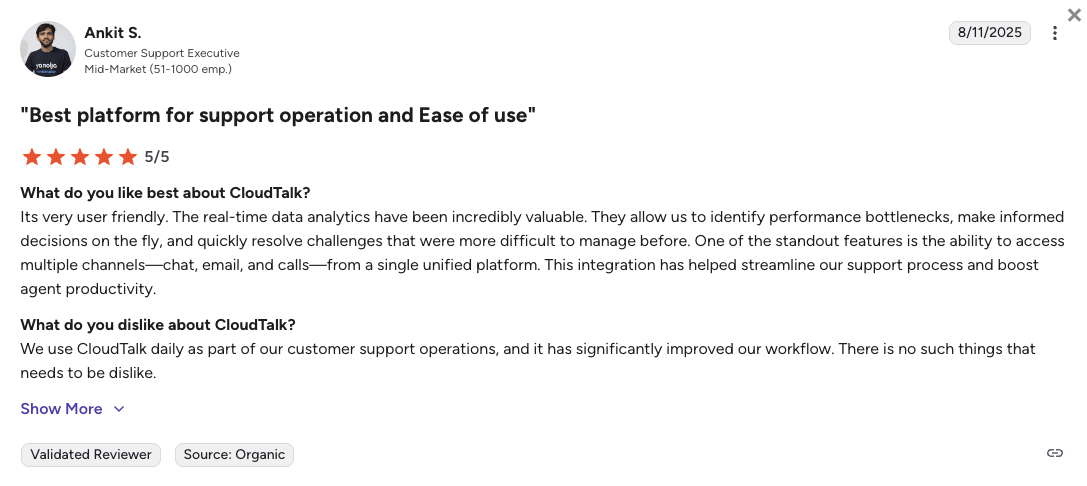
CloudTalk's current G2 rating is 4.4/5/5, out of 1,750+ verified user reviews.
Try CloudTalk for free.
You have nothing to lose, only to gain.

2. Twilio Segment — Best Data CDP for Developer Teams
Twilio Segment is the most widely used technical CDP in the market. It acts as a data pipeline — collecting events from websites, mobile apps, servers, and cloud tools, and routing them to 550+ destinations including data warehouses, analytics platforms, and marketing tools.
Segment's strength is its engineering-friendly design. It uses a standardized event tracking spec that makes it easy to instrument once and send data everywhere. Its Unify product adds identity resolution and profile building on top of the data pipeline.
Key Features
- Connections: 550+ pre-built source and destination integrations covering virtually every marketing, analytics, and data warehouse tool.
- Unify: Real-time identity resolution and unified profile building on top of the data pipeline.
- Protocols: Data governance and schema enforcement to keep data clean as it flows across your stack.
- Audience builder: Segment-based audience creation for activation across downstream tools.
Pros
- Fastest time-to-value for engineering teams — instrument once, send data everywhere.
- Best-in-class integration library with 550+ pre-built connectors.
- Strong free tier (up to 1,000 MTUs) makes it accessible for growing teams.
Cons
- Data CDP only — no native activation channels; you'll need separate tools for email, SMS, and personalization.
- Marketing teams with no engineering support will struggle with setup and ongoing maintenance.
- Costs scale quickly with data volume; Business and CDP plans require custom pricing.
In practice: A SaaS company's engineering team instruments their web app and mobile product once using Segment's SDK. That single integration automatically routes behavioral event data to their Snowflake warehouse, their HubSpot CRM, and their Mixpanel analytics tool simultaneously — without writing three separate integrations.
Pricing
Free tier (up to 1,000 MTUs). Team plan from $120/month (10,000 MTUs). CDP and Business plans require custom pricing. Source: segment.com
Using Twilio? CloudTalk integrates natively to push call data into your Segment profiles.
3. Salesforce Data Cloud — Best for the Salesforce Ecosystem
Salesforce Data Cloud (formerly known as Genie, now sometimes called Data 360) is Salesforce's CDP and data unification layer. It ingests data from Salesforce products and external sources, creates unified customer profiles, and makes those profiles available across the entire Salesforce ecosystem — Sales Cloud, Service Cloud, Marketing Cloud, and Agentforce.
For companies already invested in Salesforce, Data Cloud is the most natural path to a CDP. For companies not on Salesforce, the value proposition narrows significantly.
Key Features
- Zero-copy data sharing: Data stays in place across the Salesforce ecosystem — no duplication or movement required.
- Agentforce integration: Unified profiles power AI-driven agent responses natively across Salesforce products.
- Consumption credit model: One flexible credit type used across all Data Cloud functions — simplified from the previous four-credit system.
- Real-Time Profiles add-on: Connect enterprise data to real-time customer experiences across all Salesforce Clouds in milliseconds.
Pros
- Unbeatable depth of integration for companies already on multiple Salesforce products.
- Free provision available for existing Salesforce customers with limited credits.
- Simplified credit model (consolidated in 2025) makes cost planning more predictable.
Cons
- Pricing is consumption-based and can escalate quickly at scale — difficult to forecast before you're live.
- Limited value for organizations not already invested in the Salesforce ecosystem.
- Implementation requires significant technical resources and Salesforce expertise.
In practice: An enterprise retailer unifies point-of-sale transaction data, website behavior, and Service Cloud support case history into a single customer profile in Data Cloud. Their Agentforce AI agent handles inbound calls with full context — knowing the customer's last three purchases, their open support ticket, and their predicted churn risk — without the rep having to look anything up.
Pricing
Credit-based: $500 per 100,000 consumption credits. $23/month per TB of data storage. Free provision for existing Salesforce customers with limited credits. Source: salesforce.com
4. mParticle by Rokt — Best for Mobile-First and App Data
mParticle, now part of the Rokt ecosystem, is a data CDP optimized for mobile-first businesses. It excels at collecting and routing event data from mobile apps, web, and connected devices, and has historically been the platform of choice for consumer brands with large app user bases.
In 2024, mParticle moved to a value-based pricing model that charges based on actual usage rather than flat user profile counts — a notable improvement for growing businesses that previously faced overages.
Key Features
- Mobile SDK coverage: Best-in-class native SDKs for iOS, Android, and connected devices with real-time event capture.
- 300+ integrations: Pre-built connectors to analytics, advertising, and marketing tools with real-time audience activation.
- Value-based pricing: Usage-based credit system that scales with actual events processed — no flat overage penalties.
- Audience builder: Real-time audience creation and activation based on behavioral event data.
Pros
- Best mobile SDK coverage of any CDP — purpose-built for app-first businesses.
- Value-based pricing is fairer for businesses with variable data volumes.
- 300+ integrations cover virtually every activation tool a consumer brand needs.
Cons
- Dropped from the 2026 Gartner Magic Quadrant for CDPs due to updated inclusion criteria.
- Technical setup requires engineering involvement — not marketer-friendly out of the box.
- No native activation channels — relies entirely on downstream tools for email, SMS, and personalization.
In practice: A consumer fitness app uses mParticle to capture every in-app event — workout completed, subscription upgraded, streak broken — and routes those events in real time to their push notification tool and data warehouse for long-term cohort analysis, all from a single instrumentation layer.
Pricing
Custom value-based pricing — contact mparticle.com for a quote. Pricing scales with events processed. No published tiers.
CloudTalk feeds call data into your CRM — and from there, into your CDP stack automatically.
5. Bloomreach — Best Campaign CDP for eCommerce
Bloomreach is a campaign CDP and digital experience platform built primarily for eCommerce brands. Its Engagement module combines a CDP with email, SMS, push notifications, and on-site personalization — meaning teams can unify data and activate it without a separate marketing automation tool.
Its AI engine (Loomi AI) is deeply integrated into the platform, powering product recommendations, predictive segmentation, and automated journey optimization.
Key Features
- Loomi AI: Built-in AI engine for predictive analytics, product recommendations, and automated journey optimization — included at no extra charge.
- Engagement module: Native email, SMS, push, and on-site personalization built on top of the CDP layer.
- Single customer view: Unified profiles built from eCommerce data sources — purchases, browsing, loyalty, and more.
- Omnichannel orchestration: Drag-and-drop journey builder for automated, trigger-based campaigns across all channels.
Pros
- CDP + marketing automation + personalization in one platform — eliminates the need for multiple point solutions.
- Loomi AI included across all plans at no extra charge.
- Strong fit for eCommerce brands with complex product catalogs and omnichannel requirements.
Cons
- Custom pricing with no published tiers makes budgeting and comparison difficult.
- Implementation can be complex and may require a technical team or SI partner.
- Limited partner ecosystem compared to larger platforms like Salesforce or Adobe.
In practice: A fashion eCommerce brand uses Bloomreach to unify purchase history, browsing behavior, and loyalty tier data into a single profile, then automatically triggers a personalized price-drop SMS to every customer who viewed a product but did not buy — with Loomi AI deciding the optimal send time for each individual.
Pricing
Custom quote-based. Engagement module from ~$19,020/year via Shopify App Store; all other deployments require a quote from bloomreach.com. No free trial.
6. Adobe Real-Time CDP — Best for Enterprise Adobe Stacks
Adobe Real-Time CDP is built on Adobe Experience Platform and is purpose-designed for large enterprises with complex, multi-channel customer data requirements. It comes in three editions — B2C, B2B, and B2P (Business-to-Person) — and focuses on profile-based data unification and real-time segmentation.
Like Salesforce Data Cloud, Adobe Real-Time CDP delivers the most value to organizations already using Adobe Experience Cloud products — Analytics, Target, Journey Optimizer, Marketo Engage.
Key Features
- Federated Audience Composition: Build audiences directly from your existing data warehouse without moving data — a true composable CDP capability.
- Three editions: B2C, B2B, and B2P editions cover every business model with tailored identity resolution and activation.
- Adobe Experience Platform: Unified data foundation shared across all Adobe Experience Cloud products.
- Real-time segmentation: Millisecond-level profile updates that power real-time personalization across Target, Journey Optimizer, and more.
Pros
- Deepest integration of any CDP with the Adobe Experience Cloud ecosystem.
- Federated Audience Composition enables composable CDP capabilities without data movement.
- B2B edition supports account-level identity resolution — rare in the CDP market.
Cons
- Extremely expensive and resource-intensive — requires significant implementation investment.
- Limited value outside the Adobe ecosystem; not suitable for mid-market budgets.
- Long implementation timelines — typically 6–12 months before full value is realized.
In practice: A global airline stitches together loyalty program data, website booking behavior, in-flight purchase history, and customer service interactions into a single profile. When a high-value frequent flyer visits the homepage, Adobe Target reads that profile in milliseconds and serves a personalized experience — different hero image, different offer — without any manual segmentation work.
Pricing
Custom pricing based on profile volume. Three editions: B2C, B2B, and B2P. No published pricing — contact adobe.com for a quote.
7. Treasure Data — Best Enterprise Data + Composable CDP
Treasure Data (part of Arm Holdings) is an enterprise CDP that has been in the market since 2011 — one of the oldest pure-play CDPs available. It offers both a traditional CDP and a composable offering called Composable Audience Studio, which runs federated queries directly on Snowflake, BigQuery, and Databricks without moving data.
Its enterprise pedigree and deep privacy/compliance capabilities make it a common choice for regulated industries — financial services, healthcare, and global enterprises with strict data governance requirements.
Key Features
- Composable Audience Studio: Federated queries on Snowflake, BigQuery, and Databricks — zero data movement required.
- Trade-Up program: Switch to Treasure Data and only pay in full after your existing CDP contract ends.
- Privacy & compliance: Native GDPR/CCPA tooling and data governance built for regulated industries.
- AI decisioning: Built-in machine learning for predictive scoring, next-best-action, and churn modeling.
Pros
- One of the most mature enterprise CDPs on the market — over a decade of development.
- Composable architecture means sensitive data never leaves your governed warehouse.
- Trade-Up program significantly reduces switching cost and transition risk.
Cons
- Gartner downgraded Treasure Data from Leader to Challenger in the 2026 Magic Quadrant.
- Implementation is lengthy and resource-intensive — not suitable for fast-moving teams.
- No published pricing — requires a full sales process before any cost visibility.
In practice: A global financial services company uses Treasure Data's Composable Audience Studio to run identity resolution and segmentation queries directly on their existing Snowflake data warehouse — without copying sensitive customer data out of their governed environment. Compliance signs off; the marketing team gets the unified segments they need.
Pricing
Custom pricing. Free proof-of-concept (POC) available using your own data. No published tiers — contact treasuredata.com for a quote.
No CDP captures call data natively. CloudTalk does — and it syncs to your stack automatically.
8. BlueConic — Best Privacy-First CDP for Media and Publishing
BlueConic is a data CDP with a strong focus on first-party data, cookie-independent identity resolution, and GDPR/CCPA compliance. It is particularly popular in media, publishing, and retail — industries where understanding individual audience members without relying on third-party cookies is critical.
BlueConic builds persistent, consent-aware customer profiles from owned data and makes those profiles available to marketing, personalization, and analytics systems in real time.
Key Features
- Cookie-independent identity: Consent-based identity resolution that works without any third-party cookies.
- Privacy-by-design: Native consent management and data governance — not a bolt-on compliance layer.
- Persistent profiles: Customer profiles that survive cookie deletion and browser privacy restrictions.
- Real-time activation: Profiles available to personalization and analytics tools in real time.
Pros
- Best-in-class privacy architecture — purpose-built for the post-third-party-cookie world.
- Consent management is native, not added as an afterthought.
- Strong track record in media, publishing, and retail with strict audience data requirements.
Cons
- Premium pricing ($100K–$200K/year) puts it out of reach for most SMBs and mid-market companies.
- Niche player in the 2026 Gartner Magic Quadrant — limited analyst recognition.
- Narrower use case than full-featured campaign CDPs — activation requires downstream tools.
In practice: A major media publisher uses BlueConic to build first-party subscriber profiles from newsletter signups, article reading behavior, and podcast listens — all without third-party cookies. When a reader's cookie is blocked, BlueConic's consent-based identity graph still recognizes them from their logged-in session and keeps the profile intact.
Pricing
Custom pricing. Enterprise contracts typically start at $100,000–$150,000/year. No published tiers — contact blueconic.com for a quote.
9. Klaviyo — Best Campaign CDP for eCommerce SMBs
Klaviyo is the dominant marketing automation platform for eCommerce SMBs, and its built-in CDP capabilities make it a compelling option for brands that want data unification without a separate tool. Klaviyo's Data Platform unifies customer profiles from Shopify, WooCommerce, BigCommerce, and hundreds of other sources, and activates that data natively through email, SMS, and push notifications.
Unlike most CDPs that require months to implement, Klaviyo can be up and running in hours. It stores customer data indefinitely at no extra charge.
Key Features
- Predictive analytics: Automatically calculates predicted lifetime value, churn risk, and next purchase date for every customer profile.
- Indefinite data storage: Customer data stored with no expiry — unlike platforms that purge inactive profiles after 90 days.
- Native activation: Email, SMS, and push notifications built directly into the platform — no separate tools needed.
- eCommerce integrations: Deep native integrations with Shopify, WooCommerce, BigCommerce, and hundreds of other eCommerce platforms.
Pros
- Fastest implementation of any CDP on this list — hours, not months.
- CDP + email + SMS in one platform at a price accessible to SMBs.
- Predictive analytics built in with no extra configuration required.
Cons
- Pricing scales steeply with contact list size — can become expensive at 50K+ contacts.
- Not designed for B2B use cases or complex multi-brand enterprise environments.
- Advanced CDP features (Klaviyo Advanced Data Platform) are a separate paid add-on.
In practice: A Shopify store with 12,000 customers uses Klaviyo to automatically trigger a personalized abandoned cart email 30 minutes after a browse session ends, followed by an SMS 24 hours later if the cart is still open. Both messages reference the exact product the customer was viewing, pulled in real time from their unified profile.
Pricing
Free plan: up to 250 contacts, 500 emails/month. Email plan from $20/month (500 contacts), scaling to $150/month at 10,000 contacts. Email + SMS from $35/month. Source: klaviyo.com/pricing
10. Insider One — Best Omnichannel Campaign CDP for Enterprise
Insider One is an AI-native campaign CDP and omnichannel customer engagement platform that ranked #1 in G2's Summer 2026 reports across 11 categories, including CDPs. It unifies customer data from online and offline sources and activates it natively across 12+ channels including email, SMS, WhatsApp, push notifications, and on-site/in-app personalization.
Insider One's strength is in its breadth — it combines CDP, journey orchestration, personalization, and AI-powered optimization in a single platform, making it a genuine alternative to stacking multiple point solutions.
Key Features
- 12+ native channels: Email, SMS, WhatsApp, web push, in-app, on-site, and more — all activated from the same unified profile.
- Insider One AI: Generative, predictive, and agentic AI built into the platform for journey optimization and next-best-action.
- Unified customer profiles: 360-degree profiles built from online and offline data sources with real-time updates.
- Journey orchestration: Drag-and-drop architect tool for building cross-channel journeys with AI-powered channel selection.
Pros
- G2 #1 ranked CDP for Summer 2026 — strongest peer review recognition in the category.
- 2026 Gartner Magic Quadrant Leader for Personalization Engines.
- Fastest time to value of enterprise CDPs — up to 3x quicker than competitors per Insider One's own benchmarks.
Cons
- Custom pricing with no published tiers — requires a full sales process before cost visibility.
- Primarily targets enterprise and mid-market; overkill and overpriced for smaller businesses.
- Feature breadth can overwhelm smaller teams — full value requires dedicated implementation resources.
In practice: A global telco uses Insider One to unify app behavior, call center interaction data, and billing history into a single customer profile, then launches a coordinated retention campaign — an in-app push notification, a WhatsApp message, and a personalized web banner — all within the same 24-hour window when churn risk crosses a threshold.
Pricing
Custom pricing — contact insiderone.com for a demo and quote. No published tiers available.
11. ActionIQ (Uniphore) — Best Composable CDP for Warehouse-Native Enterprises
ActionIQ was acquired by Uniphore in 2024 and is now positioned as a composable CDP offering within Uniphore's customer intelligence platform. It supports warehouse-native CDP deployment — activating customer data directly from Snowflake, Databricks, or BigQuery without copying data into a separate CDP repository.
ActionIQ dropped from the 2026 Gartner Magic Quadrant for CDPs, but remains a solid enterprise option for organizations with mature data warehouse investments and in-house data engineering teams.
Key Features
- Warehouse-native deployment: CDP logic runs directly on Snowflake, Databricks, or BigQuery — no data movement or duplication.
- Hybrid architecture: Supports both warehouse-native activation and traditional CDP profile management in the same platform.
- Enterprise audience builder: Build complex, governed audiences from warehouse data with marketer-friendly tooling.
- Uniphore integration: Now part of Uniphore's broader customer intelligence platform — AI conversation analytics included.
Pros
- True warehouse-native architecture — data never leaves your governed environment.
- Hybrid model means you can start warehouse-native and add traditional CDP capabilities later.
- Now includes Uniphore's AI conversation analytics as part of the broader platform.
Cons
- Dropped from the 2026 Gartner Magic Quadrant for CDPs — reduced analyst recognition.
- Not a standalone product — now embedded in Uniphore's platform, which may not suit all buyers.
- Requires significant technical resources to implement and maintain — not for teams without data engineers.
In practice: A B2B software company uses ActionIQ to build marketing audiences directly from their Snowflake data warehouse — querying product usage data, CRM history, and support ticket records without copying any of it into a separate CDP. Their data engineering team stays in control; their marketing team gets the account-based segments they need.
Pricing
Custom pricing — contact uniphore.com for a quote. No published tiers available.
The Missing Data Source in Most CDP Stacks
Most organizations building a CDP stack focus on the obvious data sources: website events, mobile app behavior, email engagement, ad clicks, CRM records. These are well-covered by every platform on this list.
But phone calls are different. They are long, unstructured, rich with intent signals — and almost universally missing from CDP customer profiles. A customer who calls your support line three times in a week is telling you something critical about their experience. A prospect who just had a 45-minute discovery call is very different from one who had a 4-minute call that ended early.
CloudTalk closes that gap by pushing structured call data — outcomes, durations, transcripts, AI summaries, sentiment, and topics — into your CRM in real time, from where it flows into your CDP automatically. Pair any of the platforms above with CloudTalk and you have a complete, phone-inclusive customer data stack.
See how CloudTalk integrates with your CRM and CDP stack — visit our call center analytics guide or explore the full integrations library above.
Sources
- Gartner. Magic Quadrant for Customer Data Platforms 2026. Gartner, 2026.
- G2. Best Customer Data Platforms (CDP) Summer 2026 Report. G2, 2026.
- Twilio Segment. Connections Pricing. segment.com, accessed June 2026.
- Salesforce. New Pricing for Salesforce Data Cloud. salesforce.com, September 2025.
- Klaviyo. Pricing. klaviyo.com, accessed June 2026.
A customer data platform (CDP) is software that collects customer data from multiple sources — websites, apps, CRM systems, email platforms, and more — and unifies it into persistent, individual customer profiles that other tools can access and act on. Unlike a CRM (which stores manually entered data) or a DMP (which works with anonymous, short-lived audience data), a CDP is built around first-party, identified customer data that is continuously updated in real time.
A CRM stores data your team manually enters about customers. A CDP automatically collects behavioral data across every channel and unifies it into a single customer profile. A CRM manages relationships; a CDP builds a complete behavioral picture. Most organizations use both — the CRM as the system of record, and the CDP as the intelligence layer that enriches it.
A DMP works mostly with anonymous, third-party audience data that expires after 90 days, used primarily for programmatic ad targeting. On the CDP vs DMP question, the key distinction is persistence and data type — a CDP uses first-party, identified customer data that persists indefinitely and supports personalization, analytics, and marketing across all channels. With the decline of third-party cookies, DMPs have become less relevant while CDPs have grown in importance.
Pricing varies dramatically. At the accessible end, Klaviyo offers a free plan and paid tiers from $20/month. Twilio Segment has a free tier and team plans from $120/month. At the enterprise end, platforms like Bloomreach, Treasure Data, and BlueConic use custom pricing — typical enterprise contracts range from $30,000 to over $200,000/year. Adobe Real-Time CDP and Salesforce Data Cloud are priced based on profile volume and credits consumed.
Yes, in most cases. A CRM covers the data your team enters manually. A CDP covers the behavioral data your customers generate automatically — every website visit, email click, app event, and phone call. The CDP enriches your CRM profiles with behavioral context that your team would never have time to enter manually. Most organizations run both, with the CDP feeding enriched data into the CRM.
CloudTalk is a business phone system and call center platform that captures call data — outcomes, durations, AI transcripts, summaries, sentiment scores, and topics — and syncs that data into your CRM in real time. Because most CDPs read from your CRM to build unified profiles, CloudTalk's call data automatically flows into your CDP customer profiles — completing the picture with the phone channel data that most CDPs currently miss.