Cold Calling Statistics Roundup of the Top Numbers
Most "cold calling statistics" roundups cite each other in a loop. We rebuilt this one from primary research only — McKinsey, Harvard Business Review, Gartner, Pew Research, Baylor University, and the RAIN Group Center for Sales Research. Here are the headline numbers:
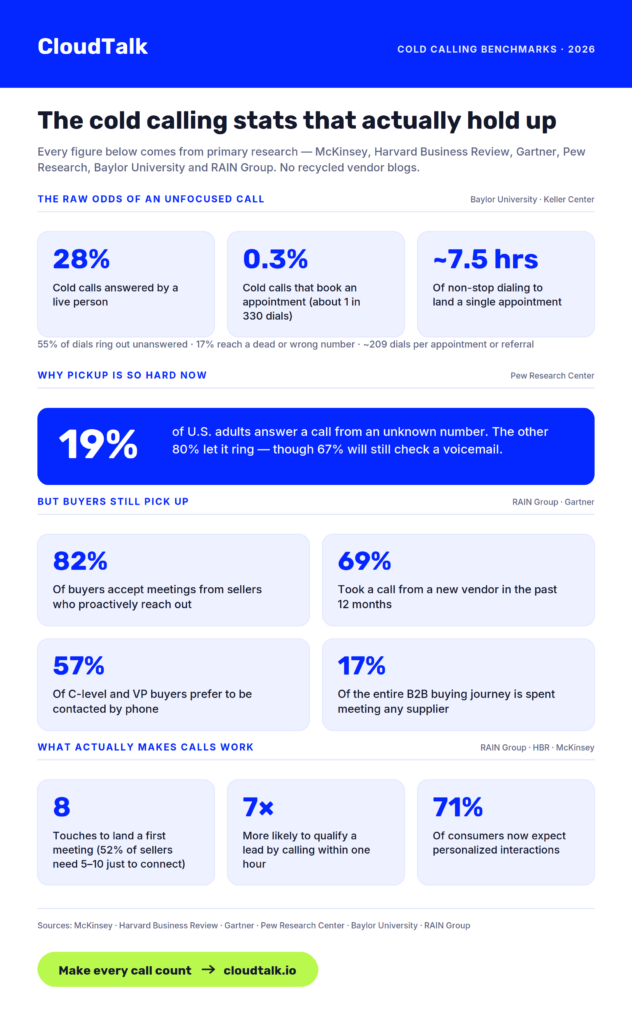
- 01Only 0.3% of cold calls turn into an appointment — roughly 1 in every 330 dials. (Baylor University)
- 02Just 28% of cold calls are answered; 55% go unanswered and 17% reach dead numbers. (Baylor University)
- 0380% of Americans don't answer calls from unknown numbers. (Pew Research Center)
- 04It takes an average of 8 touches to land a first meeting with a new prospect. (RAIN Group)
- 0582% of buyers accept meetings with sellers who proactively reach out. (RAIN Group)
- 0669% of buyers have accepted a call from a new provider in the past 12 months. (RAIN Group)
- 07Call a lead within 1 hour and you're 7x more likely to qualify it than waiting an hour longer. (Harvard Business Review)
- 08B2B buyers spend just 17% of the buying journey with suppliers — every minute on the phone has to count. (Gartner)
- 0971% of consumers expect personalized interactions; 76% are frustrated without them. (McKinsey)
Read on for the full breakdown — success rates, connect rates, follow-up benchmarks, buyer preferences, and what each number means for your 2026 outbound strategy.
Cold calling splits a sales floor in two: the reps who swear by it and the ones who dread it. The data sits somewhere in between. Dial a random list and the odds are brutal — fewer than 1 in 300 calls books a meeting. But reach the right person at the right moment with something relevant to say, and most buyers will still take the call.
The difference isn't the channel. It's the execution. Tools like the Power Dialer and CRM integrations strip out the manual dialing and guesswork so reps spend their time on conversations, not admin. This guide pulls together the cold calling statistics that survive scrutiny — every figure traced to a primary source and linked — so you can benchmark your team against numbers that are actually real.
Turn cold calls into warm conversations.

How We Verified These Cold Calling Statistics
Cold calling is one of the most misquoted topics in sales. A single number gets published once, then copied across hundreds of vendor blogs until nobody can find where it came from. For this guide, we set one rule: every statistic has to trace back to a named primary source — academic research, an analyst firm, or original survey data — not another sales-tool company's blog post.
That means the numbers here come from McKinsey & Company, Harvard Business Review, Gartner, the Pew Research Center, Baylor University's Keller Center for Research, and the RAIN Group Center for Sales Research. Where a widely-repeated "stat" only led back to circular vendor citations, we left it out. Every figure below links to its source so you can check it yourself.
What Is the Average Cold Calling Success Rate?
The most rigorous answer comes from Baylor University's Keller Center for Research, which had 50 real estate agents place 6,264 genuinely cold calls over two weeks and tracked every outcome. The results set a sobering baseline for what raw, unfocused dialing actually delivers.
- Only 28% of cold calls were answered. The rest split into 55% unanswered and 17% non-working numbers. (Baylor University)
- The cold-call-to-appointment rate was just 0.3% — about one appointment for every 330 dials. (Baylor University)
- Counting referrals, it took 209 calls to generate one appointment or referral. (Baylor University)
- That works out to roughly 7.5 hours of dialing for a single appointment when you factor in bad numbers and no-answers. (Baylor University)
Two things to keep in mind before you write off the channel. First, this was an unsegmented, random-list study — the deliberate worst case. Targeted lists and warm research move the numbers significantly. Second, an appointment isn't the only return; cold outreach also surfaces referrals and seeds future opportunities. The lesson isn't "cold calling doesn't work." It's that volume without precision is punishingly inefficient — which is exactly the problem better targeting, data, and dialing technology exist to solve.
Cold Call Connect & Answer Rate Statistics
Before a pitch can land, someone has to pick up — and that's where outbound has gotten harder. The Pew Research Center found that consumers have largely stopped answering numbers they don't recognize.
- 80% of Americans don't generally answer their cellphone when an unknown number calls. (Pew Research Center)
- Only 19% say they typically pick up for a number they don't recognize. (Pew Research Center)
- 67% will let it ring but check the voicemail if one is left — making the voicemail you leave part of the strategy, not an afterthought. (Pew Research Center)
- 14% ignore both the call and any voicemail entirely. (Pew Research Center)
A big share of "cold calling doesn't work" is really "an anonymous number doesn't work." When the recipient can see who's calling and why, pickup rates climb. That's the entire premise behind Branded Caller ID — showing your company name and a reason for the call so you're not just another "Scam Likely" on the screen.
Show up as your brand, not an unknown number.
How Many Calls and Touches It Takes to Get a Meeting
Persistence is the quietest variable in outbound — and the most underrated. Research from the RAIN Group Center for Sales Research, based on 488 B2B buyers and 489 sellers, shows that first contact almost never converts.
- It takes an average of 8 touches to get an initial meeting (or other conversion) with a new prospect. (RAIN Group)
- 52% of sellers say it takes 5 to 10 touches to connect with a new prospect for the first time. (RAIN Group)
- Baylor's data echoes this from the dial side: roughly 209 cold calls per appointment or referral on an unsegmented list. (Baylor University)
The takeaway is consistency, not brute force. A structured cadence that mixes calls with email and social — and tracks every touch — is what separates teams that convert from teams that give up at attempt two. A Power Dialer paired with CRM logging keeps the cadence moving without anyone manually counting touchpoints.
Keep every cadence on track
Cold Call Timing Statistics: Speed Beats Schedule
You'll see endless claims about the "best day" and "best hour" to cold call. The trouble is that almost none trace back to rigorous research — so we've left those out. The timing factor that is backed by hard data is speed: how fast you call a fresh lead.
- Call a lead within an hour and you're nearly 7x more likely to have a meaningful conversation with a decision-maker than if you wait just one hour longer. (Harvard Business Review)
- Wait 24 hours and you're 60x less likely to qualify that lead than a company that responded in the first hour. (Harvard Business Review)
The practical message: respond while intent is hot. Routing inbound interest straight to an available rep with click-to-call beats any theory about Tuesday at 10 a.m. If you do want the day-and-time breakdown, we cover it separately in our guide to the best time to cold call B2B leads.
Do Buyers Still Want Cold Calls? (Is Cold Calling Dead?)
Short answer: no, cold calling isn't dead — but the bar for a worthwhile call has risen. Buyers are open to outreach; they're just unforgiving about calls that waste their time. The RAIN Group research is the clearest evidence that proactive outreach still earns meetings.
- 82% of buyers accept meetings with sellers who proactively reach out to them. (RAIN Group)
- 69% of buyers accepted a phone call from a new provider in the past 12 months. (RAIN Group)
- 71% of buyers want to hear from sellers early, when they're looking for new ideas to drive better results. (RAIN Group)
- 57% of C-level and VP buyers prefer to be contacted by phone — more than directors (51%) or managers (47%). The more senior the buyer, the more the phone matters. (RAIN Group)
- But buyers spend only 17% of the entire buying journey meeting with suppliers — and across multiple vendors, any single rep gets roughly 5–6% of their time. (Gartner)
Put those together and the strategy writes itself: buyers will take your call, but you get one short window to prove relevance. That's why preparation and real-time context — knowing who you're calling and why before they answer — do more for conversion than sheer dial volume. Cold calling still works; lazy cold calling never did.
Cold Calling vs. Email vs. Multi-Channel Outreach
The phone-or-email debate is the wrong frame. The data points to a blend, with each channel doing a different job. RAIN Group asked buyers how the seller actually connected for the last meeting they agreed to.
- 54% of buyers said the seller connected by phone for their most recent agreed-upon meeting, and 58% said email — the two work in tandem, not opposition. (RAIN Group)
- 80% of buyers say they prefer to be contacted by email first — useful for the opening touch before a call. (RAIN Group)
- 82% of buyers look you up on LinkedIn before replying to outreach — your profile is part of the pitch. (RAIN Group)
- Gartner projected 80% of B2B sales interactions would shift to digital channels by 2025 — reinforcing that the phone now lives inside a wider mix. (Gartner)
The highest-performing teams sequence channels deliberately: a warm-up email, a well-timed call, a LinkedIn touch, repeat. Designing that flow once and running it consistently is where tools like CloudTalk's Call Flow Designer and workflow automation earn their keep.
Personalization Statistics: Why Generic Calls Fail
If there's one variable that moves cold calling outcomes more than any other, it's relevance. McKinsey's research on personalization isn't cold-call-specific, but it sets the expectation every buyer now brings to the phone.
- 71% of consumers expect companies to deliver personalized interactions, and 76% get frustrated when they don't. (McKinsey)
- Faster-growing companies drive 40% more of their revenue from personalization than their slower-growing peers. (McKinsey)
- Done well, personalization can lift revenue by 10–15% on average across sectors. (McKinsey)
A buyer who hears a script built for 1,000 people tunes out in seconds. One who hears their company, their problem, and a relevant idea leans in. The fastest way to personalize at scale is to learn from your own calls — what openings land, what objections recur, what language closes. CloudTalk's Call Analytics, Sentiment Analysis, and AI call summaries turn every conversation into coaching data, so reps refine their pitch instead of repeating it.
Cold Calling Benchmarks at a Glance
Every key figure from the research above, in one reference table. Use it to benchmark your own outbound numbers.
Cold Calling Statistics: Benchmark Reference Table
| Metric | Benchmark | Source |
|---|---|---|
| Cold calls answered by a live person | 28% | Baylor University |
| Cold calls that ring out unanswered | 55% | Baylor University |
| Cold calls reaching a dead or wrong number | 17% | Baylor University |
| Cold calls that convert to a booked appointment | 0.3% (≈1 in 330) | Baylor University |
| Dials needed per appointment or referral | ≈209 dials | Baylor University |
| Non-stop dialing time to land one appointment | ≈7.5 hrs | Baylor University |
| U.S. adults who answer calls from unknown numbers | 19% | Pew Research Center |
| Touches (call + email + social) to land a first meeting | 8 | RAIN Group |
| Sellers who need 5–10 touches just to connect | 52% | RAIN Group |
| Buyers who accept meetings from sellers who reach out | 82% | RAIN Group |
| Buyers who took a call from a new vendor in the past year | 69% | RAIN Group |
| C-level and VP buyers who prefer contact by phone | 57% | RAIN Group |
| More likely to qualify a lead by calling within 1 hour | ≈7× | Harvard Business Review |
| Of the B2B buying journey spent meeting any supplier | 17% | Gartner |
| Consumers who expect personalized interactions | 71% | McKinsey |
Recommended: turn this table into an original branded chart graphic. A clean, on-brand visual is the asset most likely to win the SERP image slot and earn backlinks from other sites citing the data — insert it directly below this table.
What These Cold Calling Statistics Mean for 2026
Read together, the data tells a consistent story. Raw dial volume on a random list barely moves the needle — 0.3% of those calls book a meeting, and most numbers never even connect. But buyers haven't abandoned the phone. 82% still accept meetings from sellers who reach out, senior buyers prefer the phone, and a fast, relevant call beats a slow one by a factor of seven.
The winning play in 2026 isn't more dials. It's smarter ones: tighter targeting, faster response, a consistent multi-channel cadence, and genuine personalization powered by what your own calls are telling you. Shift the focus from quantity to precision and the same reps book more meetings with less burnout — which is exactly what CloudTalk's outbound tools are built to make routine.
Make every cold call count.
Sources
- Baylor University, Keller Center for Research — Has Cold Calling Gone Cold?
- Pew Research Center — Most Americans don't answer cellphone calls from unknown numbers
- RAIN Group Center for Sales Research — Top Performance in Sales Prospecting
- Harvard Business Review — The Short Life of Online Sales Leads
- Gartner — The B2B Buying Journey
- McKinsey & Company — The value of getting personalization right—or wrong—is multiplying
Cold Calling Statistics: Frequently Asked Questions
In the most rigorous study available, Baylor University's Keller Center found a cold-call-to-appointment rate of about 0.3% — roughly one appointment per 330 dials on an unsegmented, random list. Including referrals, it took about 209 calls per result. That figure represents the deliberate worst case; targeted lists, warm research, and relevant messaging raise it substantially.
About 28% of cold calls are answered, according to Baylor University's research — with 55% going unanswered and 17% reaching non-working numbers. Connect rates are pressured further by the fact that 80% of Americans don't answer unknown numbers at all (Pew Research Center), which is why caller identity and list quality matter so much.
No. RAIN Group research shows 82% of buyers accept meetings with sellers who proactively reach out, and 69% have accepted a call from a new provider in the past year. Senior buyers (C-level and VP) prefer the phone more than any other group. Cold calling isn't dead — but generic, untargeted calling has very low odds. The channel rewards relevance and persistence.
Baylor University's study found roughly 209 cold calls per appointment or referral on a random list. From the prospect side, RAIN Group reports it takes an average of 8 touches — across calls, email, and social — to land a first meeting, with 52% of sellers needing 5 to 10 touches just to connect. Consistency across a cadence matters more than any single call.
The single most evidence-backed timing factor isn't the day of the week — it's speed. Harvard Business Review research found that contacting a lead within one hour makes you about 7x more likely to have a meaningful conversation than waiting even one hour longer, and 60x more likely than waiting 24 hours. Respond to fresh interest fast, and prioritize reaching the right person over hitting a "magic hour."
Increasingly, only when they recognize the caller. Pew Research Center found 80% of Americans don't generally answer unknown numbers, and just 19% pick up for a number they don't recognize. That said, 67% will check a voicemail if one is left — so a clear voicemail and a recognizable, branded caller ID are now essential to getting through.