How Much Does an Inbound Call Center Cost in 2026? Full Pricing Breakdown
Inbound Call Center Cost: TL;DR
An inbound call center costs roughly $20 to $30 per hour per U.S.-based agent in wages, and because labor can account for up to 95% of total cost, that one number drives almost everything else. Providers bill in one of four ways, and outsourcing or automation can cut the figure sharply. Here is the full inbound call center pricing breakdown.
- 01Labor is the bill. A U.S. agent earns a median of $20.59/hour (BLS); labor is up to 95% of total contact center cost (Gartner).
- 02Four pricing models. Per-minute (pay for talk time), per-agent (hourly, dedicated), per-call (flat per call), or flat monthly (fixed capacity).
- 03Cost per call. A 7-minute call is about $2.40 in agent wages alone; the fully loaded cost typically runs 2 to 3 times higher.
- 04In-house vs. outsourced. One in-house U.S. agent runs about $43,000/year in base pay; outsourcing turns that into a variable per-call or per-minute rate, lowest offshore.
- 05The biggest lever is automation. AI can deflect up to 50% of human-handled calls (McKinsey), the only change that lowers cost per conversation instead of just moving it.
Handle more inbound calls without adding headcount

How Much Does an Inbound Call Center Cost?
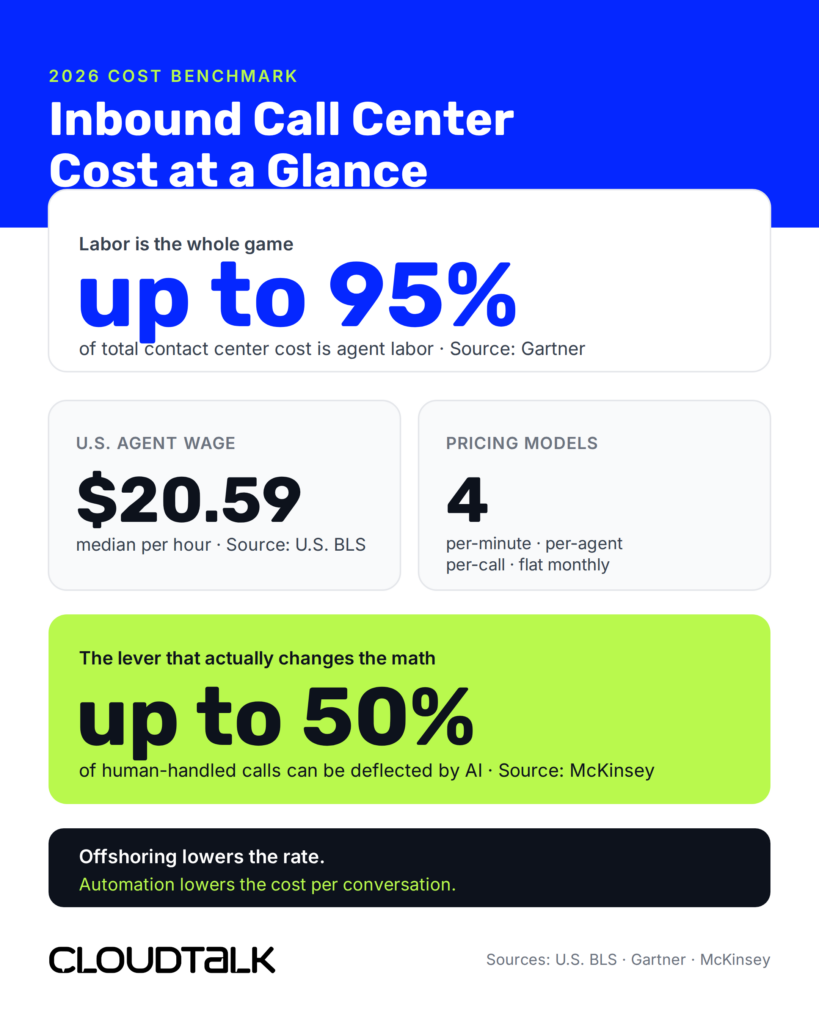
Here is the uncomfortable truth most pricing guides bury: an inbound call center is a people business wearing a technology costume. According to the U.S. Bureau of Labor Statistics, the median customer service representative earns $20.59 an hour, with the top 10% above $30. Gartner puts labor at up to 95% of total contact center costs. So when you compare quotes, you are mostly comparing how a provider packages the same wage bill, plus a margin.
That framing matters because it tells you where the savings actually live. Shaving a few dollars off a software seat barely moves the total. Changing who answers the call, or whether a human answers it at all, moves everything. The ranges below cover wages, software, telecom, and the fees that tend to show up after you sign.
| Cost component | What drives it | Typical range |
|---|---|---|
| Agent wages | Geography, skill level, language; up to 95% of total cost | $20.59/hr U.S. median (BLS); lower offshore |
| Software & phone system | Number of seats, features, AI add-ons | Per user, per month subscription |
| Telecom & numbers | Call volume, minutes, international destinations | Per minute or per number |
| Setup & onboarding | Integrations, configuration, agent training | One-time fee (often waived) |
| Compliance & security | PCI-DSS, HIPAA, GDPR requirements | Audits, encryption, secure infrastructure |
| After-hours & multilingual | 24/7 coverage, rare or native-language agents | Premium on the base rate |
The figures in the "typical range" column for telecom, setup, and outsourcing vary widely by vendor and region; treat them as market ranges, not fixed benchmarks. The two numbers you can trust are the BLS wage and the Gartner labor share, because those are the floor under every quote you will ever receive.
Inbound Call Center Pricing Models Explained
Most inbound call center pricing falls into four models. The right one depends on how predictable your call volume is, not on which looks cheapest on a quote.
- Per-minute pricing — you pay only for time agents spend on calls. Common in shared models where agents cover several companies. Best when volume swings month to month.
- Per-agent (hourly) pricing — also called the dedicated model. Agents work only for you, billed by the hour. More consistent service, higher cost. Anchored to the prevailing wage in the agent's region.
- Per-call pricing — you pay a flat amount per call handled, regardless of length. Predictable if your call mix is stable; expensive if calls run long.
- Flat monthly fee — a fixed package for a set capacity. Simplest to budget, but you pay for unused capacity in slow months.
Software-only platforms add a fifth layer on top of any of these: a per-user monthly subscription for the phone system itself. If you are weighing that route, the call center software cost guide breaks down seat pricing separately from the per-call and per-agent rates covered here.
Shared vs. Dedicated Agents
A shared model splits an agent's time across multiple businesses, which lowers your cost but dilutes brand familiarity; the agent who answers may have taken three other companies' calls that hour. A dedicated model assigns agents to you alone, raising quality and cost together. Per-minute pricing usually pairs with shared agents; per-agent hourly pricing pairs with dedicated ones.
How to Calculate Your Cost Per Inbound Call
You can estimate the cost of a single inbound call from wage data instead of trusting a vendor's headline number. The simplest formula is:
Cost per call = total operating cost over a period ÷ number of calls handled in that period.
For a quick wages-only estimate, divide an agent's hourly cost by the calls they handle per hour. At the BLS median of $20.59 an hour, a seven-minute call costs about $2.40 in wages; an agent handling roughly eight calls an hour costs about $2.57 per call. Then add the parts the wage ignores: overhead, software, telecom, and the idle time between calls. Fully loaded, the real figure typically lands two to three times the wages-only number.
That spread is the whole point. Your true cost per call is set by the agent's hourly rate and how many calls they handle per hour, far more than by any per-minute sticker price. So the two ways to lower it are shortening average handle time and removing calls that never needed a human. To turn your own volume and handle time into a monthly figure, run them through CloudTalk's customer service ROI calculator.
Cloud vs. On-Premise Inbound Call Center Costs
Where your phone system lives changes the shape of the bill, not just the size. An on-premise setup is a capital expense: servers, PBX hardware, IT staff to maintain it, and a long replacement cycle. A cloud phone system is an operating expense: a predictable per-seat subscription, no hardware to buy, and capacity you can add or drop in a day.
| Factor | On-premise | Cloud |
|---|---|---|
| Upfront cost | High: hardware, servers, install | Low to none: sign up and configure |
| Ongoing cost | Maintenance, IT staff, upgrades | Per-seat subscription |
| Scaling | Buy and install more hardware | Add or remove seats on demand |
| Best for | Large, fixed, on-site operations | Most inbound teams, especially growing or remote ones |
For most inbound teams, cloud wins on total cost of ownership because it removes the hardware and IT overhead while keeping the bill predictable. The exceptions are large operations with existing on-site infrastructure and strict on-premise data rules. If you are weighing a move, these benefits of moving your contact center to the cloud cover the trade-offs in detail.
In-House vs. Outsourced Inbound Call Center Costs
Running an inbound team in-house means you carry the full wage bill, plus recruiting, training, software, and management. At the BLS median wage, a single full-time U.S. agent runs roughly $43,000 a year in base pay before benefits and overhead. Outsourcing converts that fixed cost into a usage-based one and hands the hiring headache to someone else.
But cost is no longer the main reason companies outsource. Deloitte's 2024 Global Outsourcing Survey found that access to specialized talent and agility have overtaken cost reduction as the top drivers, a notable shift from prior years when cutting costs led the list. In other words, outsourcing today is a capability decision as much as a budget one.
| Factor | In-house | Outsourced |
|---|---|---|
| Cost structure | Fixed: salaries, benefits, overhead | Variable: per minute, per call, or per agent |
| Upfront investment | High: recruiting, training, infrastructure | Low: provider absorbs setup |
| Control & brand fit | Full control, native brand knowledge | Less control, especially in shared models |
| Scales with volume | Slowly: you must hire and train | Quickly: add capacity on demand |
Onshore vs. Offshore Rates
Geography is the single biggest swing in outsourcing cost, because it is really a swing in wages. Onshore U.S. and Canada agents command the highest rates; offshore destinations like the Philippines and India offer the lowest. The trade-offs are the familiar ones: accent and time-zone alignment, cultural fit, and data-residency rules for regulated industries. Exact per-minute outsourcing rates vary so much by provider and contract that any single number is misleading, so treat published rates as starting points for negotiation, not quotes.
Cost by Team Size: What You Pay Per Seat
Team size changes which cost dominates. For a small business running 1 to 10 agents, the per-seat software subscription and setup are the largest line items, and per-call outsourcing is often the cheapest way to cover overflow without hiring. For mid-sized and larger teams, volume earns discounts on per-minute and per-seat rates, dedicated agents become worthwhile, and automation pays back fastest because it removes labor at scale. The rule of thumb: small teams optimize the per-seat price; large teams optimize the cost per call.
Keep inbound costs predictable as you scale
What Drives Inbound Call Center Costs Up
Beyond the base rate, a handful of factors quietly inflate the bill. Knowing them up front is the difference between a quote and a surprise.
- Call volume — more calls mean more agents, though high volume can earn per-minute discounts.
- Average handle time — longer calls need more agents to cover the same volume. Efficient routing and scripts pull this down.
- After-hours and 24/7 coverage — staffing nights and weekends carries a premium.
- Multilingual support — rare and native-language agents cost more than the base rate.
- Compliance — PCI-DSS, HIPAA, and GDPR add secure infrastructure, audits, and the cost of getting it wrong.
- Agent turnover — high churn means constant recruiting and retraining, a recurring hidden cost most quotes ignore.
- Setup and reporting fees — integration, onboarding, and detailed analytics are sometimes billed on top.
How to Reduce Inbound Call Center Costs
Because labor dominates the bill, the fastest savings come from handling fewer human calls and shorter ones, not from squeezing software vendors. The tactics below are ordered by impact.
- Automate routine calls — the biggest lever. McKinsey estimates generative AI can deflect up to 50% of human-handled contacts and lift customer-care productivity 30 to 45%.
- Cut average handle time — smart call routing, a strong knowledge base, and tight scripts shorten every call.
- Add self-service and callbacks — IVR and callback options deflect simple requests and flatten peak-hour staffing.
- Right-size staffing with forecasting — matching agents to real call patterns cuts both idle time and overtime.
- Consolidate your tools — one platform for calling, analytics, and CRM sync beats paying for three overlapping subscriptions.
- Offshore or nearshore high-volume tiers — move the routine, high-volume queues where brand fit allows, and keep complex calls onshore.
The first tactic is the one that compounds. Gartner projects conversational AI will cut contact center agent labor costs by $80 billion in 2026. When labor is up to 95% of the bill, moving even the simplest calls to AI voice agents changes the math in a way that no per-minute discount can match. For more operational wins, see how to improve call center performance.
How CloudTalk Keeps Inbound Call Center Costs Predictable
CloudTalk prices the part you can control: a flat per-seat subscription from $25/user/month, with no per-minute roulette on inbound calls. You get smart call routing, real-time analytics, CRM integrations, and AI that handles routine inbound calls so your agents spend their time, and your budget, on the conversations that need a human. It is the difference between paying for capacity and paying for outcomes.
Start with a 14-day free trial, no credit card required, or compare tiers on the CloudTalk pricing page.
Join 4,000+ teams running inbound calls on CloudTalk
Sources
- U.S. Bureau of Labor Statistics — Customer Service Representatives, Occupational Outlook Handbook (median hourly wage).
- Gartner — Conversational AI Will Reduce Contact Center Agent Labor Costs by $80 Billion in 2026 (labor up to 95% of contact center costs).
- McKinsey — The economic potential of generative AI (30 to 45% productivity; up to 50% contact deflection).
- Deloitte — 2024 Global Outsourcing Survey (drivers of outsourcing decisions).
FAQs: Inbound Call Center Pricing
Cost is driven mostly by labor, which Gartner puts at up to 95% of the total. A U.S. agent earns a median of $20.59 an hour (BLS), so a single full-time in-house agent runs roughly $43,000 a year in base pay, before software, telecom, and overhead.
At the BLS median wage, a seven-minute call costs about $2.40 in agent wages alone. The fully loaded figure runs two to three times higher once you add overhead, software, and idle time. Your real cost per call depends on the agent's hourly rate and how many calls they handle per hour.
The four common inbound call center pricing models are per-minute, per-agent (hourly), per-call, and flat monthly fee. Software platforms add a per-user subscription on top. Per-minute suits variable volume; flat and per-agent pricing suit predictable, steady call traffic.
Outsourcing usually lowers upfront cost by turning fixed salaries into variable per-call or per-minute fees, and it scales faster. In-house gives you full control and brand fit. Per Deloitte's 2024 survey, companies increasingly outsource for talent and agility, not just cost.
Per-seat usually refers to the monthly software subscription for one agent's access to the phone system, billed per user per month. It is separate from the wage you pay the agent and from any per-minute or per-call outsourcing fees. CloudTalk's per-seat pricing starts at $25/user/month.
The 80/20 rule is a common service-level target: answer 80% of inbound calls within 20 seconds. It affects cost directly, because hitting a tighter service level requires more agents on hand, while a looser target lets you staff leaner and spend less.
For most teams, cloud is cheaper on total cost of ownership: no hardware, no on-site IT, and a predictable per-seat subscription that scales on demand. On-premise can suit large operations with existing infrastructure or strict on-premise data requirements, but it carries high upfront and maintenance costs.
Because labor dominates the bill, the fastest savings come from handling fewer human calls and shorter ones. Automating routine inbound calls with AI is the biggest lever; McKinsey estimates generative AI can deflect up to 50% of human-handled contacts and lift customer-care productivity 30 to 45%.