
TL;DR: 10 Best Twilio Alternatives in 2026
| # | Platform | Best for | Starting Price (annual billing) | G2 Rating |
|---|---|---|---|---|
| 1 | CloudTalk | Scaling sales & support teams (SMB to mid-market) | $19/user/mo | 4.4/5 |
| 2 | Plivo | Best direct API and CPaaS replacement | Pay-as-you-go ($0.0077/SMS) | 4.5/5 |
| 3 | Telnyx | Carrier-grade network control and low AI latency | Pay-as-you-go ($0.004/SMS) | 4.8/5 |
| 4 | Dialpad | Real-time voice AI and internal team collaboration | $15/user/mo | 4.4/5 |
| 5 | Aircall | CRM-centric teams prioritizing a simple interface | $30/user/mo (3-user min) | 4.5/5 |
| 6 | Nextiva | Enterprise-grade UCaaS with a rock-solid stability | $15/user/mo | 4.5/5 |
| 7 | RingCentral | Multi-site corporate enterprises needing UCaaS | $20/user/mo | 4.2/5 |
| 8 | JustCall | Aggressive outbound SMS and high-volume sales | $29/user/mo (2-user min) | 4.3/5 |
| 9 | Ringover | High-performance sales and European-centric teams | $21/user/mo | 4.6/5 |
| 10 | Zoom Phone | Internal video-first corporate collaboration | $10/user/mo (metered) | 4.4/5 |
Skip the reading. See it live.
Why Are Teams Searching for Twilio Alternatives?
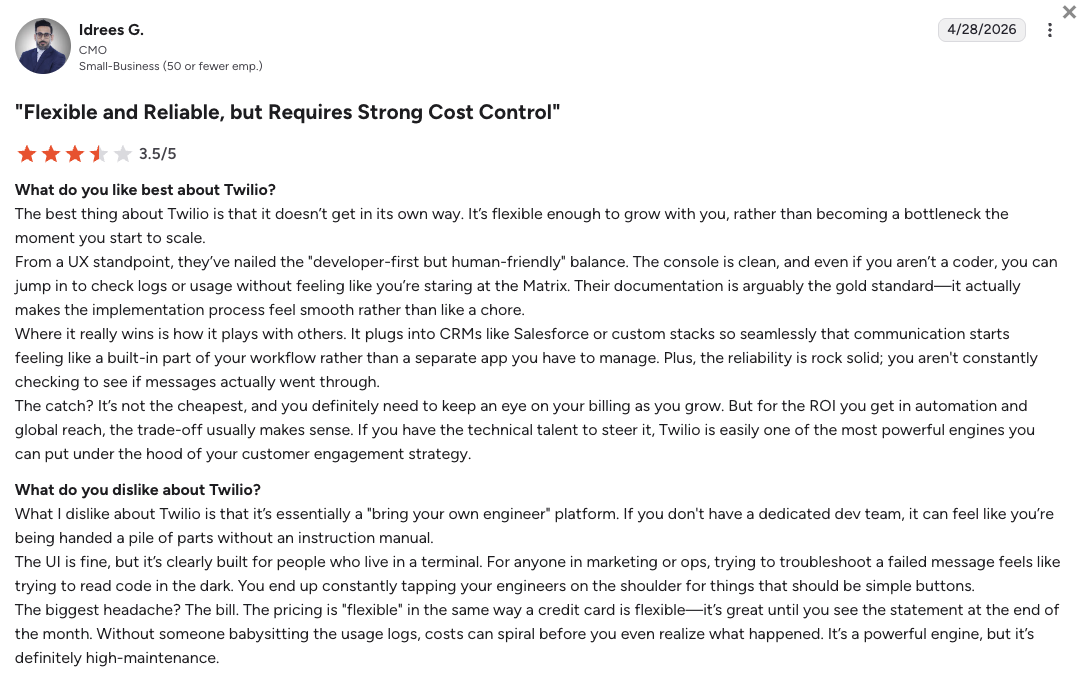
Twilio is a massive CPaaS platform (Communications Platform as a Service) that gives software engineers the raw building blocks to create custom phone and messaging apps. However, as SMB and mid-market sales and support teams scale, they quickly realize that building everything from scratch drains their budget and slows down their daily operations.
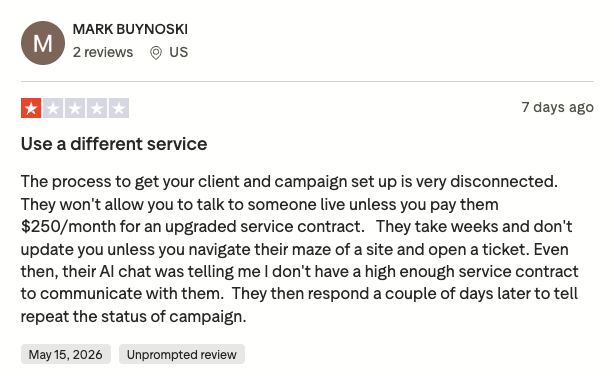
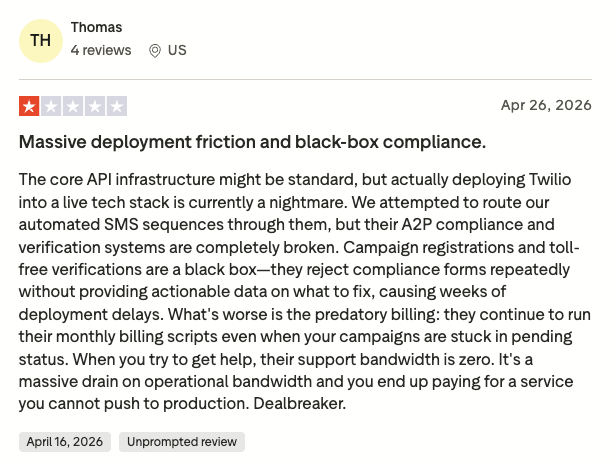
Based on verified G2 reviews (Twilio scores 4.1/5), real user reviews on TrustPilot (Twilio scores a low 1.1/5), and our own deep dive into hands-on communities like Reddit or Quora, teams are actively leaving Twilio due to five major operational roadblocks.
5 Main Cons of Twilio That Make Businesses Look for an Alternative
- The Developer Dependency Trap:Setting up Twilio requires expensive software engineers to write custom code for basic tasks like call routing and CRM logging. This lack of out-of-the-box tools forces simple changes to become slow, costly IT projects.
- Unpredictable UCS-2 Billing Escalations:Twilio’s pay-as-you-go pricing looks cheap until a single emoji in your text message triggers UCS-2 encoding. This instantly slashes your character limit to 70 and silently multiplies the cost of every automated message by up to 500%.
- The A2P 10DLC Compliance Labyrinth:Legitimate businesses frequently find their outbound campaigns paralyzed by Twilio's automated telecom spam vetting process. Users report waiting weeks in operational limbo and dealing with opaque error codes instead of getting clear guidance to launch their numbers.
- "Black Hole" Customer Support:When critical routing breaks down, Twilio users are often trapped in endless automated chatbot loops. Getting actual human assistance requires purchasing an incredibly expensive premium support tier, leaving small businesses stranded during revenue-killing downtime.
- No Native Out-of-the-Box AI:Twilio has the plumbing for artificial intelligence, but you have to manually assemble external components to make it work. Managers cannot simply click a button to get call summaries or sentiment analysis, making it highly inefficient for fast-moving sales floors.
What Is the Best Alternative to Twilio?
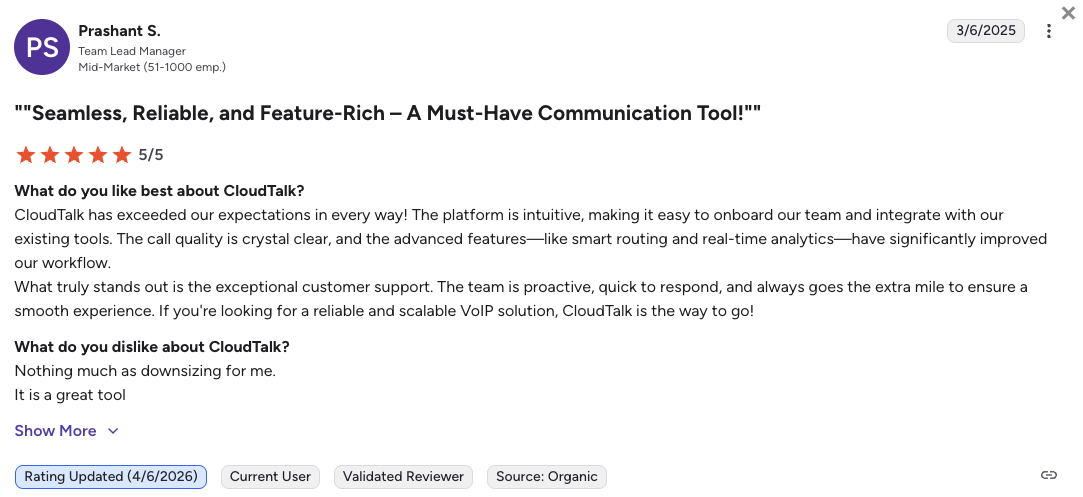
CloudTalk is the best ready-to-use Twilio alternative for scaling sales and support teams that want to stop paying for custom software development. This small-business VoIP platform replaces Twilio’s raw APIs with a fully operational contact center, offering predictable pricing starting at $19/user/month and a 99% uptime guarantee.
Why replace Twilio with CloudTalk to boost your daily productivity? Because you get the power of a global network without needing an engineering degree. Instead of writing custom webhooks, your managers can use an intuitive visual call flow builder, connect natively to your favorite CRMs (starting on the Essential plan), and easily scale up to advanced automated dialers.
Why Teams Consider CloudTalk the Best Twilio Alternative
5 Main Pros of CloudTalk and Why Businesses Switch from Twilio
- Out-of-the-Box Deployment:Skip the expensive software engineers. CloudTalk provides an intuitive, drag-and-drop call flow designer so your operations managers can build complex IVR menus and routing rules in minutes.
- Predictable Flat-Rate Pricing:CloudTalk cures Twilio's unpredictable usage spikes by offering transparent monthly plans that include unlimited domestic calling. You can scale your team confidently without worrying about sudden invoice explosions from unpredictable segment fees.
- Native Bidirectional CRM Sync:Twilio requires custom coding to log calls, but CloudTalk connects directly to your software stack. Native integrations for platforms like HubSpot activate on the Essential plan, while full access to the Salesforce ecosystem unlocks on the Expert tier to automatically log every interaction.
- High-Velocity Dialer Options:You do not need to build your own sales tools from scratch. CloudTalk features built-in click-to-call on all plans, with options to scale into automated Power, Smart, or Parallel dialers natively on our advanced plans or via flexible add-ons.
- Responsive 24/7 Technical Support:CloudTalk completely eliminates the automated chatbot loop by providing round-the-clock chat and email support with rapid resolutions on all plans. Live phone support is also bundled natively into our Expert plan to keep your workflows moving.
How We Tested & Rated The Best Twilio Alternatives and Competitors
To find the absolute best Twilio alternatives for 2026, we analyzed deep market intelligence and unfiltered feedback from developer communities on Reddit, Quora, TrustPilot, and G2. We specifically looked for platforms that solve Twilio’s massive setup costs, billing unpredictability, and frustrating compliance hurdles.
Our research focused on six areas essential for modern business communication:
- Out-of-the-Box Usability: We prioritized platforms that let operational managers set up call routing and menus visually, bypassing the need for dedicated software developers.
- Pricing Predictability: We looked for transparent, flat-rate subscription models that protect businesses from the encoding traps and volatile usage spikes common to pay-as-you-go APIs (however, we ended up including some pay-as-you-go Twilio alternatives too).
- Native CRM Integrations: Our focus was on systems that offer zero-code, two-way syncing with major tools like HubSpot and Salesforce to instantly eliminate manual data entry.
- Built-in Sales Automation: We tested for native inclusions of smart dialing tools, prioritizing platforms that help outbound teams dial faster without requiring custom builds.
- AI Accessibility: We verified platforms that bundle generative AI for real-time transcription and call summaries transparently, rather than treating AI as a complex, money-draining add-on.
- Support Responsiveness: We looked past platforms with automated "black hole" support loops, favoring providers that guarantee 24/7 human assistance without charging premium fees.
The Top 10 Twilio Competitors for 2026
Before we dive into the detailed breakdowns of the top competitors of Twilio, here is a direct look at how our top picks stack up against the legacy CPaaS provider's true entry-level pricing and core capabilities.
Alternatives to Twilio Compared
| Feature | Twilio | CloudTalk | Plivo | Telnyx | Dialpad |
|---|---|---|---|---|---|
| Platform Type | Developer API Toolkit | Ready-to-Use Contact Center | Developer API Toolkit | Raw Network Infrastructure | All-in-One Phone System |
| Starting Price (Annual) | $150/mo (Flex) + Usage (pay-as-you-go) | $19/mo | Pay-as-you-go | Pay-as-you-go | $15/mo |
| Minimum Seats | 1 User | 1 User | No minimum | No minimum | 1 User |
| Setup Requirement | Heavy custom coding | Out-of-the-box visual setup | Custom coding required | Custom coding required | Out-of-the-box software |
| AI Automation | Must be built by developers | Available as a flat-rate add-on | Must be built by developers | Must be built by developers | Included out of the box |
| CRM Sync | Requires custom coding to connect | Built-in (HubSpot on Essential / Salesforce on Expert) | Requires custom coding to connect | Requires custom coding to connect | Gated behind $39 tier |
| Free Trial | Free sandbox available | 14 Days | Free test credits | Free test credits | 14 Days |
The developer dependency trap:
Twilio’s marketing heavily promotes low per-minute rates, but the true cost of ownership hides in the engineering hours required to build and maintain the system. If you want a functional contact center like Twilio Flex, you are looking at a $150/month base cost per user, plus thousands in custom deployment fees. CloudTalk offers a ready-to-use platform with transparent pricing and flat-rate add-ons, allowing your team to start selling immediately without hiring a developer.
1. CloudTalk: The #1 Twilio Alternative for Scaling SMB Sales & Support Teams
What Is CloudTalk?
CloudTalk is an AI-powered contact center platform built specifically for fast-growing sales and customer support teams. While Twilio requires heavy engineering to function, CloudTalk is a ready-to-use business phone system that sits comfortably in the SMB to mid-market space.
Trusted by 4,000+ businesses worldwide, CloudTalk delivers enterprise-grade calling and workflow automation straight out of the box, letting your team focus on closing deals rather than writing code.
Why Is CloudTalk a Strong Twilio Alternative?
- Out-of-the-box Deployment: Bypass the developer trap completely. Your managers can build IVR menus and set up routing rules in minutes using a simple drag-and-drop visual builder. No IT tickets required.
- Predictable Flat-Rate Pricing: Stop worrying about hidden UCS-2 encoding fees and per-minute billing spikes. CloudTalk bundles your essential features into transparent monthly plans, keeping your costs entirely predictable as your team grows.
- Native CRM Integrations: Stop paying developers to build custom webhooks. CloudTalk automatically logs calls and texts directly into your tools. HubSpot syncs instantly on our Essential plan, while the Salesforce ecosystem unlocks on Expert to end manual data entry.
- Guided SMS Compliance: Skip Twilio's automated A2P 10DLC rejection loops. Our team guides you hands-on through U.S. carrier registrations, ensuring your texting campaigns launch smoothly without getting stuck in bureaucratic limbo.
- Built-In Sales Automation & AI: Twilio forces you to stitch together APIs just to get a dialer or call transcripts. CloudTalk gives your reps the tools to sell smarter on day one, offering built-in click-to-call, scalable auto-dialers, and flat-rate Conversation Intelligence or AI Voice Agent add-ons.
- Top-Rated Support by G2: Never get stuck in an automated chatbot queue when your phones go down. CloudTalk provides highly responsive, 24/7 human support. Recognized as a G2 Spring 2026 Leader, CloudTalk easily beats Twilio in categories like "Quality of Support" and "Ease of Setup."
What Are the Pros & Cons of CloudTalk?
| Pros | Cons |
|---|---|
| Proprietary Multi-Carrier Network: Bypasses traditional telecom bottlenecks to ensure crystal-clear audio globally. | No native video meetings: Requires a separate app like Zoom or Google Meet to handle video conferencing. |
| Native Deep-Sync Integrations: Flawless, two-way data syncing with major CRMs right out of the box. | Base plan limits: The entry-level Lite plan restricts certain features primarily to the NA & LATAM regions. |
| Flat-Rate Predictable Pricing: Eliminates surprise invoices by moving away from pay-as-you-go segment billing. | Parallel Dialing Add-on: Calling multiple numbers at the exact same time requires a paid Parallel Dialer add-on. |
| Advanced Dialer Options: Access Smart, Preview, and Power dialers natively on the Expert plan, or speed up your outreach with Parallel dialing. | |
| Flat-Rate Predictable Pricing: Eliminates surprise invoices by moving away from pay-as-you-go segment billing. |
What Are CloudTalk's Plans & Pricing?
CloudTalk pricing starts at $19/user/month, and the platform offers the following plans:
- Lite - $19/user/month
- Starter - $25/user/month
- Essential - $29/user/month
- Expert - $49/user/month
- Custom - Quote-based pricing, ideal for enterprises
What Are CloudTalk Customers Saying?
Customers migrating from legacy CPaaS platforms frequently highlight CloudTalk's massive relief on their IT budget and how quickly their sales floors see an impact.
- Zero Developer Friction: Operations managers love that they can finally adjust call flows and buy international numbers very quickly without waiting on a software engineer.
- Seamless Salesforce Sync: Revenue teams constantly praise the native deep-sync, noting that their reps get hours back every week because call notes and recordings log automatically.
- Analytics Learning Curve: Some newer users mention that customizing the advanced analytics dashboards takes a bit of a learning curve to get exactly the right reporting view.
How G2 Users Rate CloudTalk?
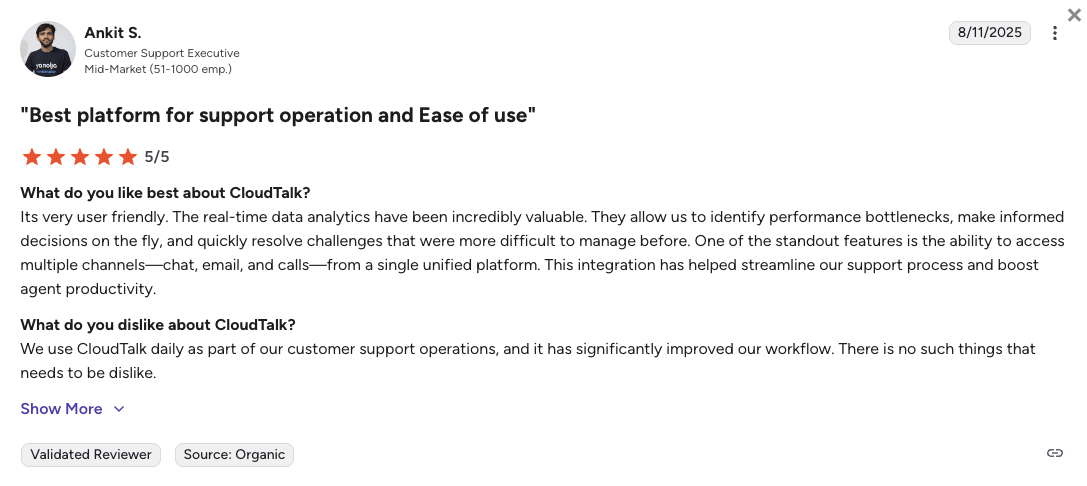
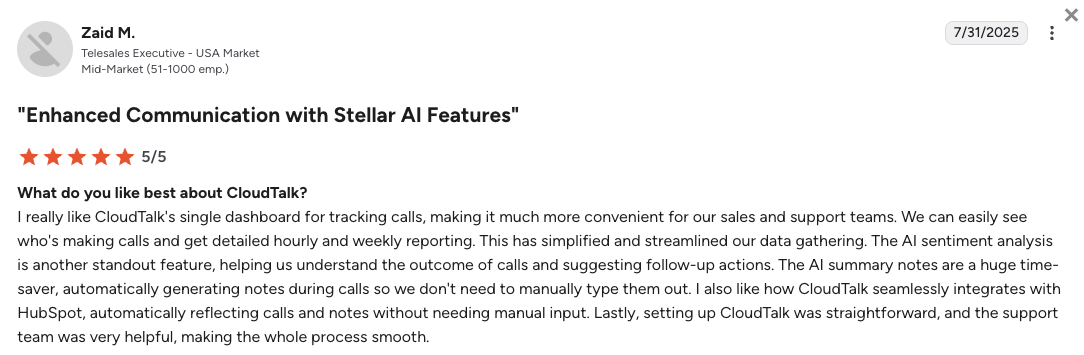
CloudTalk's current G2 rating is 4.4/5, out of 1,800+ verified user reviews.
Ready for a business phone system that just works?
2. Plivo: Best Direct API and CPaaS Replacement
What is Plivo?
Plivo is a raw CPaaS platform that acts as a direct, 1:1 API replacement for Twilio. It is engineered specifically for software development teams that want to keep building highly customized applications but desperately need to escape Twilio's inflated costs and unresponsive customer support.
Why Is Plivo a Strong Twilio Alternative?
- Aggressively Cheaper Raw Rates: Plivo systematically undercuts Twilio's pricing across voice transit and SMS. This immediately resolves the massive, unpredictable billing spikes high-volume texting teams face on Twilio.
- Highly Responsive Developer Support: Plivo cures Twilio's "black hole" support problem by offering a dedicated, fast-acting technical support team that actually helps engineers troubleshoot code rather than bouncing them to a chatbot.
- Frictionless Migration: Plivo offers near-perfect feature parity with Twilio's core APIs, meaning your developers can swap out the backend code in days, rather than spending months rebuilding from scratch.
What Are the Pros & Cons of Plivo?
| Pros | Cons |
|---|---|
| Highly aggressive pricing: Outbound US SMS starts at $0.0077, noticeably undercutting Twilio's standard operational costs | Requires coding skills: Just like Twilio, this is not a ready-to-use software; you must have developers to build the interface. |
| Premium carrier network: Direct connections lead to higher global SMS deliverability rates. | Smaller app ecosystem: Lacks the sprawling, multi-year third-party app marketplace that Twilio has established. |
| Excellent developer support: Highly rated human technical assistance for troubleshooting complex API issues. | No out-of-the-box CRM dashboards: Managers cannot log in and review call metrics without building the dashboard first. |
What Are Plivo’s Plans & Pricing?
Plivo pricing works strictly on a pay-as-you-go usage model. Here are the base outbound rates for the US market.
- Outbound SMS: Starting at $0.0077 per message.
- Outbound Voice: Starting roughly at $0.012 per minute.
The true cost of CPaaS:
Like Twilio, Plivo doesn’t charge per-user seat licenses. You only pay for the messages and minutes you actually use. While this looks incredibly cheap on paper, you must factor your software engineering payroll into your monthly budget, as you still need developers to build and maintain the interface.
What Are Plivo Customers Saying?
Developers actively seek out Plivo when they are fed up with Twilio's billing, and they generally find exactly what they are looking for: a cheaper, faster pipe.
- Massive Cost Savings: Engineering teams report immediate 30-40% reductions in their monthly telecom invoices simply by routing their existing traffic through Plivo.
- Helpful Support Team: Users frequently commend the technical support staff for actively helping them navigate the frustrating A2P 10DLC compliance vetting process.
- Feature Lags: Some advanced engineers note that while the core APIs are rock solid, Plivo occasionally lags behind Twilio in rolling out highly experimental beta features.
How G2 Users Rate Plivo?
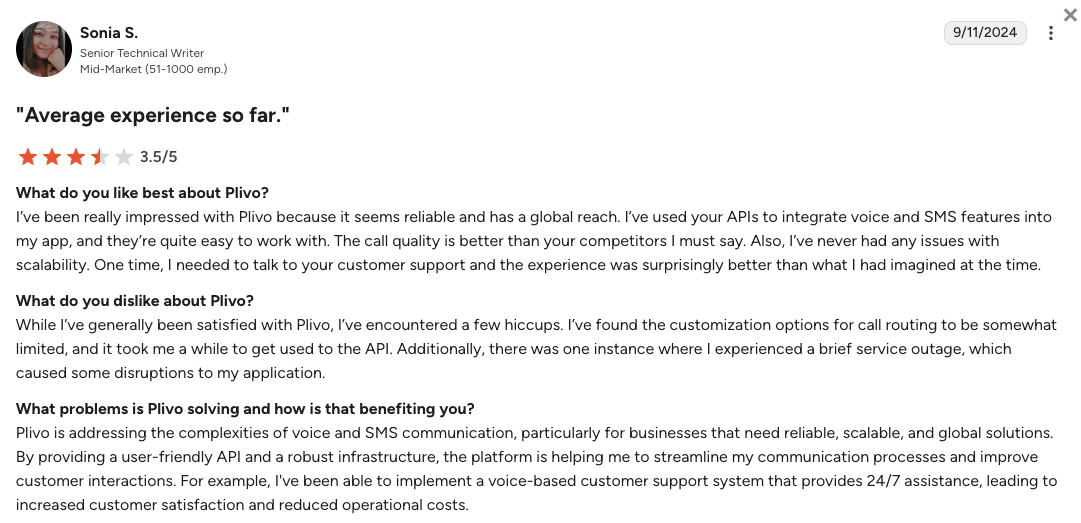
Plivo’s current G2 rating is 4.5/5, out of 700+ verified user reviews.
3. Telnyx: Best for Carrier-Grade Network Control and AI Latency
What is Telnyx?
Telnyx is a robust CPaaS provider that bypasses standard cloud aggregators by operating its own private, global IP network. Telnyx represents the ultimate playground for advanced technical teams and AI developers who need absolute, low-level control over their telecom routing and incredibly fast audio connections.
Why Is Telnyx a Strong Twilio Alternative?
- Sub-200ms Latency for AI: Twilio's standard routing introduces slight delays ("turn-gaps") that make conversational AI sound robotic. Telnyx's direct-to-carrier network shaves critical milliseconds off the round-trip, making AI voice agents sound entirely human.
- Ultra-Low SMS Pricing: Twilio charges a premium ($0.0079 per inbound text) when customers reply to you. Telnyx drastically lowers the barrier for two-way conversational applications by charging a highly aggressive $0.004 rate for both outbound and inbound SMS, effectively cutting Twilio texting bills in half.
- Direct Network Pricing: Because Telnyx owns the physical network infrastructure, they do not have to pass middleman fees onto you. This yields some of the absolute lowest outbound SMS and voice rates on the market.
What Are the Pros & Cons of Telnyx?
| Pros | Cons |
|---|---|
| Lowest outbound SMS rates: Outbound texts start at just $0.004, completely undercutting standard CPaaS providers. | Purely backend infrastructure: No human-facing dashboards or softphones; everything must be coded. |
| Symmetrical $0.004 SMS pricing: Extremely cheap inbound and outbound rates make two-way conversational bots financially viable. | DIY compliance: Developers must manually configure and code their own TCPA and A2P 10DLC logic. |
| Private IP network: Ensures exceptional voice quality and ultra-low latency for AI streaming. | Less polished developer portal: The backend management interface is functional but lacks the sleek design of its rivals. |
What Are Telnyx’s Plans & Pricing?
Like Plivo, Telnyx uses a strict pay-as-you-go pricing model. Here are the base rates for the US market.
- Outbound SMS: Starting at $0.004 per message.
- Inbound SMS: Starting at $0.004 per message.
- Outbound Voice: Starting at $0.005 per minute.
The compliance burden:
While the raw messaging is incredibly cheap, keep in mind that Telnyx requires your engineers to manage the heavy lifting of telecom compliance internally, which can slow down campaign launches.
What Are Telnyx Customers Saying?
Telnyx users are deeply technical, and they heavily praise the platform's raw network performance and cost efficiency.
- Unmatched Audio Speed: AI developers consistently highlight Telnyx as the only reliable network for building real-time voice bots that don't suffer from awkward conversational pauses.
- Great Pricing Structure: Users building massive SMS marketing tools love the ultra-low inbound messaging rates, noting it finally makes two-way SMS bots financially viable at scale.
- Tough for Beginners: Non-developers warn that the platform is extremely unforgiving if you do not have a deep understanding of SIP trunking and API orchestration.
How G2 Users Rate Telnyx?
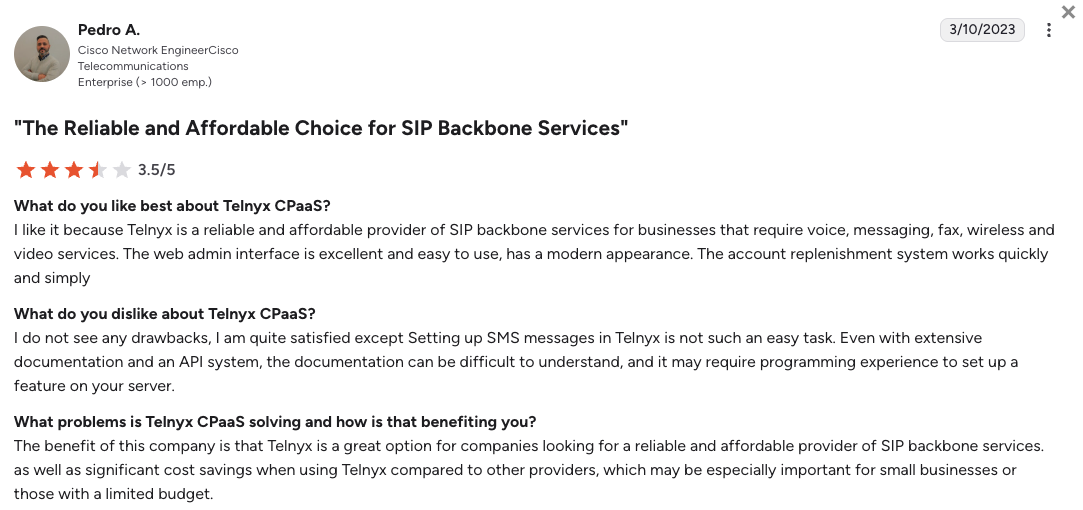
Telnyx’s current G2 rating is 4.7/5, out of 500+ verified user reviews.
4. Dialpad: Best for Real-Time Voice AI and Internal Collaboration
What Is Dialpad?
Dialpad is a modern UCaaS (Unified Communications as a Service) platform that is built on a proprietary artificial intelligence architecture. Dialpad is designed for tech-forward, remote-first teams that want live AI coaching on their sales calls and want to consolidate their internal team chat and external phone system into one app.
Why Is Dialpad a Strong Twilio Alternative?
- Native AI, Zero Coding: Twilio forces developers to manually stitch together third-party APIs (like OpenAI) to get call transcriptions. Dialpad features a native Voice Intelligence (Vi) engine that transcribes calls and generates summaries instantly with zero setup.
- Unified Workspace: Dialpad cures the fragmentation of using Twilio for external calls and Slack for internal chat. It brings voice, video, and team messaging perfectly into a single, cohesive application.
- Immediate Deployment: Sales floors can download the app and start getting real-time battlecards popping up on their screens during calls immediately, entirely bypassing the multi-week Twilio Flex setup timeline.
What Are the Pros & Cons of Dialpad?
| Pros | Cons |
|---|---|
| Real-time Vi Engine: Live transcription and automated post-call summaries happen natively with zero coding. | Fragmented product pricing: You have to buy separate products (Connect vs. Sell) to get basic internal calls versus outbound sales tools. |
| Unified app experience: Combines external phone calls, internal team chat, and video seamlessly. | Severe CRM feature gating: Deep Salesforce integrations require extremely expensive tier upgrades. |
| Low entry point: The base communication plan is highly affordable for small, tech-savvy teams. | Capped international plans: "Unlimited" global calling plans are strictly capped at 1,500 minutes per month. |
What Are Dialpad’s Plans & Pricing?
Dialpad pricing starts at $15/user/month (billed annually), with the following plans:
- Standard - $15/user/month
- Pro - $25/user/month
- Essentials - $39/user/month
- Advanced - $95/agent/month (ideal for contact centers)
The "Sell" product trap:
If you run an outbound sales team and need a power dialer or Salesforce integration, the $15 Connect plan won't work. You are forced to buy the separate Dialpad Sell product, which pushes costs closer to $39 or even $95/month to unlock the live AI coaching.
What Are Dialpad Customers Saying?
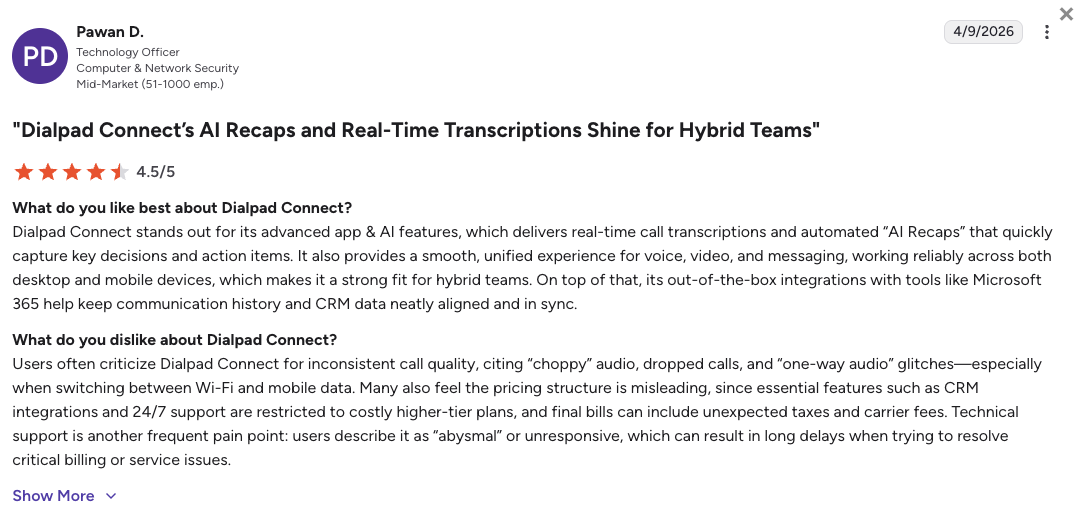
Dialpad customers love the futuristic feel of the live AI, but often run into walls when trying to scale their global reach or upgrade their basic CRM workflows.
- Handy Live Transcripts: Dialpad users enjoy the accuracy of the AI transcriptions and how helpful the live pop-up battlecards are when handling tough sales objections.
- Clean Desktop App: Remote teams love that they only need to open one app all day to chat with coworkers and call clients.
- Expensive Sales Upgrades: Reviewers frequently express frustration that unlocking the actual sales-focused tools requires a massive jump in their monthly software budget.
How G2 Users Rate Dialpad?
Dialpad’s current G2 rating is 4.4/5, out of 4,000+ verified user reviews.
5. Aircall: Best for CRM-Centric Teams Prioritizing a Simple Interface
What Is Aircall?
Aircall is an integration-first business softphone known for its sleek, minimalist design and massive third-party app marketplace. Unlike Twilio, Aircall completely rejects the heavy telecom engineering model, making it a favorite for modern support and sales teams that live entirely inside Salesforce or Zendesk and just want a phone system that plugs in instantly.
Why Is Aircall a Strong Twilio Alternative?
- Zero IT Setup: Aircall replaces Twilio’s complex webhook configurations with one-click app installations. You simply connect your CRM from their marketplace, and your team is ready to dial in an hour.
- No Developer Dependency: The interface is so intuitive that non-technical operations managers can easily buy numbers, set business hours, and build routing trees without ever speaking to an engineer.
- Rapid Team Onboarding: Because the interface mimics familiar, simple mobile apps, new sales hires require almost zero training to understand how to make calls and log notes.
What Are the Pros & Cons of Aircall?
| Pros | Cons |
|---|---|
| Massive integration ecosystem: Connects flawlessly to almost any modern SaaS tool out of the box. | Strict seat minimums: The $30 base price requires at least 3 users, making the true entry cost $90/month. |
| Highly intuitive UI: Beautiful, clean app design that removes all the clutter of legacy telecom dashboards. | Performance issues under load: Users frequently report the desktop app freezing or crashing during high call volumes. |
| Fast onboarding: Teams can deploy the entire phone system and train their staff in a single afternoon. | Unclear billing & slow support: Users consistently cite unresponsive customer service and frustrating retention practices. |
What Are Aircall’s Plans & Pricing?
Aircall pricing starts at $30/user/month (billed annually, 3-user minimum), with the following plans:
- Essentials - $30/user/month
- Professional - $50/user/month
- Custom - Quote-based pricing
The multi-seat hurdle:
Aircall completely locks out solo founders and micro-teams by strictly enforcing a 3-user minimum on all plans. If you want essential sales features like the power dialer, you must buy the $50 tier, pushing your minimum monthly spend to $150.
What Are Aircall Customers Saying?
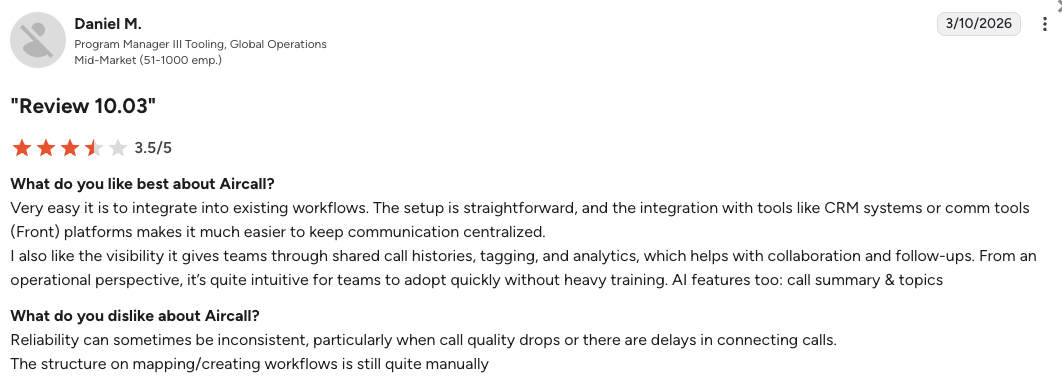
Aircall users love how easy the platform makes their daily life inside their CRM, but heavily critique the platform's stability and backend administrative support.
- Great CRM Workflows: Teams love that screen pops happen instantly in HubSpot, saving reps from having to search for client records manually.
- Incredibly Easy to Use: Managers highlight how quickly they can spin up new virtual phone numbers for temporary marketing campaigns.
- Frustrating Support & Billing: A significant number of reviewers complain about unresponsive customer service, unexpected charges, and aggressive retention tactics when trying to resolve issues.
How G2 Users Rate Aircall?
Aircall's current G2 rating is 4.4/5, out of 1,500+ verified user reviews.
6. Nextiva: Best for Traditional Businesses Prioritizing Rock-Solid Network Uptime
What Is Nextiva?
Nextiva is a highly reliable enterprise UCaaS platform that caters specifically to traditional businesses and support centers that demand absolute network stability. The platform is the perfect choice for companies that want a fully managed communication suite without having to touch a single line of code themselves. If you are searching for a cheaper alternative to Twilio that focuses purely on rock-solid calls, Nextiva is a top pick.
Why Is Nextiva a Strong Twilio Alternative?
- White-Glove Onboarding: Nextiva completely cures Twilio's developer dependency by having their own internal staff do the heavy lifting. They actively assist you in setting up your IVR and routing architecture.
- Accessible Human Support: It solves Twilio's "black hole" crisis by ensuring you can actually get a human on the phone. While their day-to-day ticket resolution can sometimes be slow, you won't be trapped in a developer's chatbot loop when critical routing breaks.
- Predictable, Bundled Usage: Nextiva protects businesses from Twilio’s hidden SMS encoding fees by bundling generous domestic calling and texting allowances straight into their transparent monthly subscriptions.
What Are the Pros & Cons of Nextiva?
| Pros | Cons |
|---|---|
| Flawless network stability: Offers a 99.999% uptime guarantee for enterprise-grade reliability. | Inconsistent ongoing support: Users report long wait times for tier-1 technical help and aggressive retention tactics if you try to cancel. |
| White-glove onboarding: Highly rated implementation teams that actively assist you in setting up your initial routing. | Lacks aggressive sales automation: Does not natively include the high-velocity power dialers needed for cold calling floors. |
| Included SMS limits: Generous text message bundling prevents the sudden mid-month invoice spikes common to API setups. | Costly advanced features: Unlocking true contact center routing requires a massive jump to their highest pricing tiers. |
What Are Nextiva’s Plans & Pricing?
Nextiva pricing starts at $15/user/month (billed annually), with the following main plans:
- Core - $15/user/month
- Engage - $25/user/month
- Scale - $75/user/month
- Professional - Quote-based (Enterprise plans)
Contact center upgrades:
While the base $15 tier is great for standard office phones, teams needing advanced call queues, deep CRM integrations, and detailed analytics will be pushed toward the $75 Scale plan and a bunch of add-ons.
What Are Nextiva Customers Saying?
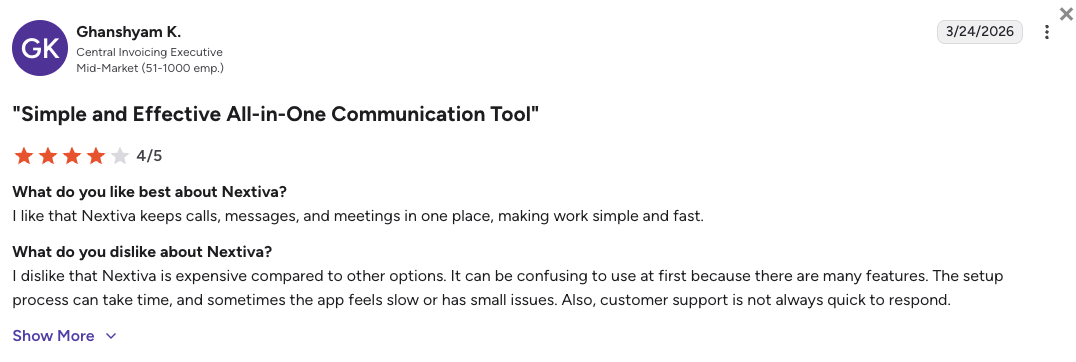
Nextiva users value the peace of mind that comes with a rock-solid network and hands-on implementation, though some warn about post-launch growing pains.
- Incredible Uptime: IT managers constantly praise the platform for never dropping calls and always sounding crystal clear.
- Great Initial Setup: Reviewers frequently shout out the implementation staff for being patient and highly capable during the complex initial rollout.
- Support and Billing Friction: A significant number of IT administrators complain that once onboarding is over, day-to-day support is slow, and navigating their rigid, auto-renewing contracts is incredibly frustrating.
How G2 Users Rate Nextiva?
Nextiva’s current G2 rating is 4.5/5, out of 3,400+ verified user reviews.
7. RingCentral: Best for Multi-Site Corporate Enterprises Needing UCaaS
What Is RingCentral?
RingCentral (specifically their RingEX product) is a massive, legacy UCaaS platform that helps consolidate complex corporate communications. If you are a multinational enterprise trying to replace your desk phones, video conferencing software, internal team chat, and digital fax machines all at once, RingCentral is the heavyweight built for the job. For huge firms seeking Twilio flex alternatives, RingCentral provides everything in one box.
Why Is RingCentral a Strong Twilio Alternative?
- Out-of-the-Box Corporate Consolidation: While Twilio requires you to build a unified system, RingCentral provides one instantly. It seamlessly wraps voice, video, and messaging into one app tailored for massive global workforces.
- Deep Compliance Leadership: RingCentral cures the compliance headaches of custom APIs by offering native, out-of-the-box security protocols (like HIPAA and SOC 2) required by heavily regulated finance and healthcare sectors.
- Enterprise-Grade Network: Unlike custom Twilio setups that might suffer if poorly coded, RingCentral operates on a highly stable, patented global voice network that practically guarantees call delivery.
What Are the Pros & Cons of RingCentral?
| Pros | Cons |
|---|---|
| Ultimate enterprise features: Consolidates voice, video, chat, webinars, and fax into a single corporate hub. | Extremely bloated interface: The admin portal is notoriously difficult to navigate and often requires certified IT staff. |
| Elite reliability: Backed by a globally redundant network that easily handles thousands of concurrent users. | Expensive AI and Contact Center add-ons: True sales tools and AI routing require highly expensive premium upgrades. |
| Advanced compliance: Ready-to-use security protocols that keep heavily regulated industries safe. | Slow support resolution: Users report that getting help involves being bounced between various offshore departments. |
What Are RingCentral’s Plans & Pricing?
RingCentral pricing starts at $20/user/month (billed annually), with the following plans:
- Core - $20/user/month
- Advanced - $25/user/month
- Ultra - $35/user/month
The call center ToC:
RingCentral's $20 base plan is just for internal office phones. If you want the features of a true contact center (like deep CRM syncing and advanced call queues), you have to purchase their separate RingCX product, which pushes costs significantly higher.
What Are RingCentral Customers Saying?
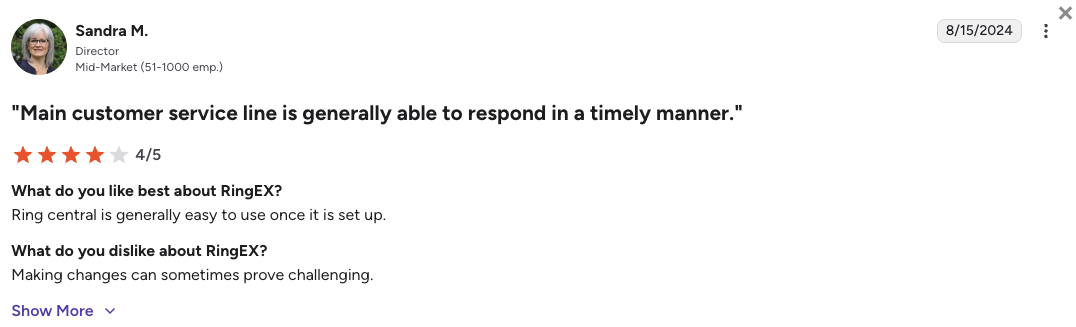
RingCentral users appreciate the sheer scale of what the platform can do, but frequently complain about how hard it is to manage on a daily basis.
- Everything in One Place: Corporate directors love that they can cancel their Zoom and Slack subscriptions because RingCentral handles it all.
- Incredible Scale: IT teams appreciate that the system doesn't break down even when rolling it out to thousands of employees across the globe.
- Administrative Nightmare: Managers constantly complain that simply trying to change a ring group or update a user profile takes ten minutes of digging through confusing settings.
How G2 Users Rate RingCentral?
RingCentral’s current G2 rating for their RingEX suite is 4.2/5, out of 1,350+ verified user reviews.
8. JustCall: Best for Aggressive Outbound SMS and High-Volume Sales
What Is JustCall?
JustCall is a specialized cloud-based phone system designed almost exclusively for high-velocity outbound sales floors. It completely skips internal corporate features to focus purely on providing aggressive auto dialers and heavy, automated SMS marketing sequences designed to burn through large lead lists.
Why Is JustCall a Strong Twilio Alternative?
- No-Code SMS Workflows: If you need a reliable Twilio alternative for SMS, JustCall fixes the developer trap. It offers visual builders that let sales managers create multi-step SMS drip campaigns and bot replies without writing any code.
- Bundled Messaging Costs: JustCall protects high-volume teams from Twilio's UCS-2 segment billing traps by bundling your monthly text message allowances into your flat-rate subscription fee. This makes it an amazing Twilio SMS alternative for budgeting.
- Native Outbound Dialers: Instead of building a dialer from Twilio's raw APIs, JustCall natively includes predictive and power dialers that ensure your reps spend their time talking, not listening to dial tones.
What Are the Pros & Cons of JustCall?
| Pros | Cons |
|---|---|
| Powerful SMS automation: Easily build automated text drips and bot responses natively inside the app. | Strict 2-user minimum: The advertised starting price is a bit misleading, meaning solo operators are completely priced out. |
| Excellent outbound dialers: Keeps high-volume sales reps on the line with live prospects constantly. | Hidden minute caps: Calling is frequently hard-capped at 1,000 minutes per user, leading to overage fees. |
| Deep CRM syncs: Connects seamlessly with over 100 CRMs to ensure high-speed dialing logs accurately. | Expensive feature gating: The crucial Power Dialer is completely locked behind the much more expensive Pro tier. |
What Are JustCall’s Plans & Pricing?
JustCall pricing starts at $29/user/month (billed annually, 2-user minimum), with the following plans:
- Team - $29/user/month
- Pro - $49/user/month
- Pro Plus - $89/user/month
- Business - Custom quote-based pricing
The power dialer paywall:
If you are choosing JustCall for its dialing speed, know that the $29 Team plan doesn't include the Power Dialer or the direct Salesforce integration. You must buy the $49 Pro tier, which (with the minimum seat rule) means your starting cost is $98/month.
What Are JustCall Customers Saying?
JustCall users praise the platform's sheer outbound velocity, but heavily criticize the hidden usage limits that punish teams as they scale.
- High Dialing Speed: Sales reps love the predictive dialer, noting it easily doubles the amount of live conversations they have each day.
- Great Automation: Marketing managers appreciate how simple it is to set up automated text follow-ups without needing IT help.
- Frustrating Usage Limits: Users frequently complain that the "unlimited" plans actually have strict minute caps, and AI transcription is severely restricted to just 60 minutes per user.
How G2 Users Rate JustCall?
JustCall's current G2 rating is 4.3/5, out of 2,300+ verified user reviews.
9. Ringover: Best for High-Performance Sales and European-Centric Teams
What Is Ringover?
Ringover is a European VoIP provider that merges standard cloud telephony with the aggressive, multi-channel cadences usually found in dedicated sales engagement platforms. The platform is built specifically for mid-market prospecting teams and recruitment agencies looking for Twilio alternatives in Europe that handle voice, email, and social media from one dashboard.
Why Is Ringover a Strong Twilio Alternative?
- Out-of-the-Box Cadences: Twilio requires custom coding to sequence an email, an SMS, and a phone call together. Ringover’s native "Cadence" tool lets reps build these multi-channel outreach flows instantly with zero development.
- Flat-Rate International Calling: Ringover removes the unpredictability of Twilio's per-minute routing fees by guaranteeing unlimited calling to over 110 countries at a fixed monthly price.
- Quick Admin Deployment: It cures the Twilio Flex setup nightmare, allowing non-technical managers to buy local European numbers, configure live agent whispering, and launch their sales floor in minutes.
What Are the Pros & Cons of Ringover?
| Pros | Cons |
|---|---|
| All-in-one cadence tool: Unifies voice, SMS, email, and LinkedIn messaging into highly effective sales sequences. | Entry plan flaw: The base tier lacks European local numbers and heavily restricts international SMS. |
| Unlimited global calling: Fixed-rate pricing to 110+ destinations completely removes international billing anxiety. | Extremely expensive add-ons: Fully equipping a user with AI and the Cadence tool pushes costs over $400/month. |
| Great live coaching: Managers can seamlessly monitor calls, whisper to reps, or take over conversations in real time. | Occasional CRM data drops: Users note that the CRM syncing is not as bulletproof as true deep-sync leaders. |
What Are Ringover’s Plans & Pricing?
Ringover pricing starts at $21/user/month (billed annually), with the following plans:
- Smart - $21/user/month
- Business - $44/user/month
- Advanced - $54/user/month
The misleading entry price:
Ringover's base price is a bit misleading. To unlock the platform's true value, you must purchase the Cadence tool (+$69/mo) and the Empower AI suite (+$69/mo). A fully equipped sales seat quickly becomes one of the most expensive options on the market.
What Are Ringover Customers Saying?
Ringover users love having a unified prospecting dashboard, but frequently mention that getting all the features they want strains their software budget.
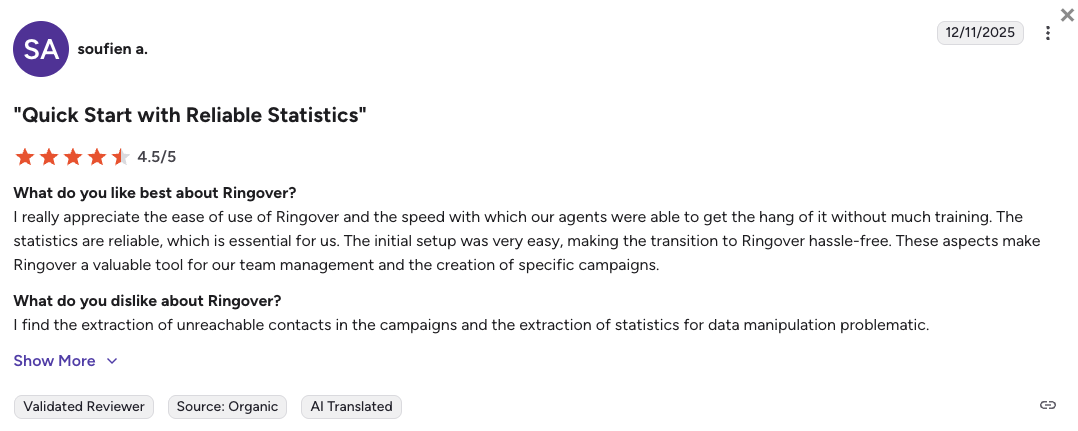
- Amazing Sales Sequencing: Reps love that they don't have to switch between their email client, LinkedIn, and phone app to run a cold outreach campaign.
- Easy to Manage: Operations leaders appreciate how quickly they can train new hires on the clean interface.
- Add-On Fatigue: Customers consistently express frustration that every cool feature, from basic WhatsApp messaging to AI tools, is locked behind a huge paywall.
How G2 Users Rate Ringover?
Ringover's current G2 rating is 4.6/5, out of 450+ verified user reviews.
10. Zoom Phone: Best for Internal Video-First Corporate Collaboration
What Is Zoom Phone?
Zoom Phone is an incredibly low-friction cloud PBX replacement built directly into Zoom, the video conferencing software most companies already use. Zoom Phone is explicitly designed for internal corporate departments and administrative staff who prioritize intra-office collaboration over outbound sales metrics. If you need a basic Twilio video competitor, Zoom Phone is your best choice.
Why Is Zoom Phone a Strong Twilio Alternative?
- Zero Learning Curve: Twilio Flex is incredibly complex for standard employees to use. Because Zoom Phone lives right inside the familiar Zoom app, your staff already knows exactly how to use it without any IT training.
- Ecosystem Fluidity: Zoom Phone provides a seamless out-of-the-box experience where an employee can elevate a quick chat message into a phone call, and then instantly transition that into a full video meeting with a single click.
- Extremely Low Base Cost: It bypasses Twilio's massive $150/month contact center base fee, offering a simple way to give office workers a reliable internal office phone for just $10 a month.
What Are the Pros & Cons of Zoom Phone?
| Pros | Cons |
|---|---|
| Familiar interface: Lives inside the Zoom client, requiring absolutely zero team training to adopt. | Metered outbound calling: The cheap entry plan charges roughly $0.03 for every minute you dial out. |
| Seamless collaboration: Transitions smoothly between internal messaging, voice calling, and video conferencing. | Lacks sales automation: No power dialers, no complex SMS workflows, and very shallow CRM logging. |
| Highly affordable entry: The $10 base plan is a perfect, cheap PBX replacement for internal corporate staff. | Basic analytics: Getting advanced call queue metrics requires an expensive "Customer Engagement Pack” add-on (former Power Pack). |
What Are Zoom Phone’s Plans & Pricing?
Zoom Phone pricing starts at $10/user/month (Metered, billed annually), with the following main plans:
- US & Canada Metered - $10/user/month (pay per minute for outgoing calls)
- US & Canada Unlimited - $15/user/month
- Global Select - $20/user/month
Not a true contact center:
Zoom Phone is fantastic for replacing physical desk phones, but it completely lacks the aggressive dialing tools, deep Salesforce automation, and robust SMS sequencing required to run a high-velocity revenue floor.
What Are Zoom Phone Customers Saying?
Zoom Phone users appreciate the simplicity of consolidating their internal tools, though sales reps note it lacks the firepower needed for heavy outbound work.
- Perfect Consolidation: IT admins love that they can finally ditch their old desk phones and manage voice and video from one single vendor.
- Highly Reliable: Zoom Phone users often note that the audio quality is just as rock-solid as Zoom's video conferencing.
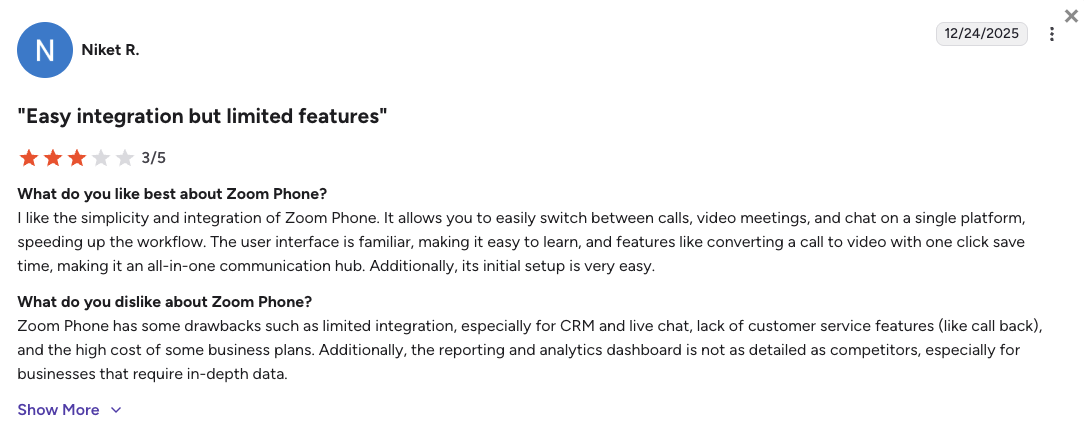
- Weak CRM Integrations: Sales teams complain that the platform mostly just logs simple call records, failing to trigger the complex workflow automations found in dedicated CCaaS tools.
How G2 Users Rate Zoom Phone?
Zoom Phone’s current G2 rating is 4.6/5, out of 2,600+ verified user reviews.
What Users Are Really Saying About Twilio Alternatives and Competitors
To get a truly accurate picture of the market, we stepped away from marketing websites and analyzed honest conversations across Reddit, Quora, and G2. While Twilio works fine for massive tech enterprises with dedicated software teams, growing small- to mid-market businesses quickly hit serious roadblocks.
What Redditors Are Asking and Saying about Twilio Alternatives
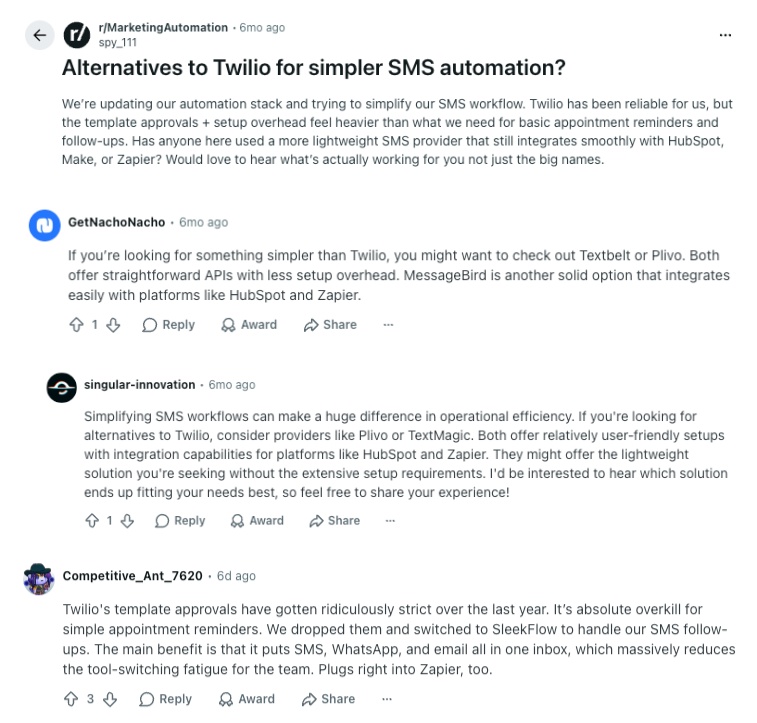
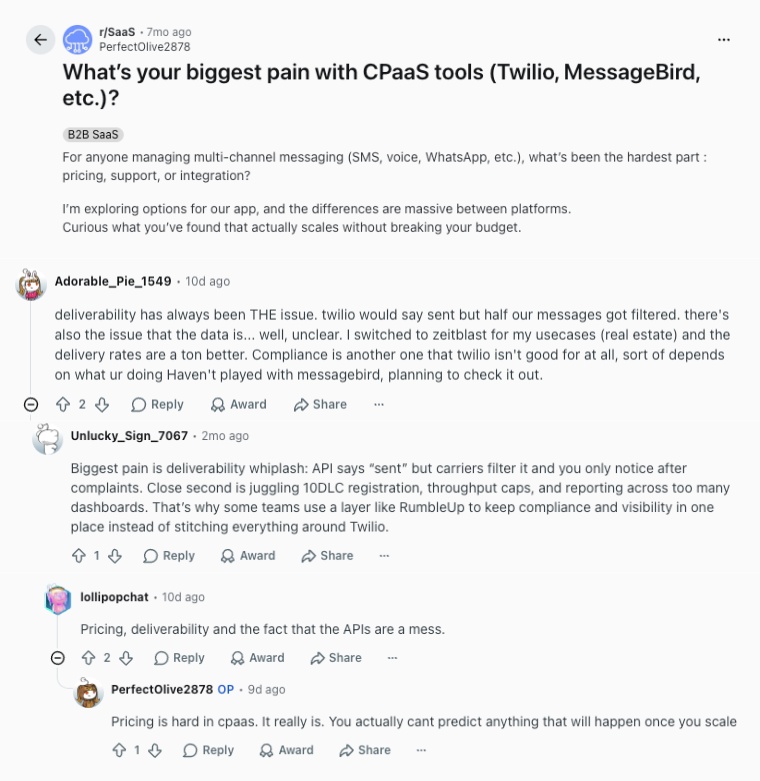
If you want the honest truth about business software, Reddit is the place to go. In communities like r/SaaS and r/MarketingAutomation, founders and marketers are highly vocal about why they are actively looking to move away from Twilio. When people ask for simpler alternatives, three clear trends pop up:
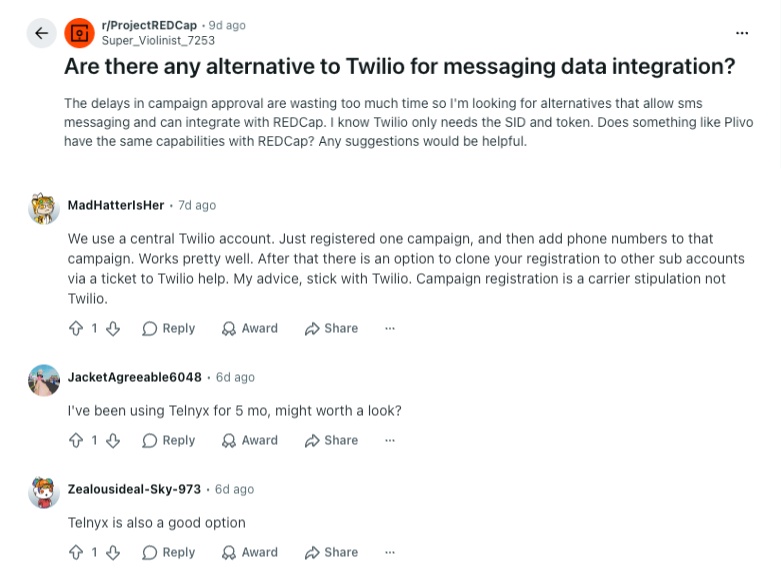
- Strict Campaign Approvals and Setup Overhead: Users are exhausted by the strict template approvals and slow campaign registrations. For basic appointment reminders or simple follow-ups, Twilio feels like massive overkill. Redditors frequently recommend platforms like Plivo or TextMagic for teams that want lightweight setups that plug right into tools like HubSpot without the heavy administrative burden.
- Deliverability Illusions and Compliance Headaches: A major pain point is what one user perfectly described as "deliverability whiplash." The Twilio dashboard might say a text message was sent, but carrier filters silently block it. Teams are incredibly frustrated having to juggle strict SMS compliance rules and complex reporting just to make sure their messages actually reach the customer.
- Unpredictable Pricing at Scale: While Twilio seems cheap at first, users warn that the costs become entirely unpredictable once your business starts growing. Between navigating confusing APIs and sudden usage spikes, businesses are actively searching for platforms that put everything in one predictable workspace to reduce tool-switching fatigue and budget anxiety.
What Quora Users Are Asking about Twilio Alternatives
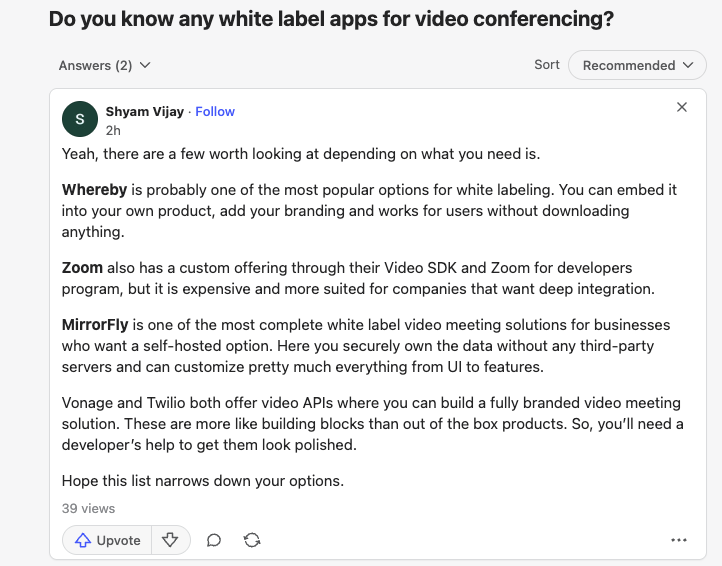
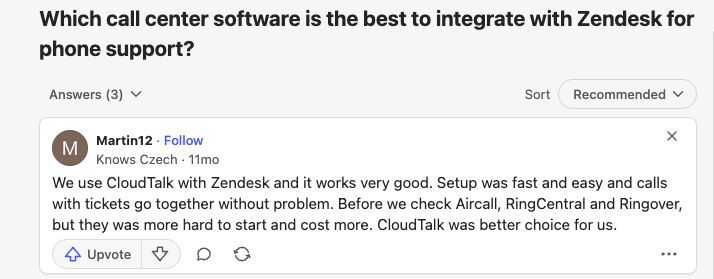
While Quora serves a slightly broader business audience, the sentiment from founders and operations managers mirrors the deep frustrations found elsewhere. When discussing Twilio and its competitors, the following themes stand out:
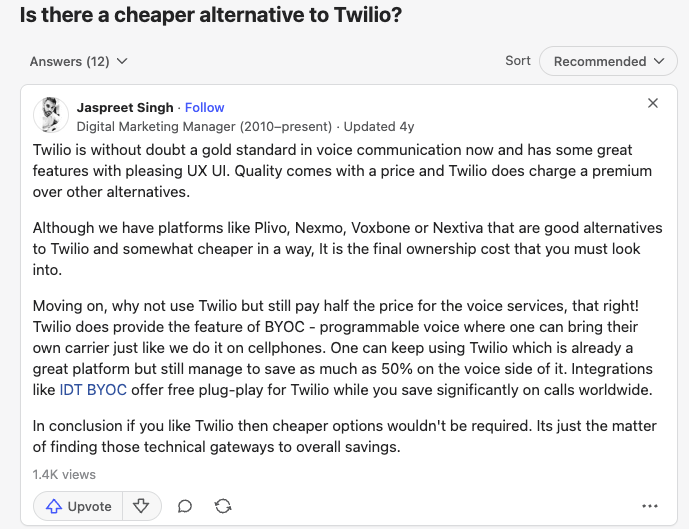
- The Search for Lower Costs: Users respect Twilio's capabilities but constantly look for ways around its premium price tag. To escape these high costs, experts frequently recommend cheaper Twilio alternatives like Plivo and Nextiva, or suggest complex "bring your own carrier" (BYOC) workarounds just to cut monthly voice bills down to a manageable size.
- Avoiding the "Building Block" Trap: When asking about specific tools like video conferencing or voice apps, users quickly realize Twilio is not a finished product. Contributors frequently warn that Twilio only offers the raw pieces. This means you have to hire a developer to make it look and work right, which pushes non-technical teams toward fully built, ready-to-use platforms instead.
- Fast, Painless Support Integrations: Support leaders don't want to build custom connections for their helpdesk. They want instant syncing. Users actively praise platforms like CloudTalk for offering fast, easy Zendesk or Zendesk Sell setups where calls and tickets link together effortlessly, noting that other big-name competitors often cost more and are harder to launch.
What Verified G2 Reviewers Say about Switching from Twilio
G2's community of verified software buyers focuses heavily on everyday usability and ease of setup. When looking at reviews from teams that actively switched away from Twilio, these trends come up:
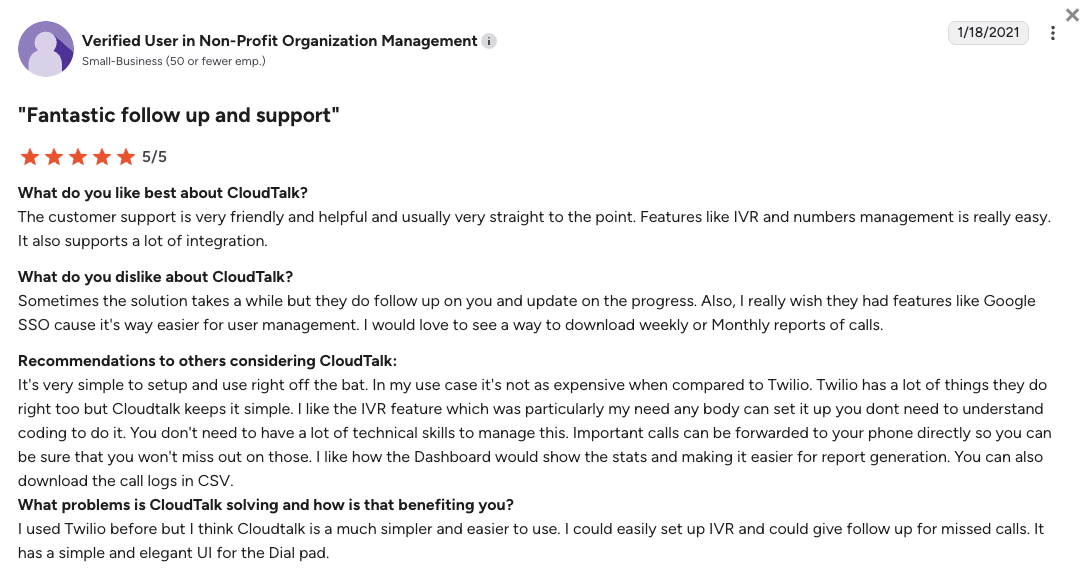
- Escaping the Developer Dependency: Users who switched from Twilio to CloudTalk constantly celebrate the massive upgrade in user experience. While Twilio is frequently cited as being difficult and complex to configure, reviewers praise CloudTalk for its intuitive interface. They highlight how easy it is to set up an IVR and manage phone numbers on their own without needing any coding skills.
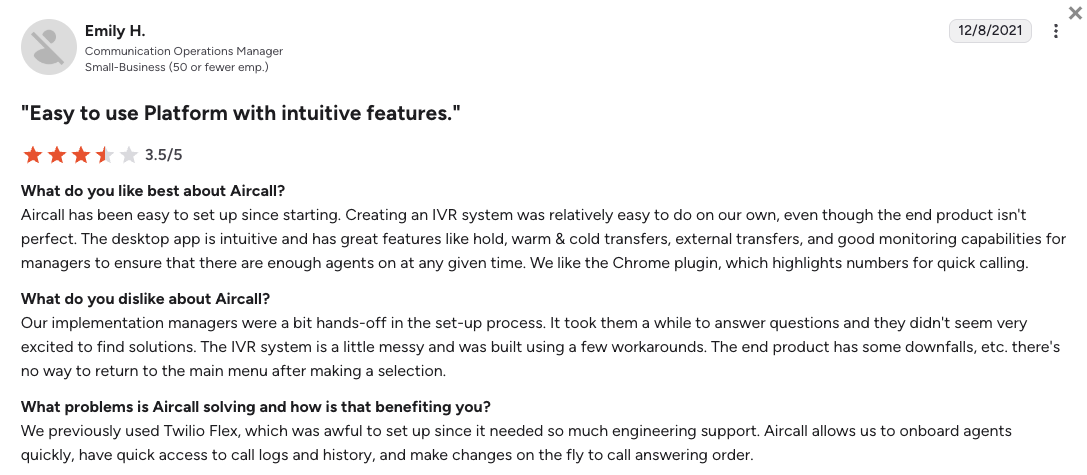
- Ditching Heavy Engineering Requirements: Teams moving away from Twilio Flex to Aircall point out how awful and engineering-heavy the Twilio setup process can be. Upon switching, they appreciate the ability to create routing menus independently, onboard new agents quickly, and access call logs instantly from a simple desktop app.
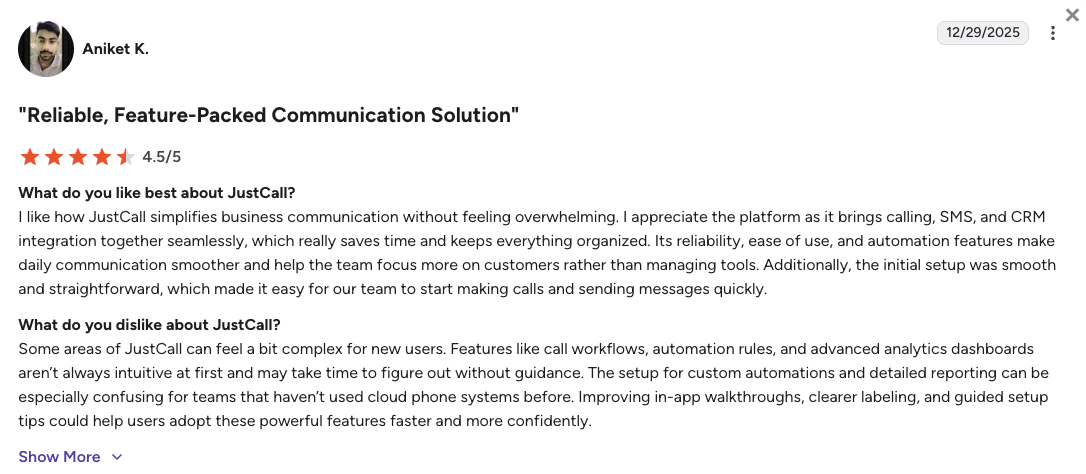
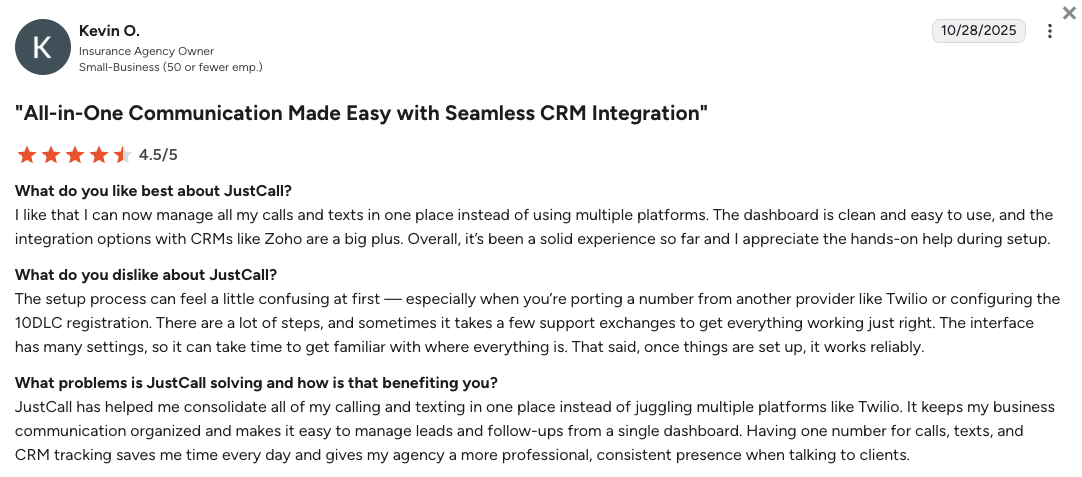
- Consolidating Calls and Texts: Are you actively looking for alternatives to Twilio for sending texts? Business owners who migrated to JustCall highlight the massive relief of managing all their calls, SMS messages, and CRM tracking in one single dashboard. They note this is a major upgrade over juggling multiple disconnected platforms like they had to with Twilio.
CloudTalk vs. Twilio: Final Head-to-Head Comparison
When choosing between CloudTalk and Twilio, the biggest difference comes down to raw API infrastructure versus ready-to-deploy revenue operations. Twilio is a toolkit for developers who want to build a custom phone application from scratch, while CloudTalk is a fully operational, intelligent contact center built specifically for sales and support teams to use on day one.
Check out this direct, side-by-side comparison of how the two platforms stack up for growing teams.
Twilio vs CloudTalk: The Final Comparison
| Category | CloudTalk | Twilio | Winner |
|---|---|---|---|
| Starting Price (annual billing) | $19/user/mo (predictable monthly bills) | From $150/user/mo plus fees (unpredictable pay-as-you-go costs) | CloudTalk |
| Minimum Users | 1 User | 1 User | Tie |
| Raw API Customization | Platform webhooks (simple connections) | Total control (build any setup from scratch) | Twilio |
| Setup Requirements | Visual setup (ready in minutes without IT) | Custom engineering (takes months to build) | CloudTalk |
| CRM Integrations | From the Essential plan on, links with 100+ CRMs natively or via API (syncs data instantly both ways) | None out of the box (requires coding to connect tools) | CloudTalk |
| Outbound Auto Dialers | Preview, Smart, Power, and Parallel Dialers available (increases agent talk time) | None (must code them from scratch) | CloudTalk |
| Conversation Intelligence | Flat-rate $9/mo add-on (fixed cost for AI notes and summaries) | Paid per minute (expensive to connect external AI) | CloudTalk |
| AI Voice Agents | Native flat-rate add-on (ready-made as well as easy to customize voice AI solutions available) | Build your own (must manually program AI models) | CloudTalk |
| Network Reliability SLA | 99.999% uptime (under 5 minutes of downtime a year) | 99.95% SLA (up to 4 hours of downtime a year) | CloudTalk |
| Global Coverage | 160+ countries (wider local reach) | 100+ countries (smaller global footprint) | CloudTalk |
| Support Quality | 24/7 live human help (fast support on all plans, including phone on Expert) | Automated bots (real help costs extra) | CloudTalk |
| G2 Rating | 4.4/5 based on 1,800+ reviews (easier to use) | 4.1/5 based on 500+ reviews (harder to use) | CloudTalk |
| Free Trial | 14 days (test features instantly) | Free sandbox (requires coding) | Tie |
The SMB advantage:
Twilio requires an IT team, but growing SMBs need speed. CloudTalk replaces months of custom coding with rapid deployment and intuitive workflow automation. With the right plan and add-ons, your team can connect your CRM, build visual call flows, and launch auto-dialers in minutes. You get a ready-to-use platform that scales effortlessly as your business grows.
How to Choose the Right Twilio Alternative for Growing Businesses?
When choosing the right Twilio alternative for small-business teams, focus on your specific business roadblocks rather than just a feature list. Based on community questions and search trends, here is how to match your business needs to the right Twilio alternative for scaling teams:
1. What Are the Best Twilio Lower Price Alternatives?
If you have been burned by Twilio's hidden UCS-2 encoding traps or surprise per-minute API spikes, you need a platform with transparent subscription plans.
- Top Picks: CloudTalk is the best choice for scaling teams because it bundles your essential calling features into clear monthly tiers. Nextiva is also a great option for support centers wanting generous, predictable text message allowances included in their base plan.
2. Which Twilio Alternative Has the Best CRM Sync?
If you want to stop paying developers to maintain buggy webhooks just to log your call data, you need a system with true two-way software syncing built natively into the app.
- Top Picks: CloudTalk uses Deep-Sync technology, ensuring every call and text log is automatically synced into HubSpot or Salesforce. Aircall is another strong option for teams that want a highly reliable software ecosystem, though you must watch out for their strict API rate limits.
3. What Is the Best Twilio Alternative for International Reach?
If you are expanding globally and need local numbers without jumping through massive bureaucratic hoops, look for providers with strong multi-carrier networks.
- Top Picks: CloudTalk wins this category easily, providing high-quality virtual numbers in over 160 countries backed by a network that guarantees clear audio. Ringover is a decent secondary choice for European teams needing flat-rate international calling.
4. Are There Twilio Alternatives without Heavy Verification Delays?
Twilio is notorious for paralyzing outbound sales teams with rigid, automated A2P 10DLC campaign rejections and opaque error codes.
- Top Picks: CloudTalk replaces that bureaucratic nightmare with a streamlined onboarding process and expert guidance. For teams purely focused on massive outbound SMS sequences, JustCall also helps simplify the compliance process.
5. Plivo vs Telnyx vs Twilio: Which is Best for Developers?
If you are a CTO looking for raw infrastructure to build a highly customized, low-level application, you still need a CPaaS provider, just a better one than Twilio.
- Top Picks: Plivo is the ultimate direct replacement for Twilio, offering familiar APIs but at much lower prices and with better support. If you are specifically building real-time AI voice agents, Telnyx is the winner due to its direct-to-carrier network offering sub-200ms audio latency.
6. Overall, What Is the Best Twilio Alternative Worth Switching To?
If you run a growing business looking to replace Twilio's heavy developer costs, unpredictable billing, and slow support with a ready-to-use phone system, CloudTalk is the definitive choice.
- Top Picks: CloudTalk stands out as the ultimate upgrade for small and mid-sized businesses. It gives your scaling team the perfect mix of enterprise-grade reliability, out-of-the-box CRM integrations, and smart sales automation without the bloated IT costs and engineering headaches.
Ready to Make the Switch from Twilio?
As Twilio feedback across Reddit, Quora, and G2 shows, growing teams simply want a phone system that works right out of the box. Switching to a ready-made platform like CloudTalk helps you take back your time, protect your budget, and keep your daily operations running smoothly.
Here’s what switching from Twilio to CloudTalk gets you immediately:
- More Time for Strategy: Skip the custom coding. Your operations managers get a visual drag-and-drop builder to set up and adjust call routing instantly, freeing up your tech team for bigger projects.
- Total Budget Control: Stop guessing your next invoice. Transparent monthly plans and flat-rate add-ons, like our $9/mo Conversation Intelligence or AI Voice Agents, let you know your monthly spend.
- Faster Sales Cycles: Give reps hours back every week. Calls log automatically into HubSpot (Essential plan) or Salesforce (Expert plan), while advanced auto dialers keep your team talking to prospects instead of dial tones.
- Peace of Mind: Never get stuck in an automated queue. You get 24/7 live chat and email help across all plans to keep your team connected, plus dedicated phone support on the Expert tier.
Ready to focus on closing deals instead of managing telecom setups?
Frequently Asked Questions
about Twilio Alternatives
Find quick answers to the most common questions businesses have about Twilio and its top competitors.
The platform that is better than Twilio depends on your team's needs. For example, CloudTalk is the best Twilio alternative for small business sales and customer support teams that want to grow fast and smart. It provides a ready-to-use business phone system and deep CRM connections (starting on the Essential plan) that eliminate the expensive software coding required to build tools on Twilio.
Twilio's competition includes both ready-to-use phone systems and raw API providers. Top Twilio competitors include CloudTalk, Plivo, Telnyx, and Nextiva. While Plivo and Telnyx are companies similar to Twilio that sell raw developer APIs, providers like CloudTalk are fully built platforms that require no coding to use.
There is no completely free Twilio alternative for business-grade calling and texting. However, if you want to avoid Twilio's unpredictable pay-as-you-go costs, you can use a 14-day free trial from CloudTalk to test a predictable, flat-rate phone system risk-free.
Massive companies use Twilio, including Uber, Airbnb, and Netflix. These giant tech enterprises use Twilio to build their backend communications because they have thousands of software engineers on staff to write and manage the complex API code.
Businesses switch to find a simpler alternative to Twilio that does not require a dedicated team of developers. As companies grow, they leave Twilio to escape unpredictable billing spikes, slow A2P 10DLC compliance approvals, and a lack of plug-and-play CRM integrations.
CloudTalk is the best Twilio alternative for scaling teams in 2026, especially if you are looking for Twilio Flex alternatives. It replaces Twilio's developer-heavy environment with a ready-to-use contact center, offering scalable auto dialers (via advanced plans or add-ons), native CRM syncing, and flat-rate pricing.
CloudTalk is a cheaper alternative to Twilio for growing SMB and mid-market teams. While Twilio advertises low per-minute API rates, building a functional interface requires a $150 per user base fee plus expensive developer salaries. CloudTalk is the best Twilio lower price alternative because it bundles your essential calling tools into predictable plans starting at $19/user/mo.
The cheapest Twilio alternative for SMS API infrastructure is Telnyx or Plivo. If you need a raw Twilio SMS alternative for bulk messaging, Telnyx offers US text rates starting at $0.004, and Plivo starts around $0.0077/SMS. Both options are significantly cheaper than Twilio's standard raw rates.
Your Twilio SMS billing is unpredictable mostly because of hidden character encoding rules. If you send a text containing an emoji or a smart quote, Twilio shrinks your message limit from 160 characters to 70. This secretly splits your message into multiple segments, multiplying your costs unexpectedly.
You can avoid Twilio's A2P 10DLC registration delays by migrating to a platform that manages compliance for you. Alternatives to Twilio like CloudTalk or Nextiva provide direct onboarding guidance, helping you launch your texting campaigns smoothly without getting stuck in automated rejection loops.
CloudTalk provides the best out-of-the-box CRM integration among alternatives to Twilio for calls. Instead of paying developers to build custom webhooks on Twilio, CloudTalk connects directly to HubSpot and Zendesk (on the Essential plan) and Salesforce (on the Expert tier) to log your calls and texts. You can even sync AI notes automatically using the flexible Conversation Intelligence add-on.
Plivo is the best lightweight SMS API for SaaS startups. When looking for developer apps like Twilio to send simple passwords or alerts (OTPs), Plivo offers an easy, REST-based setup without the massive infrastructure bloat required to scale on Twilio.
The best Twilio video alternative is Zoom Phone. If you need a simple, ready-to-use replacement for Twilio's programmable video APIs, Zoom Phone lets your internal teams easily switch from team chat to voice and video conferencing within a single familiar app.
The best small tech services shop for Twilio branded calling on mobile is actually a direct competitor. Instead of hiring a third-party agency to fix Twilio's complex setup, switching to a platform like CloudTalk offers you verified local numbers, caller ID management, and their constant support.
Ready to Try the Best Small Business Alternative to Twilio?
Join 4,000+ businesses growing with CloudTalk. No setup fees. No contracts. 14-day free trial.
Start Free Trial