Predictive Dialer: TL;DR
A predictive dialer is outbound calling software that dials several numbers at once and uses an algorithm to connect each answered call to the next free agent.
The point is simple: reps spend their time talking to people instead of waiting through rings, busy signals, and voicemail. It is the most aggressive of the outbound dialer types, which is why it suits high-volume teams and comes with specific compliance rules.
- 01What it is — automated outbound software that dials multiple numbers per agent and predicts when an agent will be free, then routes live answers to them
- 02How it works — it overdials on purpose, filters out busy signals, voicemail, and no-answers, and connects only human pickups to agents
- 03Typical cost — roughly $50 to $150 per user per month across providers (market range); CloudTalk plans start at $25/user/month
- 04The 6 dialer types — auto, predictive, power, progressive, preview, and parallel, ordered roughly from most automated to most personalized
- 05Best for — high-volume outbound work: sales, telemarketing, debt collection, and market research
- 06Compliance — in the US, the FTC caps abandoned calls at 3% with a two-second connect rule; after Facebook v. Duguid (2021), list-based dialers usually are not TCPA "autodialers," but consent and Do-Not-Call rules still apply
See predictive, power, and parallel dialing in one outbound platform

What Is a Predictive Dialer?
A predictive dialer is an outbound calling system that places multiple calls at the same time and uses an algorithm to connect answered calls to available agents. It's called "predictive" because it forecasts when agents will finish their current calls and starts dialing the next batch before they hang up, so a live person is usually waiting the moment the agent is free.
Here is the honest version most product pages skip: a predictive dialer is built to dial faster than your agents can talk. That is the whole idea, and it is also the catch.
- When the math is right, idle time between calls nearly disappears.
- When the math is wrong, the system connects a call with no agent ready, and the person on the other end gets silence. Used well, it is the highest-throughput option among outbound dialers.
Used carelessly, it generates dropped calls and compliance risk. The rest of this guide is about staying on the right side of that line.
How Does a Predictive Dialer Work?
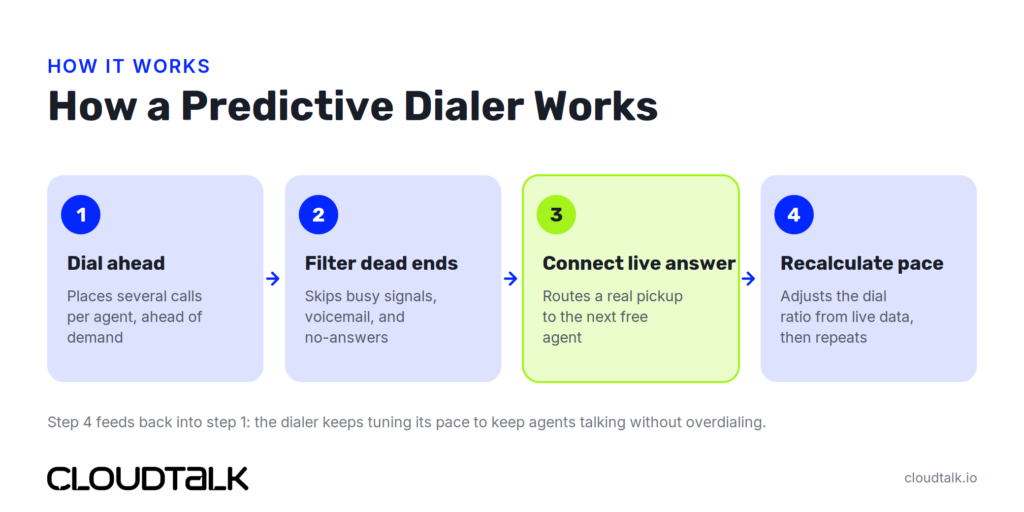
A predictive dialer works by watching your call data in real time and dialing ahead of demand. It tracks how long calls last, how often numbers actually connect, and how many agents are free, then dials enough numbers to keep everyone talking without overshooting. The flow looks like this:
- It dials multiple lines per agent — instead of one number at a time, the system places several calls per available agent based on a calculated ratio
- It filters the dead ends — busy signals, ringouts, disconnected numbers, and voicemail are screened out, often with answering machine detection, so agents never hear them
- It connects only live answers — when a real person picks up, the call is routed to the next free agent, ideally within a second or two
- It keeps adjusting the pace — the algorithm constantly recalculates the dial ratio from live answer rates and call durations, speeding up or slowing down to match agent availability
- It logs everything — outcomes, talk time, and abandonment feed real-time reporting so you can tune the ratio and prove compliance
The single most important number in that loop is the dial ratio (lines dialed per agent). Push it too high and you connect calls with no agent available, which creates abandoned calls. Keep it conservative and you trade a little speed for a clean abandonment rate. Good software manages this automatically; the operator's job is to set sensible limits and watch the reports.
The 6 Types of Outbound Dialers Compared
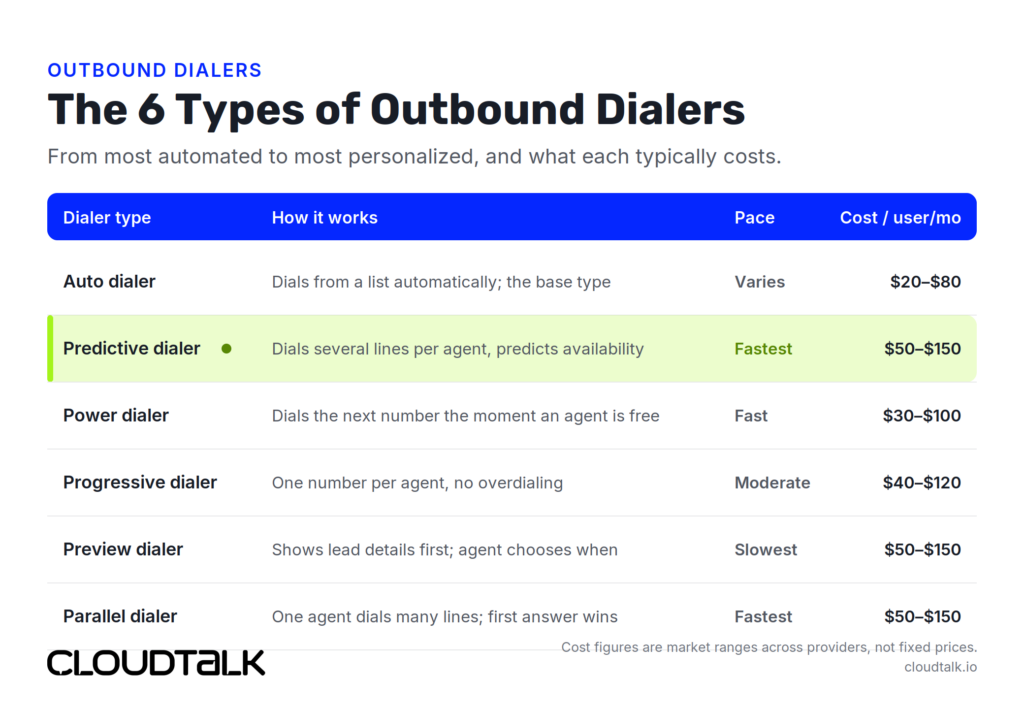
"Predictive dialer" is one option on a spectrum. All six types below are versions of the auto dialer, arranged roughly from most automated to most personalized. The right one depends on a single trade-off: call volume versus call preparation. The table gives you the short answer; the sections under it link to a deeper guide for each.
| Dialer type | How it works | Pace | Best for | Typical cost (per user/mo) |
|---|---|---|---|---|
| Auto dialer | Dials numbers automatically; the umbrella category for the rest | Varies | Simple automated campaigns and reminders | $20–$80 |
| Predictive dialer | Dials several lines per agent and predicts availability | Fastest | High-volume sales, telemarketing, collections | $50–$150 |
| Power dialer | Dials the next number the moment an agent frees up | Fast | Steady medium-volume outbound | $30–$100 |
| Progressive dialer | Dials one number per agent, no overdialing | Moderate | Smaller teams that want zero dropped calls | $40–$120 |
| Preview dialer | Shows lead details first; agent decides when to dial | Slowest | High-value or complex sales | $50–$150 |
| Parallel dialer | One agent dials many lines at once; first answer wins | Fastest | Cold-calling campaigns with low pickup rates | $50–$150 |
Cost figures above are market ranges across providers, not fixed prices; actual pricing depends on features, contract, and call volume.
Auto Dialer
The auto dialer is the foundation. It places calls automatically from a list but does not adjust pace based on agent availability. Predictive, power, progressive, preview, and parallel dialers are all specialized versions of it. Auto dialing suits simple, repetitive campaigns: appointment reminders, payment notices, and basic promotional outreach.
Predictive Dialer
The predictive dialer overdials and routes live answers to whichever agent is free, making it the highest-throughput option for teams that need to reach as many people as possible. It pays off only at volume, where there are enough agents and calls for the algorithm to predict accurately. At low volume the prediction has too little data to work with, and abandoned calls climb.
Power Dialer
A power dialer dials the next number automatically the instant an agent becomes available, one call at a time. There is no overdialing, so dropped calls are far less likely than with predictive dialing. It is the natural fit for steady medium-volume outbound. For a side-by-side, see power dialer vs. predictive dialer.
Progressive Dialer
A progressive dialer also dials one number per agent, but gives the agent a short, set pause to review the contact before connecting. It eliminates abandoned calls entirely at the cost of raw volume, which makes it a good choice for smaller teams or campaigns where call quality matters more than quantity.
Preview Dialer
A preview dialer shows the agent the lead's details first and lets them decide when to place the call. It is the slowest and most deliberate mode, built for high-value or complex sales where a few minutes of prep changes the outcome of the conversation.
Parallel Dialer
A parallel dialer lets a single agent dial several lines at once, typically up to ten. When one call connects, the system drops the others, logs them, and reschedules them for later. It is purpose-built for cold-calling campaigns with low pickup rates, where dialing many lines is the only way to find a live conversation quickly.
How Much Does a Predictive Dialer Cost?
Predictive dialing typically runs about $50 to $150 per user per month across providers, though that is a market range rather than a fixed price. Where you land inside it depends less on the dialer itself and more on what surrounds it. The dialer is rarely sold alone; it usually rides on top of a calling platform, so you are really paying for the whole stack.
The factors that move the number:
- Seats — most platforms price per user per month, so cost scales with team size
- Feature tier — CRM integration, analytics, call recording, and AI features often sit on higher plans
- Call volume and numbers — minutes, local numbers, and international coverage can be billed separately
- Contract — annual billing usually undercuts monthly, and dialing is sometimes an add-on rather than a base feature
CloudTalk includes outbound dialing in its plans rather than charging for it as a bolt-on, starting at $25/user/month billed annually, with a 14-day free trial and no credit card required. The full breakdown lives on the pricing page.
Are Predictive Dialers Legal? TCPA and Compliance Rules
Yes, predictive dialers are legal in the US, but they are regulated, and the rules are the part teams most often get wrong. Two bodies of law matter: the FTC's Telemarketing Sales Rule, which governs abandoned calls, and the Telephone Consumer Protection Act, which governs autodialers and consent.
On abandoned calls, the rule is specific. Under the FTC's Telemarketing Sales Rule, a call is "abandoned" if a person answers and is not connected to a live representative within two seconds of their greeting. Telemarketers stay inside a safe harbor only if they abandon no more than 3% of answered calls, measured per campaign over each 30-day period, which means at least 97% of human answers must reach an agent within two seconds. That single threshold is why dial ratios matter so much: push the pace too hard and you breach it.
On the autodialer question, the law shifted in 2021. In Facebook v. Duguid, the Supreme Court ruled unanimously that equipment qualifies as an autodialer under the TCPA only if it uses a random or sequential number generator. Most modern predictive dialers call from an uploaded list of real contacts, not randomly generated numbers, so they generally fall outside that narrow definition. \
That does not make them rule-free: do-not-call lists, prior consent for marketing calls, calling-hour limits, and state laws all still apply, and the abandoned-call rules above are entirely separate from the autodialer question.
The practical takeaway: treat compliance as a configuration task, not an afterthought. Cap the abandonment rate below the legal limit, scrub against do-not-call lists, honor consent, and keep the records your reporting already produces. None of this is legal advice; rules change and vary by jurisdiction, so confirm your setup with counsel.
Who Uses Predictive Dialers, and the Benefits
Predictive dialing earns its keep wherever outbound volume is high and conversations are relatively standardized. The clearest fits:
- Sales teams — more live conversations per hour means more pipeline, which is why predictive dialing is a staple of sales dialers
- Telemarketing firms — reaching the largest possible number of contacts in the least time is the entire business model
- Debt collection agencies — higher contact rates on hard-to-reach accounts, within strict compliance limits
- Market research companies — faster connections to a large sample by filtering out unproductive calls
- Support and follow-up teams — automating outbound callbacks so agents reach customers at scale
The benefits all trace back to one thing: removing idle time. Agents stop waiting through rings and voicemail and spend more of the day in live conversations. That raises contact rates, cuts the cost per connection, and produces real-time reporting that managers can act on. The trade-off is the abandoned-call risk covered above, which is the price of the speed.
How to Choose a Predictive Dialer
Most buying mistakes come from picking a dialer mode that does not match call volume, or a platform that cannot grow with the team. Work through these in order:
- Match the mode to your volume. Predictive only pays off at genuine scale. If volume is modest, a power dialer or progressive dialer will serve you better with fewer dropped calls.
- Check compliance controls. Look for built-in abandonment-rate limits, do-not-call scrubbing, and clear reporting. These keep you inside the legal thresholds without manual policing.
- Confirm the integrations. The dialer should sync with your CRM so reps see context on every call and outcomes log automatically. Native integration beats a brittle workaround.
- Plan for scale. Make sure the platform handles rising call volumes, more agents, and new numbers without a forced migration later.
- Trial it on real campaigns. Pricing and feature lists only tell you so much. Run a trial on live data and watch the contact rate, abandonment rate, and agent feedback before committing.
Predictive Dialing with CloudTalk
CloudTalk runs every outbound mode from one platform, so you are not locked into a single dialer. The predictive dialer handles high-volume campaigns, while the power dialer and parallel dialer cover steadier and cold-calling work. Outbound dialing is built into the plans rather than sold as an add-on, with answering machine detection, CRM sync, and real-time reporting included. Plans start at $25/user/month, and reviewers give CloudTalk 4.4/5 across 1,660+ ratings on G2 and Capterra.
Reach more prospects with predictive, power, and parallel dialing in one place
Sources
- Federal Trade Commission — Telemarketing Sales Rule, call abandonment safe harbor (3% rate, two-second connect rule): ftc.gov
- Supreme Court of the United States — Facebook, Inc. v. Duguid (2021), autodialer (ATDS) definition: supremecourt.gov
FAQs: Predictive Dialers
A predictive dialer is outbound calling software that dials several numbers at once and uses an algorithm to connect answered calls to the next available agent. It filters out busy signals, voicemail, and no-answers, so agents spend their time in live conversations rather than waiting between calls.
It tracks live answer rates, call durations, and agent availability, then dials multiple lines per agent ahead of demand. When a real person answers, the system routes the call to a free agent and keeps recalculating the dial ratio so the pace matches how fast agents finish calls.
A predictive dialer overdials, placing several calls per agent to maximize volume, which can cause abandoned calls. A power dialer dials one number at a time the moment an agent is free, so it is slower but avoids dropped calls. Predictive suits high volume; power suits steady pacing.
Yes, in the US, but they are regulated. The FTC's Telemarketing Sales Rule caps abandoned calls at 3% and requires a live agent within two seconds of a human answer. Do-not-call lists, consent rules, and calling-hour limits also apply. Confirm your specific setup with legal counsel.
In the US, the legal ceiling under the FTC's Telemarketing Sales Rule is 3% of answered calls. Many operators set a hard limit a little below that, around 2 to 2.5%, to leave a safety margin. A lower dial ratio reduces abandonment but also reduces raw call throughput.
Across providers, predictive dialing typically falls between $50 and $150 per user per month as a market range, depending on features, call volume, and contract. CloudTalk includes outbound dialing in its plans starting at $25/user/month, billed annually, with a 14-day free trial.
The main outbound dialer types are auto, predictive, power, progressive, preview, and parallel. They range from fully automated and high-volume (predictive, parallel) to slower and more personalized (preview, progressive). Each is a version of the auto dialer, tuned for a different balance of call volume and call preparation.
Predictive dialing places multiple calls per agent and predicts availability for maximum speed, which can produce abandoned calls. Progressive dialing places one call per agent with a short pause to review the contact, so it eliminates dropped calls but handles lower volume. Predictive favors quantity; progressive favors quality.