8 Sales Prospecting Methods That Actually Work in 2026: Techniques, Tips & Tools
Sales Prospecting Methods: TL;DR
Sales prospecting is the process of identifying and reaching out to potential customers who fit your ideal customer profile. The most effective sales prospecting methods in 2026 combine outbound outreach with social selling, AI-powered tools, and consistent follow-up. Here are the 8 methods covered in this guide — click to jump to any section:
- 01Cold Calling — Still the fastest way to create pipeline when done with the right script, tools, and timing
- 02Email Prospecting — Personalised, sequenced outbound emails remain one of the highest-ROI prospecting channels
- 03LinkedIn Social Selling — Build relationships, engage with prospects, and convert connections into conversations
- 04Referral Prospecting — Leverage existing customers for warm introductions with dramatically higher conversion rates
- 05Content & Inbound Prospecting — Create educational content that attracts, qualifies, and converts prospects at scale
- 06Events & Networking — Meet decision-makers in person and online through conferences, webinars, and communities
- 07AI-Powered Prospecting — Use AI tools to identify, prioritise, and personalise outreach at scale
- 08Video Prospecting — Short, personalised video messages that cut through crowded inboxes and increase reply rates
Sales Prospecting Methods Comparison: Which Approach Delivers the Best Results?
This table summarises the key differences between sales prospecting tips so you can choose the right combination for your team:
Comparison Table: Best Sales Prospecting Methods 2026
| Method | Conversion Potential | Speed to Pipeline | Cost | Best For |
|---|---|---|---|---|
| Cold Calling | High | Fast (same day) | Low–Medium | Best for high-volume outbound, SDR-heavy teams, short-cycle sales |
| Email Prospecting | Medium–High | Medium (days to weeks) | Low | Best for scaling outreach, automated sequences, B2B multi-touch |
| LinkedIn Social Selling | Medium | Slow (weeks to months) | Low | Best for enterprise B2B, relationship-driven sales, long cycles |
| Referral Prospecting | Very High | Variable | Low | Best for any team — highest close rate of any channel |
| Content & Inbound | Medium | Slow (months) | Medium | Best for scaling pipeline without scaling headcount |
| Events & Networking | Medium | Medium (weeks) | High | Best for building relationships and brand at industry events |
| AI-Powered Prospecting | High | Fast | Medium | Best for teams that want to scale personalised outreach without adding headcount |
| Video Prospecting | High | Fast (same day) | Low–Medium | Best for breaking through crowded inboxes, enterprise deals, AE follow-up |
How We Chose These Sales Prospecting Methods
These sales prospecting methods were selected based on real-world data from CloudTalk's network of over 5,500 business customers, combined with conversion benchmarks, industry research, and hands-on testing with our own sales team. We prioritised methods that consistently generate qualified pipeline — not just activity — and excluded approaches that rely on outdated tactics or declining channels.
We also weighted each method's compatibility with modern sales prospecting tools and AI, recognising that the highest-performing reps in 2026 are those who combine proven techniques with the right technology stack.
Fill Your Pipeline Faster with CloudTalk

The 8 Best Sales Prospecting Methods That Actually Work
1. Cold Calling — The Fastest Way to Create Pipeline When Done Right
Cold calling remains one of the most effective sales prospecting methods available — when done strategically. Despite predictions of its demise, 57% of C-level executives say they prefer to be contacted by phone, and a well-timed, well-researched call can open conversations that no email ever would. The key is treating cold calling as a skill to be developed, not a numbers game to be won through volume alone.
The reps who excel at cold calling in 2026 are doing three things differently: they research prospects before dialing, they use a proven call script that opens with relevance rather than a pitch, and they use a power or parallel dialer to maximise the number of conversations they can have in a day without burning out on manual dialing.
Key Cold Calling Prospecting Tips That Actually Work
- Research before you dial: Spend 2–3 minutes on LinkedIn, the company website, and recent news before calling. Relevance beats rehearsed pitches.
- Call at the right times: Data consistently shows Wednesday and Thursday between 8–9 AM and 4–5 PM local time produce the highest connect rates.
- Open with a reason for calling: Reference a trigger event — a funding round, a job change, a competitor switch — to make the call feel timely, not random.
- Use a power dialer: Tools like CloudTalk's Power Dialer auto-dial sequentially and log every call to your CRM automatically, giving reps 3x more conversations per day.
- Drop voicemails strategically: Use voicemail drop to leave pre-recorded messages in one click and move on — don't waste 30 seconds per unanswered call.
- Track talk-to-listen ratio: The best cold callers listen more than they speak. Aim for a talk-to-listen ratio of 43:57 — it dramatically improves booking rates.
What Tools Make Cold Calling Prospecting More Effective?
The right sales prospecting tools for cold calling include a power dialer, local presence dialing, call recording, and AI-powered conversation intelligence. CloudTalk combines all of these in one platform: reps can auto-dial from CRM lists, see real-time prospect data during calls, drop voicemails automatically, and have every call transcribed and scored by AI. For teams focused on phone-based prospecting, this cuts administrative time by 60% and increases connected conversations by up to 3x.
Other useful cold calling tools include ZoomInfo or Apollo for prospect data, Gong or Chorus for call coaching, and CloudTalk's Smart Dialer for intelligent dialing prioritisation based on historical answer rate data.
2. Email Prospecting — High-ROI Outreach at Scale
Email prospecting is the backbone of most B2B outbound sales prospecting strategies — and for good reason. When done well, it delivers consistent pipeline at low cost and scales without adding headcount. The challenge is that inboxes are more crowded than ever, which means the average prospecting email needs to be significantly more personalised and relevant than it was five years ago.
The highest-converting prospecting emails follow a clear structure: a subject line that creates curiosity or urgency, an opening line that proves you've done your research, a concise value proposition tied to a specific problem the prospect likely has, and a low-friction call to action. Mass-blast emails are dead; hyper-personalised sequences at scale — powered by a modern mass email service and AI — are what work in 2026.
Sales Prospecting Email Best Practices
- Personalise the opening line: Reference something specific — a recent post they wrote, a company milestone, or a shared connection. Generic openers get deleted.
- Keep it short: The ideal prospecting email is 50–125 words. Long emails signal that you haven't respected the prospect's time.
- One CTA per email: Ask for one specific action — a 15-minute call, a reply with availability, or a click to a calendar link. Multiple CTAs reduce response rates.
- Send sequences, not one-offs: Research shows it takes 5–7 touches to get a response. Build multi-step email sequences that escalate in value with each follow-up.
- A/B test subject lines: The subject line determines whether the email gets opened. Test question-based vs. statement-based, long vs. short, and with/without personalisation tokens.
- Time your sends strategically: Tuesday through Thursday between 8–10 AM in the recipient's timezone consistently produces the highest open and response rates.
Sales Prospecting Email Examples That Drive Replies
The most effective prospecting email structures in B2B sales follow these patterns: the trigger-event email (you just raised a round / hired a head of sales), the problem-aware email (companies like yours typically struggle with X), the mutual connection email (your colleague Jane mentioned you're evaluating Y), and the contrarian email (most people think X, but the data shows Y).
For a deeper look at prospecting email frameworks, see our guide to sales prospecting methods and our cold calling and outreach script templates.
3. LinkedIn Social Selling — Build Relationships That Convert
LinkedIn is the most powerful platform for B2B sales prospecting. With over 1 billion members and advanced filtering tools, it allows reps to identify exact-fit prospects by industry, title, company size, geography, and dozens of other criteria — then engage them where they're already spending professional time. LinkedIn's Social Selling Index (SSI) research shows that reps with high SSI scores create 45% more opportunities per quarter than peers with low scores.
Effective LinkedIn prospecting in 2026 goes beyond InMail blasts. While many teams use tools to automate LinkedIn prospecting, the highest-performing reps still focus on personalization, relationship-building, and relevant engagement. The best reps build genuine professional profiles, engage with prospects' content before sending a connection request, and treat LinkedIn as a long-term relationship channel rather than a short-term lead-generation hack. Used correctly, LinkedIn prospecting becomes less about volume and more about starting the right conversations with the right people.
LinkedIn Sales Prospecting Tips That Actually Generate Pipeline
- Optimise your profile for buyers, not recruiters: Your headline and summary should speak to the problems you solve, not just your job title. Prospects visit your profile before accepting connection requests.
- Engage before connecting: Comment thoughtfully on a prospect's post 2–3 times before sending a connection request. They're far more likely to accept from someone they recognise.
- Personalise every connection request: Always include a note — reference why you're connecting, a shared interest, or something specific you found in their content.
- Use LinkedIn Sales Navigator: The Advanced Search and Saved Alerts features let you track job changes, company news, and content activity — turning LinkedIn into a real-time prospect intelligence tool.
- Share content that attracts prospects: Post weekly about problems your ideal customers face. Prospects who engage with your content are pre-qualifying themselves.
- Transition to phone or email quickly: LinkedIn is for relationship-building, not for closing. Move warm conversations to a phone call or direct email as quickly as appropriate.
4. Referral Prospecting — The Highest-Converting Channel in Sales
Referrals consistently produce the highest conversion rates of any sales prospecting method — with referred leads converting 3–4x more often than cold outbound. Despite this, most sales teams have no systematic approach to generating referrals. They wait for customers to refer spontaneously instead of building a referral engine that produces a steady stream of warm introductions.
A structured referral prospecting process identifies your happiest customers at the peak of their satisfaction (typically 30–90 days after a positive outcome), asks them specifically for introductions rather than generic referrals, and makes the referral as easy as possible by providing context and templates they can forward. When done systematically, referral programs can account for 20–30% of total new pipeline.
How to Build a Systematic Referral Prospecting Program
- Identify your happiest customers: Use NPS surveys, support ticket data, and renewal signals to identify promoters. These are your most likely referral sources.
- Ask at the right moment: The best time to ask for a referral is right after a customer experiences a meaningful win — not at renewal time.
- Ask for introductions, not referrals:'Do you know anyone at [Company X] who might benefit from what we do?' is far more effective than 'Do you know anyone I could talk to?'
- Make it easy to refer: Provide customers with a pre-written introduction they can forward. Remove all friction from the referral process.
- Follow up and close the loop: Always let the referring customer know what happened with their introduction. This makes them more likely to refer again.
- Consider a formal referral program: Incentivised referral programs — whether with credits, gifts, or revenue share — can dramatically increase referral volume from existing customers and partners.
5. Content & Inbound Prospecting — Scale Pipeline Without Scaling Headcount
Content-driven prospecting works by attracting qualified buyers to you, rather than hunting for them. When a prospect downloads a guide on solving a specific problem, attends a webinar on a topic your product addresses, or finds your blog through a search query, they arrive with built-in intent. The sales conversation starts from a position of established trust rather than cold outreach.
The most effective inbound prospecting strategies in 2026 combine SEO-optimised blog content, gated resources (whitepapers, calculators, templates), webinars, and paid distribution to ensure the right people find your content at the right time. Sales reps then engage inbound leads as soon as they hit a qualification threshold — within minutes, not days.
How to Use Content as a Sales Prospecting Tool
- Create content that solves real problems: Every piece of content should answer a question your ideal prospect is actively searching for. Problem-aware content attracts decision-makers.
- Use gated content to generate leads: Offer high-value resources (calculators, industry reports, templates) in exchange for contact information. These prospects self-qualify by their interest.
- Respond to inbound leads immediately: Research from HubSpot shows response within 5 minutes of a content download increases qualification rate by 9x compared to a 30-minute response.
- Host webinars and virtual events: Webinar attendees are highly qualified prospects who've already invested time in a topic you address. Follow up by phone within 24 hours.
- Leverage intent data: Tools like Bombora and G2 Buyer Intent show which companies are actively researching solutions like yours — letting you prioritise outreach to accounts with high purchase intent.
6. Events & Networking — Meet Decision-Makers Where They Learn
Industry events — whether in-person conferences, virtual summits, trade shows, or community meetups — remain one of the highest-quality sources of qualified prospects. Unlike cold outreach, event conversations happen in a context where both parties are already invested in the topic at hand. A well-prepared rep can generate months of pipeline from a single two-day conference.
The key is treating event prospecting as a structured activity, not a social one. Define exactly which events your ideal customers attend, set a target for the number of meaningful conversations per event, prepare your opening questions in advance, and have a clear follow-up plan in place before you arrive. The reps who get the most from events are those who treat the follow-up as part of the event itself.
How to Make Events and Networking a Reliable Prospecting Channel
- Pre-book meetings before the event: Research attendee lists or speaker lineups in advance and reach out to request 15-minute coffee chats during breaks. Scheduled meetings produce better conversations than cold approaches.
- Focus on learning, not pitching: Ask about the prospect's biggest challenges and goals. Prospects remember people who listened and understood their problems.
- Capture contact details systematically: Use a business card app or CRM mobile app to capture prospect information immediately. Don't rely on memory or business cards you'll forget about.
- Follow up within 24 hours: Send a personalised email the day after the event that references your specific conversation. The follow-up while the event is still fresh doubles response rates.
- Host your own events: Virtual roundtables, lunch-and-learns, and hosted dinners at conferences position you as a connector and thought leader — the most powerful positioning for any sales rep.
7. AI-Powered Sales Prospecting — Scale Personalisation Without Scaling Headcount
AI has fundamentally changed what's possible in sales prospecting. Where personalisation at scale once required large teams manually researching prospects, AI for sales prospecting now enables a single rep to research hundreds of prospects, draft personalised outreach, identify the best time to contact each one, and analyse which conversations are most likely to convert — all in a fraction of the time.
The most effective AI sales prospecting tools in 2026 fall into three categories: AI research and data enrichment tools (Apollo, ZoomInfo, Clay) that automatically surface prospect insights; AI writing assistants (built into platforms like CloudTalk, Salesloft, and Outreach) that generate personalised first lines and follow-up messages; and AI conversation intelligence tools (CloudTalk AI, Gong, Chorus) that analyse calls to identify what's working and coach reps in real time.
Best Ways to Use AI for Sales Prospecting in 2026
- AI prospect research and data enrichment: Tools like Apollo.io and Clay automatically pull prospect data — job titles, technographics, funding events, recent news — and surface it in your CRM before you make a call.
- AI-personalised email sequences: AI writing tools can generate personalised opening lines based on a prospect's recent LinkedIn activity, company news, or role — at scale, without manual research.
- AI call scoring and coaching: CloudTalk's AI call scoring automatically analyses every prospecting call and gives reps feedback on talk speed, sentiment, objection-handling, and next-step clarity.
- AI smart notes and transcription: CloudTalk AI Smart Notes automatically generates call summaries, action items, and CRM updates after every prospecting call — eliminating post-call admin.
- AI lead prioritisation: AI-powered CRM tools score leads based on engagement signals and historical conversion data, helping reps focus their limited time on the prospects most likely to buy.
- AI conversation intelligence: CloudTalk's sentiment analysis identifies which parts of a prospecting call generated positive or negative reactions, giving managers data to coach reps more effectively.
Best AI Sales Prospecting Tools for 2026
The leading best ai tools for sales prospecting stack includes tools for data, outreach, and conversation intelligence. Here are the categories and tools worth evaluating:
Best AI Tools for Sales Prospecting 2026
| Category | Leading Tools | What They Do |
|---|---|---|
| Prospect Data & Enrichment | Apollo.io, ZoomInfo, Clay, Clearbit | Find, enrich, and score prospect data automatically |
| Outreach & Sequencing | Salesloft, Outreach, Apollo, Lemlist | Automate multi-touch email + call sequences |
| Dialing & Calling | CloudTalk, Kixie, Orum | Power/parallel dialing with AI call logging and coaching |
| Conversation Intelligence | CloudTalk AI, Gong, Chorus | Analyse calls, score conversations, coach reps at scale |
| AI Writing & Personalisation | Lavender, Smartwriter, built-in AI in Salesloft/Outreach | Generate personalised email opening lines and follow-ups |
| Intent Data | Bombora, G2 Buyer Intent, 6sense | Identify accounts actively researching solutions like yours |
8. Video Prospecting — Cut Through Crowded Inboxes with Personalised Video
Video prospecting has emerged as one of the highest-performing outbound sales prospecting techniques for breaking through crowded inboxes. A short, personalised video message — 60 to 90 seconds, recorded specifically for one prospect — consistently achieves 2–5x higher response rates than text-only emails. Why? Because video communicates personality, builds trust, and demonstrates effort in a way that text simply cannot.
The most effective video prospecting messages follow a simple structure: start by naming the prospect (so they see their name in the thumbnail), mention one specific thing you noticed about them or their company, explain why you're reaching out and what problem you solve, and end with a clear, low-pressure call to action. Keep it conversational, not polished — authenticity outperforms production quality in prospecting video.
How to Make Video Prospecting Part of Your Sales Outreach
- Use the right tools: Loom, Vidyard, and BombBomb make it easy to record, share, and track video messages — including who watched your video and for how long.
- Write the prospect's name on a whiteboard: Show it at the start so the thumbnail in their email shows their name. This dramatically increases open rates.
- Keep it under 90 seconds: Shorter videos have dramatically higher completion rates. If you can't make your point in 90 seconds, you need to narrow your focus.
- Personalise the context: Open by pointing to something specific — their website, a recent news article about them, or a challenge common in their industry. Generic video prospecting is no better than generic text.
- Embed video in email sequences: Use video as the second or third touch in a multi-step sequence rather than the first. Prospects are more receptive after seeing your name in their inbox once.
Make Every Prospecting Call Count
How to Build a High-Performance Sales Prospecting Process
The highest-performing sales teams don't rely on one sales prospecting method — they build a structured, repeatable multi-channel process that combines several of the approaches above into a coherent daily routine. Here's the framework used by top-performing SDR teams:
The 5-Step Sales Prospecting Process
- 01Define your ICP (Ideal Customer Profile): Before you prospect, be crystal clear on who you're targeting. Industry, company size, tech stack, geography, team size, and key pain points. The tighter your ICP, the more effective your outreach.
- 02Build a targeted prospect list: Use tools like Apollo, LinkedIn Sales Navigator, or ZoomInfo to build a list of accounts and contacts that match your ICP. Prioritise by intent signals, industry fit, and timing.
- 03Research each prospect before outreach: Even 5 minutes of research — LinkedIn profile, company news, recent posts — produces significantly more relevant outreach and higher response rates.
- 04Execute a multi-touch outreach sequence: Combine phone, email, LinkedIn, and (where relevant) video in a structured sequence over 2–3 weeks. Most deals require 5–8 touches before a prospect responds.
- 05Measure, iterate, and optimise: Track connect rate, response rate, meeting rate, and pipeline created from each channel. Use this data to double down on what's working and fix what isn't.
Sales Prospecting Best Practices: What Top Performers Do Differently
- Prospect every day: Top performers treat prospecting as a non-negotiable daily activity, not something they do when the pipeline looks thin. 60–90 minutes of protected prospecting time every morning builds consistent pipeline.
- Quality over quantity: Ten highly researched, personalised outreach messages consistently outperform a hundred generic ones. Spend more time on better prospects, not more prospects.
- Use trigger events as prospecting signals: A prospect who just raised funding, hired a new VP of Sales, or expanded into a new market is actively in buying mode. Monitor for these signals and reach out immediately.
- Always follow up:80% of sales require 5 follow-ups after the initial contact, yet 44% of reps give up after one. Build follow-up into your process — it's where most pipeline is won or lost.
- Review and coach regularly: Use call recording and AI conversation intelligence to identify patterns — what openings work, what objections kill conversations, what questions lead to meetings. Coach reps based on data, not anecdote.
What Is Sales Prospecting? Definition and Why It Matters
Sales prospecting is the first stage of the sales process — identifying and reaching out to individuals or companies who could benefit from your product or service. A prospect is not yet a lead; they become a lead once they show interest. Prospecting is the work that happens before that moment.
Effective sales prospecting is the difference between a pipeline that's always full and a team that scrambles at end-of-quarter. According to research from Sales Insights Lab, 40% of salespeople say prospecting is the hardest part of the sales process — yet it's the most directly linked to revenue outcomes. The best salespeople treat prospecting as a daily discipline, not an occasional task.
Modern b2b sales prospecting now integrates AI-powered tools, conversation intelligence, and multichannel outreach sequences to identify the right prospects faster and engage them more effectively. The methods below represent what actually works in practice — not just in theory.
Sales Prospecting by the Numbers: What the Research Actually Shows
The data on sales prospecting consistently challenges what most teams assume. According to Salesforce's sixth State of Sales report, surveying 5,500 sales professionals across 27 countries, sales reps currently spend 70% of their time on non-selling tasks — meaning the average rep dedicates less than a third of their working week to actual prospect outreach.
That same report found that 84% of reps missed quota last year, and 67% don't expect to hit it this year either — not because they lack skill, but because insufficient pipeline is the underlying problem. The research is equally clear on what fixes it: companies using sales prospecting tools powered by AI saw revenue growth at a rate of 83%, compared to 66% for those without AI.
On the buyer side, RAIN Group's landmark prospecting study — covering 488 buyers representing $4.2 billion in purchases across 25 industries — found that 82% of buyers accept meetings with sellers who proactively reach out to them, and 71% want to hear from sellers early in the buying process, not after they've already formed a shortlist.
HubSpot's 2025 State of Sales report, drawing on responses from over 1,000 global sales professionals, found that 82% of top-performing salespeople always research a prospect before making contact, compared to just 49% of average performers — a 33-point gap that is one of the strongest predictors of quota attainment.
And yet, despite the abundance of outreach channels, HubSpot's cold calling research found that 55% of sales professionals still give up after just three to five call attempts, even though most prospects require eight or more touches before agreeing to a meeting. Taken together, the research points to the same conclusion: the teams filling pipeline consistently are the ones who prospect every day, personalise every touch, use the right tools to eliminate manual work, and follow up far longer than their competitors.
Reviews of Sales Prospecting Tools
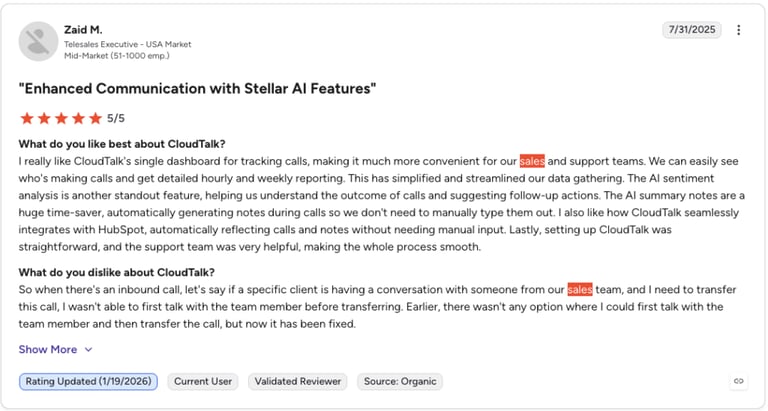
Reviewers on G2 find call tracking and weekly reporting essential to their sales processes.
Why CloudTalk Makes Sales Prospecting More Effective
CloudTalk is purpose-built for sales teams that rely on phone-based prospecting. Its combination of power and parallel dialing, AI conversation intelligence, real-time coaching, and deep CRM integration makes it one of the most effective sales prospecting tools available for teams that prioritise pipeline creation through outbound calling.
- Power Dialer: Auto-dial your prospect list sequentially, skipping unanswered calls and logging every outcome to your CRM automatically — 3x more conversations per day.
- Parallel Dialer: Call multiple prospects simultaneously and connect only when someone picks up — dramatically increases the number of live conversations per rep per day.
- AI Smart Notes: Automatic call summaries, action items, and CRM updates after every prospecting call — eliminating post-call admin that kills selling time.
- Call Scoring: AI automatically scores every prospecting call for quality, sentiment, and adherence to your process — giving managers the data they need to coach reps at scale.
- Talk-Listen Ratio Analytics: Identify reps who are pitching too much and not listening enough — a leading indicator of prospecting call quality.
- Deep CRM Integration: Native integrations with Salesforce, HubSpot, Pipedrive, and 35+ other CRMs ensure every prospect interaction is automatically logged and available for sales managers.
Join 5,500+ Sales Teams Already Prospecting Smarter
Sources:
- 01Salesforce State of Sales Report, 6th Edition (2024) — 5,500 sales professionals across 27 countries
- 02RAIN Group: Top Performance in Sales Prospecting Benchmark Report — 488 buyers representing $4.2B in purchases across 25 industries
- 03HubSpot: 2025 State of Sales Report — 1,000+ global sales professionals
- 04HubSpot: 2025 State of Cold Calling Report — 379 sales professionals
Sales Prospecting: Frequently Asked Questions
Sales prospecting is the process of identifying and initiating contact with potential customers who match your ideal customer profile. It's the first and most critical stage of the sales process — without consistent prospecting, pipeline dries up and revenue targets become impossible to hit. The best sales teams treat prospecting as a daily discipline and build systematic, multi-channel processes rather than relying on sporadic outreach.
The most effective sales prospecting methods in 2026 are: cold calling (with a power dialer and strong script), personalised email sequences, LinkedIn social selling, referral prospecting, AI-powered outreach, video prospecting, content and inbound marketing, and events/networking. The highest-performing teams combine multiple methods in structured, multi-touch sequences rather than relying on any single channel.
The best sales prospecting tools stack includes: a power or parallel dialer (CloudTalk, Kixie, Orum) for phone outreach; a sales engagement platform (Salesloft, Outreach, Apollo) for email sequencing; LinkedIn Sales Navigator for social prospecting; a data enrichment tool (ZoomInfo, Apollo, Clay) for prospect research; and AI conversation intelligence (CloudTalk AI, Gong, Chorus) for call coaching and performance analysis. See our full guide to sales prospecting tools for detailed reviews.
AI for sales prospecting can be applied across multiple stages: AI data enrichment tools (Apollo, Clay, ZoomInfo) automatically research and score prospects; AI writing assistants generate personalised email opening lines at scale; AI dialers prioritise which prospects to call and when; and AI conversation intelligence tools (like CloudTalk AI) analyse calls to identify patterns, coach reps, and surface what's driving conversions. The biggest gains come from using AI to eliminate manual research and administrative tasks so reps spend more time in actual conversations.
Sales prospecting is typically an outbound, rep-driven activity — actively identifying and reaching out to potential customers who match your ICP. Lead generation is more often inbound and marketing-driven — creating content, ads, or events that attract potential buyers and convert them into leads. The distinction matters for process design: prospecting is owned by sales, lead generation is owned by marketing, and the best revenue teams align both into a unified pipeline engine.
Research consistently shows that most prospects respond between the 5th and 8th touch. Despite this, 44% of reps give up after a single follow-up. The best sales prospecting techniques involve building structured multi-touch sequences — combining calls, emails, LinkedIn messages, and (where appropriate) video messages — spread over 2–3 weeks, with each touch providing incremental value rather than just asking again for a meeting.
B2B sales prospecting involves identifying companies and specific decision-makers within those companies who match your ICP, then initiating contact through personalised, research-driven outreach. B2C prospecting typically relies more on mass marketing channels and shorter, lower-touch sales cycles. B2B prospecting requires deeper research, longer nurture sequences, multi-stakeholder engagement, and a stronger focus on business ROI in outreach messaging. The tools and techniques covered in this guide are primarily optimised for B2B prospecting contexts.
Building an effective sales prospecting list starts with a clearly defined Ideal Customer Profile (ICP) — the specific attributes of companies and buyers most likely to buy and retain your product. Use tools like LinkedIn Sales Navigator, Apollo.io, ZoomInfo, or Clearbit to filter prospects by industry, company size, title, geography, tech stack, and growth signals. Prioritise accounts showing buying intent (recent job changes, funding events, competitor mentions) and enrich each contact with verified email and phone data before beginning outreach.
The most important sales prospecting tips for reps starting out: (1) Prospect every single day — consistency builds pipeline; (2) Define your ICP before building lists — quality over quantity always wins; (3) Research every prospect before you reach out — relevance beats volume; (4) Build multi-touch sequences — most prospects need 5+ contacts; (5) Listen more than you speak on calls — great prospectors diagnose problems, they don't pitch products; (6) Use a power dialer to maximise connected conversations without burning out on manual dialing. Tools like CloudTalk are designed to make all of this faster and more effective.