10 Best Conversational AI Platforms & Conversation Intelligence Software for 2026

SUMMARY:
We evaluated and tested 30+ conversation intelligence software platforms and chose the 10 top conversational AI companies for 2026, based on NLP accuracy, conversation analytics depth, CRM integrations, AI capabilities, omnichannel support, and scalability.
10 top conversational AI platforms by use case:
The line between human and AI conversations grows thinner each day. Modern conversation analytics software now handles millions of customer interactions with increasingly natural dialogue—turning every call, chat, and support ticket into actionable intelligence your team can act on.
CloudTalk is the strongest choice for most sales and support teams that want to scale with AI-powered conversation intelligence without enterprise-level complexity. Larger organizations with strict compliance, governance, or multi-layered admin requirements may prefer a full CCaaS or vertical-AI platform.
Quick Comparison Table of the 10 Best Conversational AI Vendors
What Is a Conversational AI Platform?
Conversational AI for business represents a quantum leap from its humble beginnings, with ELIZA's pattern matching in 1966. Unlike traditional chatbots that follow rigid scripts, these platforms process natural language with a sophisticated understanding of context, sentiment, and intent. They learn from each interaction, building on conversation history to deliver more refined responses.
The foundation rests on three key technologies. Natural Language Processing (NLP) dissects human speech into meaningful data points. Machine Learning algorithms detect patterns and continuously improve responses through exposure to millions of conversations. Speech-to-text conversion enables fluid voice interactions across multiple channels.
Market adoption signals a clear trajectory for conversational AI. Approximately 40% of large organizations already leverage conversational AI in their daily operations. The future looks even more connected, with 7 in 11 businesses anticipating AI assistants as standard tools by 2030. These platforms have evolved beyond simple automation, becoming integral to how businesses understand and serve their customers.
What Is Conversation Analytics Software?
Conversation analytics software is a layer of AI that sits on top of your communication channels—calls, chats, emails—and extracts structured data from every interaction. Rather than recording conversations and leaving them in a library no one reviews, conversation analytics automatically tags topics, detects sentiment, scores resolution quality, and maps outcomes to business metrics like conversion rate and first-contact resolution. It turns raw dialogue into a searchable, quantifiable dataset your team can act on.
What Is the Difference Between Conversation Analytics and Conversation Intelligence?
Conversation analytics is about measurement—tracking metrics like talk/listen ratio, sentiment shifts, topic frequency, and resolution rates across a large volume of conversations. Conversation intelligence goes a step further: it uses those measurements to surface recommendations, flag coaching moments, and predict deal or ticket outcomes. Think of analytics as the dashboard and intelligence as the co-pilot. Most leading platforms today bundle both—you get the data and the decision-making layer in one tool.
How Conversational AI Works
In practice, conversational AI is a set of technologies that work together. For instance, when a customer calls about an order issue, the system captures their voice, converts it to text, understands the intent, processes the emotion, searches relevant databases, and formulates an appropriate response—all within seconds.
Here's how it works:
- Think of conversational AI as a skilled interpreter at a global conference. Just as the interpreter processes multiple languages simultaneously, these systems handle countless conversations in real-time, translating human intent into actionable responses.
- Natural Language Processing serves as the system's ears and brain. When a customer asks about their account balance, NLP breaks down this request into meaningful chunks—distinguishing between "account" (the subject), "balance" (the specific information needed), and any qualifying details. This happens in milliseconds.
- Machine Learning and AI models act as the system's memory and decision-making center. These models train on millions of conversations, learning patterns like a veteran sales representative who's handled countless calls.
- When a customer expresses frustration about a delayed shipment, the AI recognizes the emotion and adapts its response accordingly, just as an experienced support agent would change their tone.
- Speech technologies complete the communication loop. Speech-to-text converts spoken words into written form with remarkable accuracy, while text-to-speech generates natural-sounding responses—like a well-trained virtual assistant who can both take perfect notes and speak clearly in any situation.
How Does Conversation Analytics Work?
Conversation analytics works by ingesting audio or text from every customer interaction, then running it through a pipeline of AI models. First, speech-to-text transcription converts voice data into searchable text. Next, NLP layers parse the transcript for intent, keywords, named entities, and question types. Sentiment analysis then scores each segment of the conversation on an emotional scale. Finally, the platform aggregates these signals into dashboards—showing you drop-off rates by topic, resolution scores by agent, intent clusters by channel, and CRM-linked outcomes like closed deals or resolved tickets. The best customer conversation analytics tools run this process automatically within seconds of a call ending, so insights are available before your rep even writes the follow-up.
Conversational AI vs. Chatbots – What's the Difference?
The gap between traditional chatbots and conversational AI resembles the difference between a vending machine and a knowledgeable store clerk. While both can provide what you need, their approaches differ dramatically. Traditional chatbots operate like vending machines—input A must match slot B to get result C. Conversational AI, however, functions more like that experienced clerk who remembers your preferences, understands context, and can handle complex requests. Here's how they stack up:
How We Chose the Best Conversation Intelligence Software
To create this guide, we evaluated 30+ leading conversational AI and conversation analytics software platforms using verified user reviews, product documentation, feature comparisons, and market research.
Our evaluation criteria included:
- Conversation analytics depth: intent detection, sentiment analysis, topic extraction, drop-off rates, and resolution scoring
- NLP accuracy: natural language understanding quality and contextual relevance across channels
- Ease of use: onboarding speed, UI clarity, and time-to-value
- Integrations: CRM, telephony, and business tool connectivity
- Pricing transparency: clarity of tiers, value for money, and scaling costs
- Scalability: ability to grow with team size and conversation volume
- User satisfaction: verified reviews from G2, Capterra, TrustRadius, Reddit, and Quora
Why Trust Our Software Reviews?
For nearly a decade, we've helped over 30,000 professionals choose and implement better communication tools. We've reviewed 200+ products, analyzed 5,500+ verified reviews from G2 and Capterra, and drawn insights from real user discussions on platforms like Reddit and Quora.
In the past year alone, we've published 1,000+ articles, all written and reviewed by humans, for humans, to provide reliable, data-backed insights you can trust.
Learn how we keep our content integrity and our software review methodology.
Top 10 Conversational AI Platforms & Conversation Analytics Tools for 2026
Selecting the right conversational AI platform providers shapes how your business connects with customers. While big names like ChatGPT grab headlines, specialized business platforms deliver targeted solutions for specific industry needs. This comparison examines ten leading platforms, breaking down their strengths, limitations, and ideal use cases to help you make an informed choice.
1. CloudTalk: Best Conversation Intelligence Software for Sales & Support Teams
What Is CloudTalk?
CloudTalk is an AI-powered business calling platform that combines conversation intelligence with comprehensive phone system features. It transforms customer interactions into actionable insights while streamlining sales and support operations—making it one of the top conversation intelligence software platforms available for growing teams.
What Are CloudTalk's Key Features?
- Post-call sentiment analysis and conversation monitoring
- Automated call summaries and smart tagging
- Topic extraction and trend identification
- Multi-language transcription and analysis
- CRM integration with automatic data syncing
- Power Dialer and Smart Dialer for high-volume outbound
- Real-time analytics dashboard with call recording
What Is CloudTalk Best For?
- Tech companies scaling their sales operations with AI-driven call intelligence
- Professional service firms handling high call volumes who need clean CRM data
- Growing SMBs with an international customer base who need 160+ country coverage
What Are CloudTalk's Plans & Pricing?
- CloudTalk's pricing starts at $19 per user/month (NAM & LATAM) or $25 per user/month (worldwide)
- Lite: 19
- Starter: 34
- Essential: 39
- Expert: 69
- Custom pricing options for larger teams with specific needs
What Are CloudTalk's Pros & Cons?
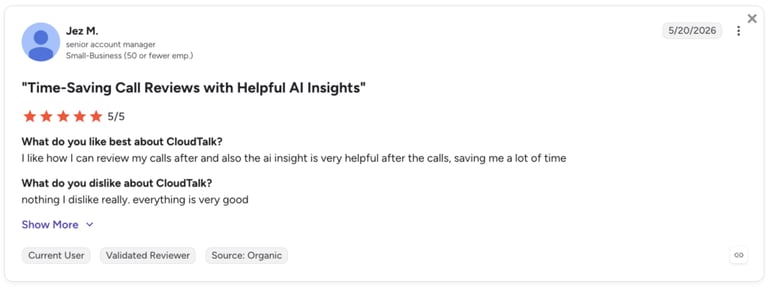
2. Dialpad: Best for Unified Communications with Built-In Conversation Analytics
What Is Dialpad?
Dialpad is a unified communications platform that leverages AI for voice, video, and messaging. Their conversational AI focuses on real-time assistance and post-call analytics, making it a solid option for remote teams that need conversation intelligence baked directly into their phone system.
What Are Dialpad's Key Features?
- Real-time call transcription and live coaching
- AI-powered noise cancellation
- Automated call scoring and performance tracking
- Voice analytics and sentiment tracking
- International calling capabilities with built-in video conferencing
What Is Dialpad Best For?
- Healthcare providers needing HIPAA-compliant conversation analytics
- Financial services with distributed remote teams
- Educational institutions requiring video + calling in one platform
What Are Dialpad's Plans & Pricing?
Dialpad's pricing includes three tiers:
- Standard: $15/user/month
- Pro: $25/user/month
- Enterprise: Custom pricing
What Are Dialpad's Pros & Cons?
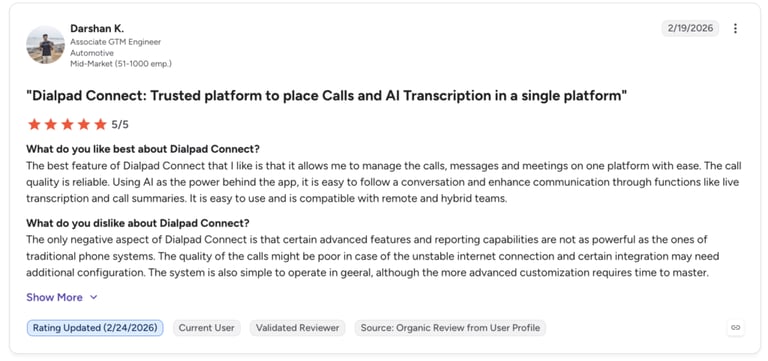
3. Quiq: Best Enterprise Conversational AI Platform Across Voice and Digital Channels
What Is Quiq?
Quiq is a conversational AI platform for enterprise customer service, support, and sales teams. It helps brands manage customer conversations across chat, SMS, voice, and messaging channels, with AI agents, agent assistance, voice automation, analytics, and a digital contact center all in one platform.
What Are Quiq's Key Features?
- AI agents for resolving customer questions across channels
- Voice AI agents for natural phone conversations at scale
- Real-time agent assistance for human support teams
- Digital contact center for managing customer conversations in one place
- Conversation analytics for turning support data into actionable insights
What Is Quiq Best For?
- Enterprise customer service teams that want conversational AI across voice and digital channels
- Retail and ecommerce brands handling high support volume
- Companies that need AI agents, live agent support, and conversation analytics in one platform
What Are Quiq's Plans & Pricing?
- Custom pricing — Quiq uses conversation-based pricing for its AI agent platform; voice AI pricing is customized based on call volume and use-case requirements
What Are Quiq's Pros & Cons?
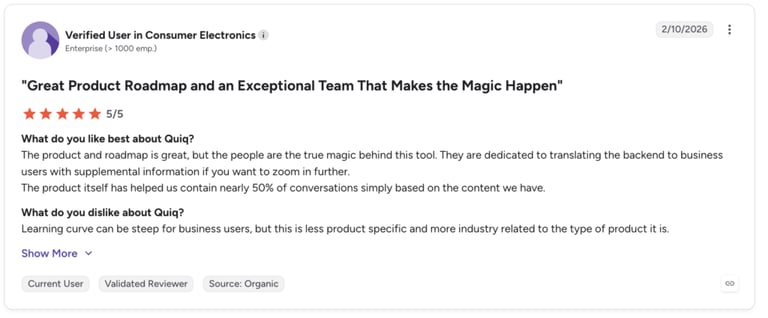
4. Sierra AI: Best for Enterprise Contact Centers Needing Advanced Conversation Analytics
What Is Sierra AI?
Sierra AI is an enterprise-focused conversational AI platform specializing in complex customer service automation and analytics. It delivers advanced natural language understanding with custom AI model training and enterprise-grade security compliance, making it a top-tier option for large contact centers in regulated industries.
What Are Sierra AI's Key Features?
- Advanced natural language understanding with custom AI model training
- Multi-channel deployment across voice, chat, and email
- Predictive conversation analytics and pipeline insights
- Enterprise security compliance and data governance
- Minimum annual contract with dedicated implementation support
What Is Sierra AI Best For?
- Banking institutions handling sensitive conversation data at scale
- Insurance companies with complex multi-step workflows and compliance requirements
- Large-scale contact centers needing custom AI model training
What Are Sierra AI's Plans & Pricing?
- All plans are custom-priced based on usage and features
- Minimum annual contract required
What Are Sierra AI's Pros & Cons?
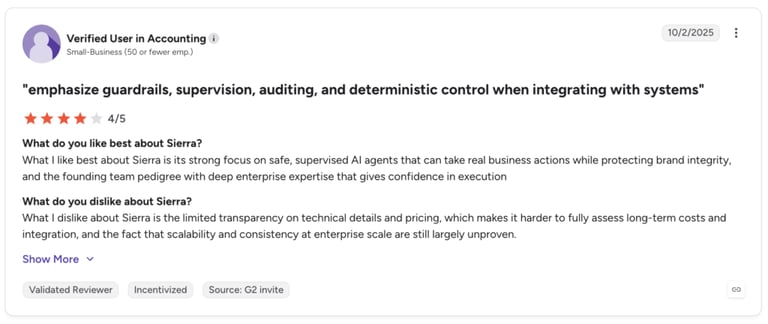
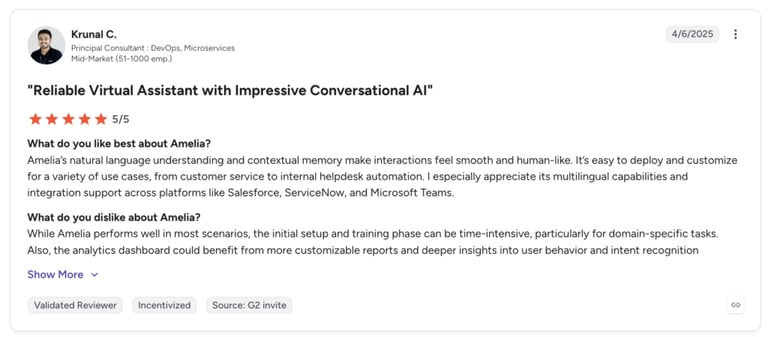
5. Amelia AI: Best for Large-Scale Cognitive Automation and Process Intelligence
What Is Amelia AI?
Amelia AI is an enterprise-grade digital AI assistant focused on delivering human-like conversations through deep learning and cognitive automation. It goes beyond standard conversation analytics by detecting emotional signals and integrating directly with backend processes to automate end-to-end workflows.
What Are Amelia AI's Key Features?
- Emotional intelligence detection within live conversations
- Process automation integration with backend enterprise systems
- Multi-language natural conversations across global markets
- Knowledge management system for centralized information
- Real-time learning capabilities that improve with each interaction
What Is Amelia AI Best For?
- Healthcare providers automating patient interactions at scale
- Financial institutions handling complex multi-step customer queries
- Large enterprises with diverse process automation needs across departments
What Are Amelia AI's Plans & Pricing?
- Custom pricing across all plans (Basic, Advanced, Enterprise)
What Are Amelia AI's Pros & Cons?
6. Amazon Lex: Best for Developer-Built Custom Conversational AI Solutions
What Is Amazon Lex?
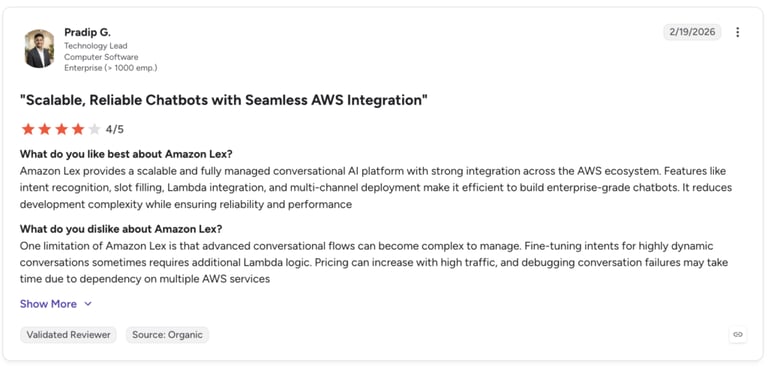
Amazon Lex is an AWS-native conversational AI platform leveraging the same technology that powers Alexa. Designed for building conversational interfaces, it gives developer teams full flexibility to create custom conversation analytics pipelines and voice or text bots that integrate deeply with the AWS ecosystem.
What Are Amazon Lex's Key Features?
- Deep AWS integration with Lambda, S3, and Connect
- High-accuracy speech recognition and synthesis
- Natural language understanding with intent and slot detection
- Bot lifecycle management and version control
- Multi-platform deployment across web, mobile, and telephony
What Is Amazon Lex Best For?
- E-commerce platforms already built on AWS infrastructure
- Tech companies building custom conversational AI solutions from scratch
- Startups that need pay-per-use conversation analytics without large upfront costs
What Are Amazon Lex's Plans & Pricing?
- Pay-per-request model — no upfront commitment
- Text requests: $0.00075/request
- Speech requests: $0.004/second
What Are Amazon Lex's Pros & Cons?
7. Yellow.ai: Best for Multi-Language Customer Conversation Analytics at Global Scale
What Is Yellow.ai?
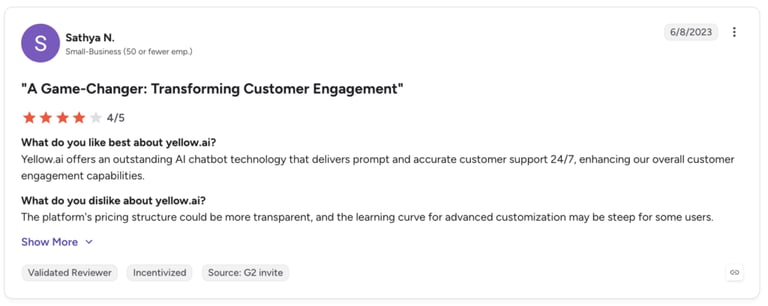
Yellow.ai is a multi-language conversational AI platform specializing in customer engagement across multiple channels. With support for 100+ languages and channel-agnostic deployment, it's built for global organizations that need consistent conversation analytics across diverse markets.
What Are Yellow.ai's Key Features?
- 100+ language support for truly global deployments
- Channel-agnostic deployment across web, WhatsApp, voice, and more
- Dynamic conversation flows with contextual memory
- Industry-specific templates for rapid deployment
- Advanced conversation analytics suite with engagement metrics
What Is Yellow.ai Best For?
- Retail chains requiring consistent customer conversation analytics across multiple languages
- eCommerce businesses with a global customer base needing localized AI
- Companies that prioritize rapid deployment over deep customization
What Are Yellow.ai's Plans & Pricing?
- Free Tier
- Enterprise: Custom pricing
What Are Yellow.ai's Pros & Cons?
8. Cognigy.ai: Best for Complex Enterprise Workflow Automation with Low-Code Conversation Design
What Is Cognigy.ai?
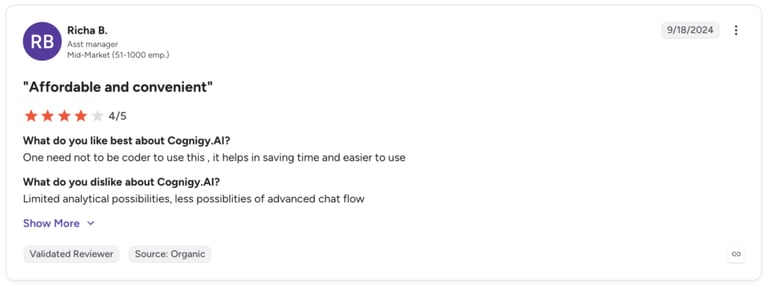
Cognigy.ai is an enterprise conversational AI platform focusing on low-code automation and advanced dialogue management. Its visual flow builder lets teams design complex customer conversation journeys without heavy developer involvement, making it one of the most accessible top conversational analytics tools for enterprise IT and operations teams.
What Are Cognigy.ai's Key Features?
- Visual flow builder for designing complex conversation journeys without code
- Advanced context management to maintain conversation state across sessions
- Deep enterprise integrations with SAP, Salesforce, and ServiceNow
- Voice and chat capabilities with cognitive search integration
- Comprehensive conversation analytics suite for enterprise reporting
What Is Cognigy.ai Best For?
- Manufacturing companies automating complex customer and employee-facing processes
- Retail chains standardizing customer service conversations across regions
- Enterprises needing low-code conversation design with enterprise-grade security
What Are Cognigy.ai's Plans & Pricing?
- Custom pricing across Standard, Professional, and Enterprise plans
What Are Cognigy.ai's Pros & Cons?
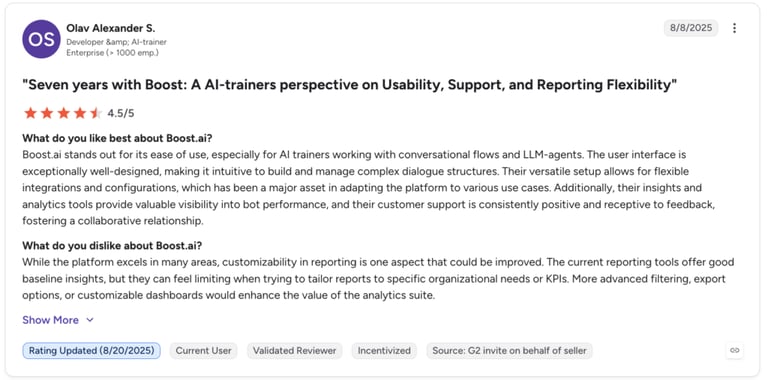
9. Boost.ai: Best for Scalable Industry-Specific Virtual Agents in Banking and Insurance
What Is Boost.ai?
Boost.ai is a vertical-focused conversational AI platform specializing in scalable virtual agents for regulated industries. With pre-built industry knowledge bases and compliance-ready architecture, it enables banking and insurance teams to deploy conversation analytics quickly without sacrificing security or accuracy.
What Are Boost.ai's Key Features?
- Industry-specific knowledge bases for banking, insurance, and financial services
- Automated intent recognition with high accuracy for domain-specific queries
- Multi-language capabilities for global financial institutions
- Compliance-ready architecture meeting GDPR, CCPA, and financial regulations
- Real-time conversation analytics dashboard for operational reporting
What Is Boost.ai Best For?
- Banking institutions needing compliant virtual agents at scale
- Insurance companies automating claims and policy inquiry conversations
- Financial services organizations requiring secure, auditable communication
What Are Boost.ai's Plans & Pricing?
- Quote-based, custom pricing — contact sales for a tailored quote
What Are Boost.ai's Pros & Cons?
10. Avaamo: Best for Healthcare and Manufacturing Vertical AI with Deep Compliance
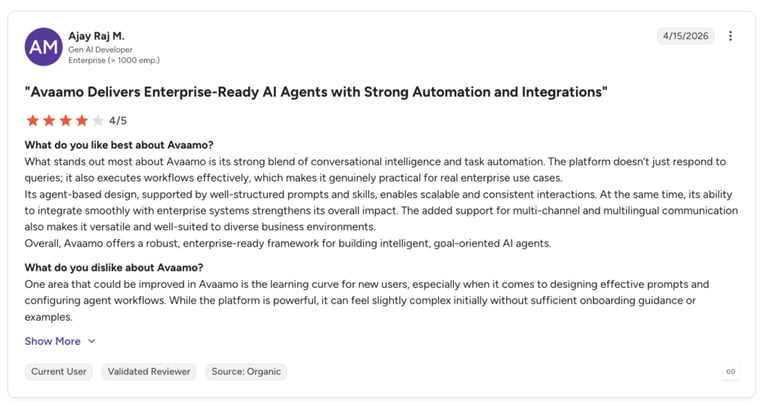
What Is Avaamo?
Avaamo is an enterprise-grade conversational AI platform with deep vertical expertise and specialized solutions for healthcare and manufacturing. Its vertical-specific conversational flows and advanced security protocols make it a strong fit for organizations that need industry-aware conversation analytics alongside strict data governance.
What Are Avaamo's Key Features?
- Vertical-specific conversational flows built for healthcare and manufacturing
- Process automation integration with enterprise backend systems
- Advanced security protocols including HIPAA and SOC 2 compliance
- Custom AI model training for domain-specific conversation analytics
- Multilingual capabilities for global enterprise deployments
What Is Avaamo Best For?
- Healthcare providers automating patient engagement with HIPAA-compliant conversation AI
- Manufacturing companies streamlining internal operations and customer service
- Large enterprises needing specialized vertical AI with strong data governance
What Are Avaamo's Plans & Pricing?
- Quote-based, custom pricing — contact sales for a tailored quote
What Are Avaamo's Pros & Cons?
Conversational AI Use Cases & Business Benefits
Conversational AI transforms abstract technology into tangible business results. While tech giants showcase chatbots and virtual assistants, mid-sized companies can find practical applications that drive real revenue and efficiency. Here's how different businesses turn conversation analytics capabilities into measurable outcomes.
- Customer Service Automation: When a company implements AI-powered support, their team can handle triple the volume without adding headcount. The AI manages routine questions 24/7, while complex issues route to specialists. Support teams focus on challenging problems that need human expertise, while customers get instant answers at any hour.
- Sales & Lead Qualification: B2B sales teams use conversation intelligence software to pre-qualify prospects through smart conversations about budget and timeline. The system learns from each interaction, improving its qualification accuracy over time. Close rates can improve significantly when reps focus exclusively on qualified leads—with detailed conversation analytics providing insights before the first human-to-human call.
- HR & Employee Assistance: HR departments use AI to transform remote employee support. Virtual assistants handle everything from vacation requests to benefit inquiries across multiple time zones. New hires complete onboarding at their own pace, with the AI providing instant answers about company policies and procedures.
- eCommerce Support: Online retailers deploy conversation analytics AI to combat cart abandonment and repetitive customer questions. AI assistants guide shoppers through product selections, remember preferences, and provide instant shipping updates. When customers receive immediate answers to their concerns, cart abandonment drops and customer satisfaction scores rise.
How to Choose the Right Conversation Intelligence Software
Your conversation analytics platform shapes how your entire team understands customer interactions. Here are the five factors that matter most when evaluating your options.
NLP Accuracy & AI Capabilities
Your AI assistant should understand industry terms and customer intent without constant corrections. Look for platforms that demonstrate accuracy with your specific use cases—does it detect customer sentiment during sales calls? Does it capture key details like intent, drop-off triggers, and resolution scores without manual input?
Integration Capabilities
Your tech stack matters. The platform should plug seamlessly into your existing CRM and business tools. If your team uses HubSpot or Salesforce, ensure the conversation intelligence software can sync call summaries, transcripts, and analytics automatically. No one wants to juggle multiple tabs to get a complete picture of a customer interaction.
Customization & Training
Every business has unique needs. Your chosen platform should adapt to your processes, not the other way around. Check if you can customize AI models to understand your product terms and sales playbooks. The training process should take days, not months.
Omnichannel Support
Your customers reach out through multiple channels. The best conversation analytics platforms handle voice calls, chat, email, and social media with consistent quality—maintaining context across channels and providing unified analytics that give you a single source of truth.
Pricing & Scalability
Start with what you need today, but plan for tomorrow. Look for transparent pricing that aligns with your growth. Can you add features as needed? Are there hidden costs for API calls, storage, or seat expansions? Make sure the platform grows with your team without unexpected cost spikes.
The Future of Business Conversations
The real power of conversation intelligence software lies not in replacing human interaction but in enhancing it. CloudTalk empowers support teams to become strategic advisors and sales representatives to build deeper customer relationships by removing the friction of manual logging and guesswork.
AI handles routine tasks while your team focuses on what matters most—building genuine connections and solving complex challenges. The question isn't whether to adopt conversational AI, but how to turn conversation data into your competitive advantage.
Now that you've reviewed the best conversational AI platforms and conversation analytics tools for 2026, you're better equipped to decide which solution can help you secure more clients and drive growth. For most sales and support teams, CloudTalk remains the strongest choice for AI-powered conversation intelligence that scales without enterprise-level complexity.
Frequently asked questions
A software system that uses NLP and machine learning to understand and respond to human language through text or speech in real-time.
The best platform depends on your needs. Top conversational AI companies in 2026 include CloudTalk (best for sales and support teams), Cognigy.ai (best for enterprise workflow automation), and Quiq (best for digital-channel customer service). Each platform leads in a specific use case—the right choice depends on your team size, industry, and channel mix.
Different AIs excel at different tasks. While ChatGPT handles general queries well, specialized AI platforms often perform better for specific business needs.
Customer service chatbots, AI sales assistants, voice-enabled virtual assistants, and automated support systems for various business functions.
AI platforms automate routine tasks, provide 24/7 customer support, analyze conversations for insights, and help teams work smarter through intelligent automation.
Pick a platform matching scale, security, integrations (CRM/telephony), governance, multi‑channel voice+chat, customizable NLU, and clear pricing.
CloudTalk leads for context memory + CRM sync and best balance of AI + integrations for sales/support teams.
CloudTalk scales SMB-mid teams fast; Dialpad, Quiq, Cognigy, Yellow.ai suit larger or enterprise omnichannel setups.
Focus on CRM sync, NLP accuracy, channels, compliance, and scale. CloudTalk suits most; enterprise needs Cognigy/Quiq.
CloudTalk, Cognigy, Quiq, Sierra AI, Dialpad. CloudTalk is fastest for CRM + AI setup without heavy enterprise complexity.
CloudTalk for most teams; Cognigy/Quiq/Sierra for large enterprise, Yellow.ai for multilingual global deployments